
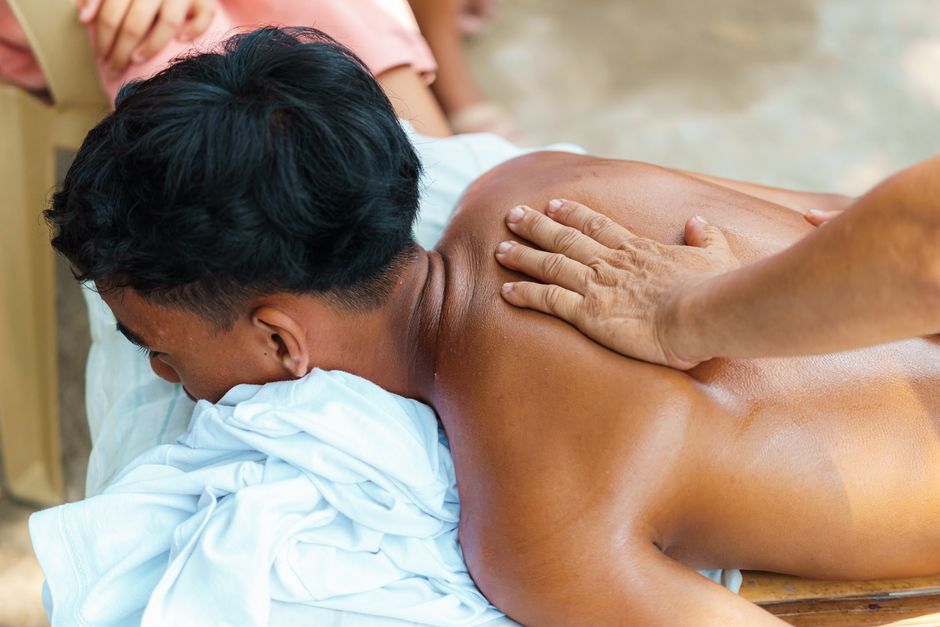
Giving a good back massage is more about technique than strength. You do not need to press hard to relieve tension. The goal is to relax muscles, improve blood flow, and help the person feel cared for. This guide covers the steps, the science, and the common mistakes so you can give a safe and effective back massage.
What Are the Basic Steps for Giving a Back Massage?
Start with the person lying face down on a firm but comfortable surface. A yoga mat on the floor works well. A soft bed is not ideal because the person sinks in and you lose leverage.
Use massage oil or lotion to reduce friction. Warm it in your hands first. Cold oil is a shock and makes muscles tense up.
Begin with light, broad strokes using your palms. Move from the lower back up toward the shoulders. This is called effleurage. It warms the tissue and tells the nervous system it is safe to relax. Do this for two to three minutes before going deeper.
Work in long, slow strokes. Speed matters. Fast strokes stimulate. Slow strokes relax. Keep your pace steady and calm.
Focus on the large muscle groups first — the trapezius across the top of the shoulders and the erector spinae along the spine. Avoid pressing directly on the spine itself. Work the muscles beside it.
How Do You Apply the Right Amount of Pressure?
Pressure is the most common problem people get wrong. Many people think a massage must hurt to work. Research published in the Journal of Pain found that moderate pressure reduced muscle pain more effectively than light or deep pressure. Moderate pressure means you feel the muscle compress but it does not cause sharp pain.
Ask the person to give feedback. Use a simple scale from one to ten. One is a feather touch. Ten is unbearable. Aim for a six or seven. If they say eight or higher, back off. If they say four or lower, increase gradually.
Deep pressure does not mean digging in with your fingertips. Use your forearm or elbow for deeper work on thick muscle areas like the upper shoulders. Your forearms have more surface area and distribute force evenly. Fingertips create point pressure that can bruise tissue.
A common sign of too much pressure is the person holding their breath or tensing their legs. Watch for this. If you see it, lighten up immediately.
What Techniques Work Best for Common Problem Areas?
Most tension collects in two places: the upper traps and the lower back near the hips. Each needs a different approach.
For the upper traps — the thick muscle between your neck and shoulder — use a kneading motion. Grip the muscle between your thumb and fingers and gently lift and roll it. This is called petrissage. It helps release trigger points and improve blood flow. Do this for one to two minutes per side.
For the lower back, use your thumbs to make small circles along the muscles next to the spine. Work from the bottom up. The lower back muscles are often tight from sitting. Slow circular pressure helps them lengthen.
For general relaxation, use this sequence:
- Long gliding strokes from low back to shoulders — 3 minutes
- Kneading on upper traps — 2 minutes per side
- Thumb circles on lower back muscles — 2 minutes per side
- Forearm compression on upper back — 1 minute
- Long closing strokes — 1 minute
Total time should be 10 to 15 minutes. Longer is not always better. The body starts to habituate after about 15 minutes of steady pressure.
| Technique | Best For | Pressure Level | Duration |
|---|---|---|---|
| Effleurage (gliding) | Warming up, ending session | Light to moderate | 2-3 minutes |
| Petrissage (kneading) | Upper traps, shoulder tension | Moderate | 2 minutes per side |
| Friction (thumb circles) | Lower back knots | Moderate to firm | 2 minutes per side |
| Compression (forearm) | Thick muscle areas | Firm | 1 minute |





What Are the Biggest Mistakes People Make?
The most common mistake is pressing directly on the spine. The vertebrae are bony and not designed for direct pressure. It can cause pain and in rare cases nerve irritation. Always work the muscles alongside the spine, not the bone itself.
Another mistake is rushing. A massage that lasts under five minutes often does more to annoy than relax. The nervous system needs time to shift from alert to calm. The first few minutes are just preparation.
Using too much oil is also a problem. Excess oil makes it hard to grip the muscle for kneading. You slide over the skin instead of moving the tissue underneath. A small amount — about a teaspoon for the whole back — is enough.
Some people report that massaging too soon after a meal causes nausea. Wait at least an hour after eating before giving a massage. The body diverts blood flow for digestion and massage can interfere with that process.
How To Give A Massage Back When Someone Has Chronic Pain
Chronic back pain is different from the typical tension after a long day. The muscles are often in a protective spasm. The American Academy of Family Physicians notes that massage can help reduce chronic low back pain, but it must be done gently.
Do not work directly on an area that is actively painful. Work the muscles around it instead. For example, if the lower back is tender, focus on the glutes and upper back. Releasing those areas often reduces the load on the lower back.
Light pressure only. A 2014 study in the Annals of Internal Medicine found that relaxation massage was as effective as structural massage for chronic back pain. You do not need to dig deep to get results.
Avoid any technique that causes the person to brace or flinch. If they have a diagnosed condition like a herniated disc or spinal stenosis, check with their doctor first. Massage is generally safe but certain conditions require modified techniques.
What Should You Avoid During a Back Massage?
Do not massage over open wounds, rashes, or sunburns. This can spread bacteria or worsen skin irritation. Skip areas with visible varicose veins. Pressure on these veins can cause discomfort or damage.
Do not massage if the person has a fever or feels sick. Massage increases circulation and can make an infection worse. The body needs its energy for healing, not for processing touch.
Do not use deep pressure on the kidneys. The kidneys sit just under the lower ribs on either side of the spine. Heavy pressure here can cause bruising or pain. Stick to the muscles, not the organs.
Do not crack or twist the spine unless you are a trained professional. Chiropractic adjustments are not massage. Attempting to manipulate the spine without training can cause injury.
Frequently Asked Questions
How long should a back massage last?
Ten to fifteen minutes is ideal for a basic relaxation massage. Longer sessions can cause the person to feel overstimulated or numb.
Can I give a back massage without oil?
You can but it is harder on the skin and less comfortable. Oil reduces friction and allows your hands to glide smoothly over the back.
Is it safe to massage someone with high blood pressure?
Generally yes with light to moderate pressure. Avoid deep or intense techniques that might cause a spike in blood pressure during the session.
What is the best position for giving a back massage?
The person should lie face down with their head turned to one side. Place a small pillow under their chest if they have lower back issues.
