
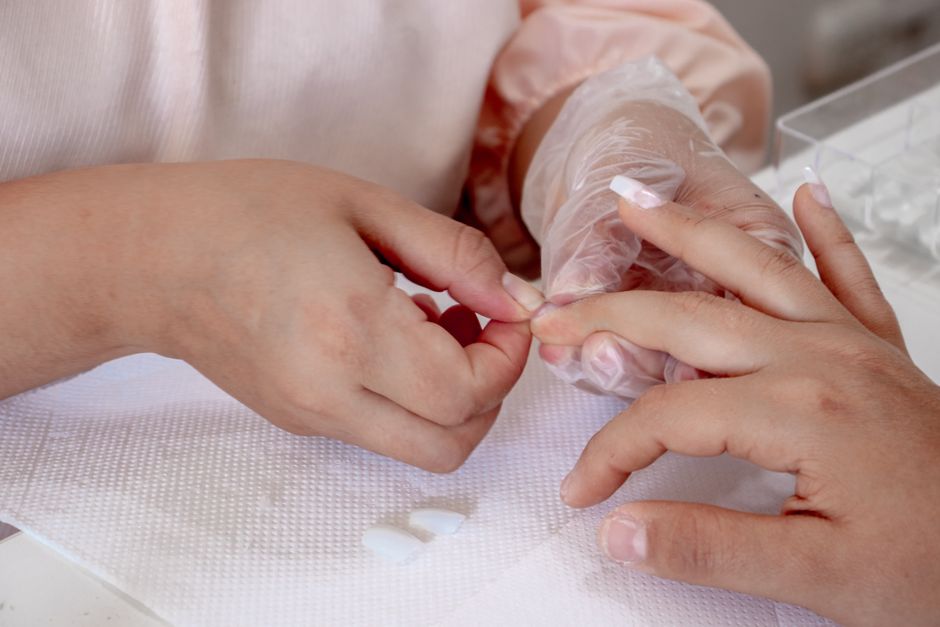
Acrylic nails are removed safely by soaking them in 100% acetone, either at home with patience or at a salon with professional tools. Filing down the top layer first speeds up the process. You should never pry, bite, or peel them off, because that can tear the natural nail plate and lead to infection.
If you have ever picked at a lifting acrylic and watched your real nail come away with it, you already know why this matters. The removal method you choose affects how your natural nails look and feel for weeks afterward. Here is what actually works, what damages your nails, and when to leave it to a professional.
Why Can’t You Just Peel Acrylic Nails Off?
Peeling acrylics off tears layers off your natural nail. That is the core problem, and it is not a minor one.
Acrylic is not sitting on top of your nail like a sticker. The liquid monomer and powder polymer bond to the keratin in your nail plate. When the acrylic is applied, it physically fuses to the top layers of that keratin. Pulling it off means pulling those layers with it.
What you are left with is a nail that looks white, feels thin, and often stings. In some cases the nail bed separates from the nail plate, a condition called onycholysis. That gap becomes a place where moisture and bacteria collect. It also makes the nail more likely to catch on things and tear further.
Repeated peeling thins the nail plate over time. Nails grow slowly, roughly 3 to 3.5 millimeters per month for fingernails, so damage near the cuticle can take months to grow out completely. The nail will eventually recover in most healthy people, but the process is slow and uncomfortable.
There is one more risk worth naming. If the nail bed is broken or the skin around it is torn, bacteria can get in. That can lead to a paronychia, an infection of the skin around the nail. It causes redness, swelling, and pain, and it sometimes needs medical treatment.
What Is the Safest Way To Remove Acrylic Nails at Home?
Soaking in pure acetone is the standard at-home method. It works because acetone dissolves the acrylic polymer. Nothing else commonly found at home does this as effectively.
Here is the process that minimizes damage:
- File the top of each nail with a coarse file to break the sealed surface. Do not file down to your natural nail.
- Apply petroleum jelly to the skin around your nails. Acetone strips oils and can irritate skin.
- Soak your fingertips in a bowl of 100% acetone. Warm acetone works faster, but do not heat it over a flame.
- Alternatively, soak cotton balls in acetone, place them on your nails, and wrap each fingertip in foil. This keeps the acetone in contact and reduces fumes.
- Wait. This typically takes 15 to 30 minutes, sometimes longer for thick or well-built nails. Check every few minutes.
- Once the acrylic is soft, gently push it off with an orange stick or cuticle pusher. Do not scrape hard.
- If acrylic remains, keep soaking. Do not force it.
- Wash your hands, then moisturize with a product containing jojoba oil or a similar oil. Acetone is very drying.
The main mistake people make is not waiting long enough. If the acrylic is not coming off easily, it is not ready. Forcing it at that stage causes the same damage as peeling.
Acetone is flammable and gives off strong fumes. Work in a ventilated room and keep it away from open flames. It also dissolves many plastic surfaces, so avoid letting it touch countertops, eyeglass frames, or phone cases.
Does Acetone-Free Polish Remover Work on Acrylics?
Acetone-free remover does not dissolve acrylic nails. It is designed for regular nail polish, which has a different chemical structure.
Most acetone-free removers use ethyl acetate or similar solvents. These break down standard lacquer but are not strong enough to break the cross-linked polymer bonds in acrylic. You can soak for an hour and the acrylic will still be there.
Some products are marketed as “acrylic removers” without acetone. A few contain other solvents that can soften certain gel products. If a product claims to remove acrylic and does not list acetone, check the ingredients. If it contains no acetone or similar strong solvent, it is unlikely to work on true acrylic. The evidence for these products is generally limited to manufacturer claims rather than independent testing.
If you want to avoid acetone because of skin sensitivity or the smell, a salon removal is the better option. A technician can use professional methods and limit your exposure.





Should You Get Acrylic Nails Removed at a Salon?
A salon removal is the safer choice if your nails are damaged, painful, or showing signs of infection. It is also reasonable if you simply do not want to deal with acetone at home.
Professional removal usually follows the same basic principle: file down the surface and soak in acetone. The difference is speed and skill. A technician has better tools and can tell when a nail should not be soaked further.
Some salons use an electric file to thin the acrylic before soaking. This is faster but carries its own risk. If the file slips or the technician is not careful, it can grind into the natural nail. A good technician keeps the file on the acrylic, not the nail plate.
Cost varies widely by location and salon, so it is worth asking when you book. Many salons charge less for a removal if you are getting a new set applied.
Tell your technician if you feel heat, burning, or pain during the process. Those are signals to stop.
What If Your Nails Hurt or Look Infected After Removal?
Some tenderness right after removal is common, especially if the nails were thin or the acrylic was pried. Pain that is getting worse is not normal, and it needs attention.
Watch for these signs:
- Increasing pain, throbbing, or heat in the finger
- Redness or swelling that spreads
- Pus or yellow discharge
- A nail that is lifting away from the nail bed
- Fever
These can point to a bacterial or fungal infection. See a doctor or a dermatologist. Do not try to treat a suspected infection with home remedies. An infection in the finger can get worse quickly, and some cases need antibiotics or drainage.
If your nails are simply thin and sensitive, keep them short and moisturized. Avoid gel or acrylic for a while to let the nail plate recover. Most healthy nails grow back to normal thickness, but it takes time.
How Can You Protect Your Nails Between Sets?
Giving your nails a break between sets reduces cumulative damage. Even a few weeks off helps.
Keep the nails moisturized, since both acetone and the acrylic process dry them out. Cuticle oil and a hand cream used daily support the nail plate and surrounding skin. Drink enough water and eat a balanced diet, though no single food or supplement has been proven to speed nail growth in healthy people.
Trim nails straight across and file edges gently. Avoid using your nails as tools to open cans or peel labels, which causes chips and breaks.
If you go back to acrylics, consider telling your technician to keep the product thin. Thick, heavy nails are more likely to lift at the edges, and lifted areas are where moisture gets trapped and problems start. A well-applied, properly maintained set is easier to remove and less likely to damage the natural nail.
One point that gets overlooked: the skill of the person applying and removing your nails matters as much as the product itself. Over-filing during prep is a common cause of long-term nail thinning, and it happens before the acrylic ever goes on.
Frequently Asked Questions
How long do you have to soak acrylic nails in acetone to get them off?
Most acrylic nails soften after 15 to 30 minutes of soaking in 100% acetone. Thick or well-built nails can take longer, so keep soaking until the acrylic slides off easily rather than forcing it.
Can I use nail polish remover without acetone on acrylic nails?
No, acetone-free remover will not dissolve acrylic nails because it is formulated for regular polish. You need pure acetone or a professional salon removal for true acrylic.
Is it bad to peel acrylic nails off?
Yes, peeling acrylics can tear layers off your natural nail and may cause separation of the nail from the nail bed. It also raises the risk of infection, so soaking is always the safer method.
When should I see a doctor after removing acrylic nails?
See a doctor if you have spreading redness, swelling, pus, worsening pain, or fever. These signs suggest an infection that may need medical treatment rather than home care.
