
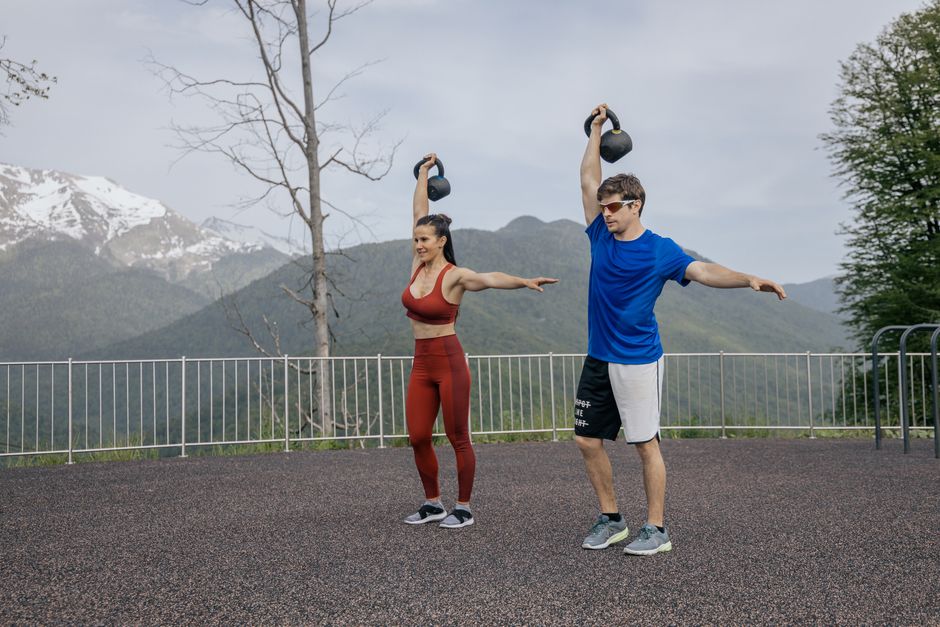
A kettlebell swing is a hip hinge, not a squat and not a shoulder exercise. You push your hips back, snap them forward, and let that force float the bell to about chest height while your arms stay relaxed. The power comes from your glutes and hamstrings. Your arms are just ropes holding on.
That single distinction separates a swing that builds strength from one that strains a lower back. Most swing problems trace back to it. Learn the hinge first, and the rest follows.
How To Do Kettlebell Swings With Proper Form
Set the bell on the floor about a foot in front of you. Stand with feet a little wider than shoulder width, toes pointed slightly out. Hinge at the hips and grip the handle with both hands, thumbs wrapped around.
Now tilt the bell toward you so the handle angles up and the bell hangs behind your hands. This small move keeps the bell from banging your forearms during the swing. Grip it, then hike it back between your legs like a football snap. That backward hike starts the momentum.
From the hike, drive your hips forward hard. Stand tall. The bell floats up on its own. Let it reach roughly chest height, then let it fall back between your legs as you hinge again. Repeat.
The rhythm is a hinge, not a lift. Your knees bend a little but your torso tips forward at the hips. Think of closing a car door with your backside.
Where Your Body Should Be at Each Point
- Top of the swing: Body straight, glutes squeezed, ribs down. The bell is at chest height. Do not lean back or arch.
- Bottom of the swing: Hips pushed back, shins close to vertical, back flat. The bell passes between your knees, not out in front.
- Arms: Straight but not locked. They stay loose and let the hips do the work.
- Head and neck: Eyes forward. Your neck follows your spine, not craned up.
Exhale sharply at the top as your hips snap. Inhale as the bell falls. Some people call this a power breath. It helps you brace your core at the moment of force.
What Muscles Does a Kettlebell Swing Work?
The swing is mainly a posterior chain exercise. That means the muscles along the back of your body. Research using muscle activity testing has found the glutes and hamstrings do most of the work, with the lower back muscles stabilizing the spine.
Your core braces hard to keep your trunk from folding. Your grip and forearms work to hold the bell. The shoulders get some demand but far less than people assume. This is not a shoulder builder.
Because it is a hip-driven movement done at speed, the swing also raises your heart rate. Some studies describe it as moderate-intensity cardiovascular work when done in continuous sets. It is not a replacement for dedicated aerobic training, but it does count as activity.
One clarification worth making: the swing is often marketed as a fat-burning shortcut. No exercise burns enough calories on its own to drive meaningful fat loss. The swing builds strength and conditioning. Fat loss still comes down to overall energy balance and diet.
How Heavy Should a Kettlebell Be for Swings?
Pick a weight you can swing with good form for sets of 10 to 15 reps without your back rounding or your arms taking over. For most healthy adults new to the movement, that lands somewhere in the range of 8 to 16 kilograms (about 18 to 35 pounds), though this varies widely by body size and training background.
No official guideline sets a starting weight for swings. The honest approach is trial and error with light weight first. If the bell feels like you are lifting it rather than floating it, it is too heavy. If you can swing it with one hand and barely feel your hips working, it is too light.
Many coaches teach the swing with a heavier bell than people expect, because the hips can move more than the arms can lift. But that only applies once your hinge is solid. Start lighter than you think you need.




What Are the Most Common Kettlebell Swing Mistakes?
The number one mistake is squatting the bell up instead of hinging. When you bend your knees and stand up to lift the bell, your quads take over and your back rounds. The fix is to sit your hips back and keep your shins fairly upright.
The second is using your arms to raise the bell. If your shoulders are doing the lifting, the bell will not float. Let the hips generate the force and keep the arms passive.
Other frequent errors:
- Leaning back at the top. This arches the lower back under load. Stop tall with glutes squeezed, not tilted backward.
- Letting the bell drift forward. Keep it close to your body on the way down so the path stays vertical.
- Rounding the lower back at the bottom. Keep a flat back and stop the hinge before your spine curves.
- Looking up at the ceiling. Keep your neck neutral and eyes forward.
If your lower back hurts after swings, the cause is usually one of these form breaks, not the exercise itself. Film yourself from the side. It shows the hinge clearly.
How Many Kettlebell Swings Should You Do?
There is no single correct number. A common starting approach is 3 to 5 sets of 10 to 15 swings, with rest between sets. That gives you enough reps to learn the pattern without piling on fatigue.
Rest is part of the training. Swings are a power movement, so quality matters more than volume. When your form starts to slip, stop the set. Pushing through sloppy reps is how backs get tweaked.
As your hinge and conditioning improve, you can add reps or sets gradually. Some people work up to longer continuous sets. Others keep sets short and focus on power. Both can work. The key is that every rep looks like your first one.
People with lower back problems, shoulder issues, or heart conditions should check with a clinician before starting. The swing is generally well tolerated by healthy adults, but it loads the spine and raises heart rate quickly.
Kettlebell Swing vs. Deadlift: What Is the Difference?
Both are hip hinge movements, but they train different qualities. The deadlift is a slow, heavy lift from a dead stop. The swing is a fast, ballistic movement that uses momentum. The table below lays out the main differences.
| Feature | Kettlebell Swing | Deadlift |
|---|---|---|
| Speed | Fast, continuous | Slow, controlled |
| Starting position | Moving bell, uses momentum | Dead stop on the floor |
| Primary goal | Power and conditioning | Maximal strength |
| Typical load | Lighter, moved fast | Heavier, moved slowly |
| Cardio demand | Higher when done in sets | Lower |
Neither is better. They serve different purposes. Many strength programs use both. If you are new to hinging, learning a slow deadlift pattern first often makes the swing easier to master.
How Do You Breathe During Kettlebell Swings?
Breathe in as the bell falls and your hips hinge back. Breathe out sharply as you snap your hips forward and the bell rises. This rhythm matches the effort and helps you brace your core at the top.
Do not hold your breath through the whole set. Holding your breath raises blood pressure, and swings are done for many reps. A steady in-and-out pattern keeps you safe and keeps the set going.
If you find yourself gasping, the set is probably too long or the bell too heavy. Shorten it.
Frequently Asked Questions
How high should a kettlebell swing go?
About chest height for most people. The bell floats up from hip power, so forcing it higher with your arms or shoulders defeats the purpose.
Can kettlebell swings hurt your lower back?
They can if your form breaks down, especially if you round your back or lean backward at the top. Done with a proper hinge and controlled weight, the movement is generally well tolerated by healthy adults.
How many calories does a kettlebell swing burn?
It varies too much by body size, effort, and set length to give a reliable number. Swings raise your heart rate and count as activity, but no single exercise drives fat loss on its own.
Is a kettlebell swing better than a squat?
Neither is better because they train different things. The swing is a hip-driven power movement, while the squat mainly loads the quads and glutes through a full range of motion.
