
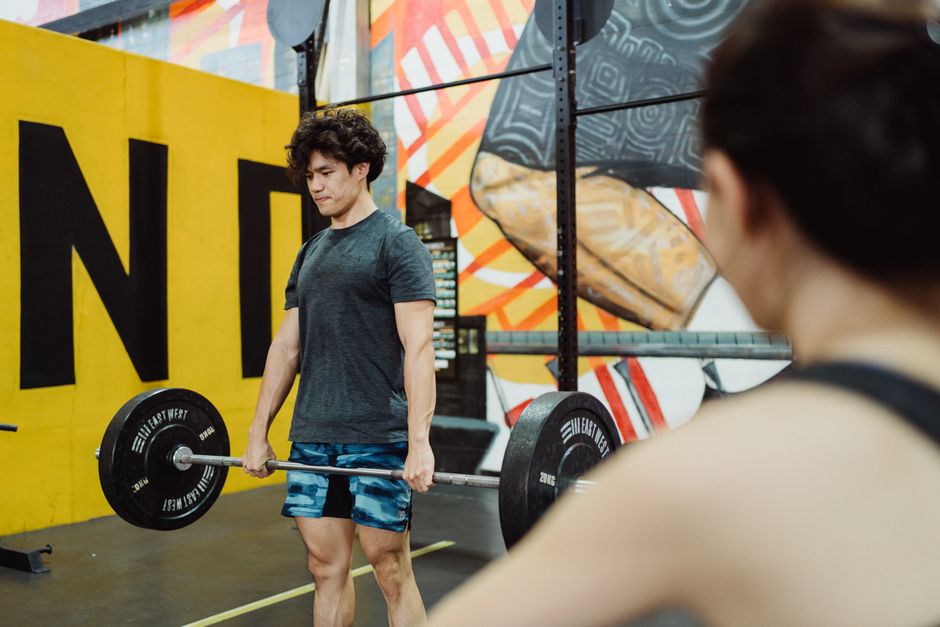
The Romanian deadlift is a hip hinge movement that builds the hamstrings and glutes without the deep knee bend of a conventional deadlift. You start standing with the bar at your hips, push your hips back while keeping a slight bend in the knees, lower the bar along your legs until you feel a strong stretch in your hamstrings, then drive your hips forward to stand. The bar stays close to your body the entire time, and your back stays flat.
How To Do A Romanian Deadlift Step by Step
Set up with the bar at hip height in a rack, or deadlift it from the floor first if you are using a loaded barbell. Stand with feet hip-width apart. Grip the bar just outside your thighs with both hands, palms facing you.
Pull your shoulders back and down. Brace your core like you are about to take a light punch to the stomach. Keep your chest up and your neck in line with your spine.
Now the movement itself:
- Push your hips straight back, as if closing a car door with your butt.
- Let your knees bend slightly — about 15 to 20 degrees — and then hold that angle. The knees do not bend further as you descend.
- Keep the bar dragging close to your legs. It should almost brush your thighs and shins.
- Lower until you feel a strong stretch in the back of your thighs, usually around mid-shin or just below the knee. Stop there.
- Drive your hips forward to return to standing. Squeeze your glutes at the top without leaning back.
That is the whole movement. The lowering phase is where most of the work happens. The return to standing is a hip thrust, not a back pull.
What Muscles Does the Romanian Deadlift Work?
The Romanian deadlift primarily loads the hamstrings and glutes. The hamstrings work hardest during the lowering phase, when they lengthen under tension. This is called an eccentric contraction, and it is one reason the exercise is popular for hamstring development.
The glutes drive the hip extension at the top. The spinal erectors and other back muscles work isometrically to hold your spine neutral. Your grip and forearms also get significant work because you are holding the bar the whole time.
What the Romanian deadlift does not do much of: quadriceps work. Because the knees stay mostly fixed, the quads contribute far less than they would in a squat or a conventional deadlift. If quad development is your goal, you need other movements.
Romanian Deadlift vs Conventional Deadlift: What Is the Difference?
The two lifts look similar but train different things.
| Feature | Romanian Deadlift | Conventional Deadlift |
|---|---|---|
| Starting position | Standing, bar at hips | Bar on floor |
| Knee bend | Slight, fixed | Deep, changes through lift |
| Primary emphasis | Hamstrings, glutes | Back, glutes, quads, hamstrings |
| Range of motion | Hip hinge only | Full pull from floor |
| Typical loading | Lighter than conventional | Heavier |
Because the Romanian version starts at the top and skips the floor pull, most people use less weight than they would for a conventional deadlift. That is normal and not a sign of weakness.
The Romanian deadlift also places more sustained tension on the hamstrings at longer muscle lengths. Some research suggests that training muscles at longer lengths may produce greater hypertrophy, though the evidence is not yet definitive across all muscle groups.





How Do You Know If You Are Doing It Wrong?
The most common mistake is turning the movement into a squat. If your knees bend a lot and travel forward, you are squatting, not hinging. The hips should travel backward, not downward.
Other common errors:
- Rounding the lower back. This happens when you go lower than your hamstring flexibility allows. Stop the descent earlier.
- Letting the bar drift away from your legs. This shifts load to your lower back and makes the lift harder.
- Hyperextending at the top. Leaning back past vertical puts unnecessary stress on the spine. Stand tall and stop.
- Using too much weight. If you cannot control the descent, the weight is too heavy.
- Bending the knees more as you go down. The knee angle should stay roughly the same throughout.
If you feel the movement mostly in your lower back rather than your hamstrings, something is off. Usually it is one of the errors above.
How Much Weight Should You Use?
Start with an empty bar or a light dumbbell. The Romanian deadlift is a technical lift, and the hamstrings are vulnerable when loaded at long muscle lengths.
A reasonable approach: begin with a weight you can control for 8 to 12 reps with good form. Add weight gradually over weeks, not sessions. There is no single correct load — it depends on your training history, hamstring flexibility, and goals.
No clinical guidelines exist for how much weight a specific person should Romanian deadlift. General strength training principles apply: progressive overload over time, adequate recovery between sessions, and stopping if sharp pain appears.
If you are new to lifting, working with a qualified coach for a few sessions can help you learn the hip hinge pattern correctly before you add load.
Is the Romanian Deadlift Safe for Your Back?
When performed with a neutral spine and controlled load, the Romanian deadlift is generally considered a safe and effective exercise for most healthy adults. It is widely used in strength and rehabilitation settings.
That said, no exercise is risk-free. The lower back is loaded isometrically throughout the lift. If you have an existing back injury, disc issue, or chronic pain condition, check with a clinician or physical therapist before adding this movement.
People with very tight hamstrings may struggle to reach even mid-shin without rounding the back. In that case, reduce the range of motion. Lowering to just below the knee still trains the hamstrings effectively. Range can improve over time with consistent practice and dedicated stretching.
Sharp pain during the lift is a stop signal. Muscle fatigue and a stretching sensation in the hamstrings are expected. Pain that is sharp, shooting, or located in the joint is not.
How Often Should You Train the Romanian Deadlift?
Most strength programs include hip hinge movements one to three times per week. The Romanian deadlift can serve as your primary hamstring exercise or as an accessory after squats or conventional deadlifts.
Recovery matters. Hamstrings are heavily involved in sprinting, running, and many other lifts. If you are also doing those activities, you may need fewer dedicated Romanian deadlift sessions to avoid overuse.
Start with once or twice per week and adjust based on how you feel and how you perform. Soreness in the hamstrings for a day or two after training is normal, especially when you are new to the movement. Soreness that lasts more than a few days or limits daily activity suggests you did too much.
Can You Do Romanian Deadlifts With Dumbbells or Kettlebells?
Yes. The movement pattern is identical. Instead of a barbell, hold a dumbbell in each hand or a kettlebell in front of you. The weight stays close to your legs either way.
Dumbbells can be a good starting point because they are often easier to control and let you find the hip hinge without worrying about bar path. They also allow a slightly more natural arm position for some people.
Single-leg Romanian deadlifts are a variation that adds a balance challenge and increases demand on the glute medius and other stabilizers. They are harder than they look. Start with no weight and master the balance before adding load.
What Should You Feel During the Movement?
You should feel a strong stretch in the back of your thighs as you lower the weight. That stretch is the point of the exercise. Your glutes should feel engaged as you stand up.
You should not feel a sharp pinch in your lower back, pain behind the knee, or numbness or tingling in your legs. Any of those are reasons to stop and get assessed.
Some people feel very little in their hamstrings at first. This usually means the weight is too light, the range of motion is too short, or the movement has become a squat. A coach or training partner can often spot the issue in a few reps.
Frequently Asked Questions
How low should you go on a Romanian deadlift?
Lower until you feel a strong stretch in your hamstrings, typically around mid-shin or just below the knee. Stop before your lower back begins to round.
Are Romanian deadlifts better than regular deadlifts?
Neither is better — they train different things. Romanian deadlifts emphasize the hamstrings and glutes, while conventional deadlifts involve more total body strength from the floor.
Can beginners do Romanian deadlifts?
Yes, with light weight and attention to form. Practicing the hip hinge with no weight or an empty bar first is a sensible starting point.
How many sets and reps of Romanian deadlifts should I do?
Most programs use 3 to 4 sets of 6 to 12 reps. The right number depends on your goals and how the lift fits into your overall training plan.
