
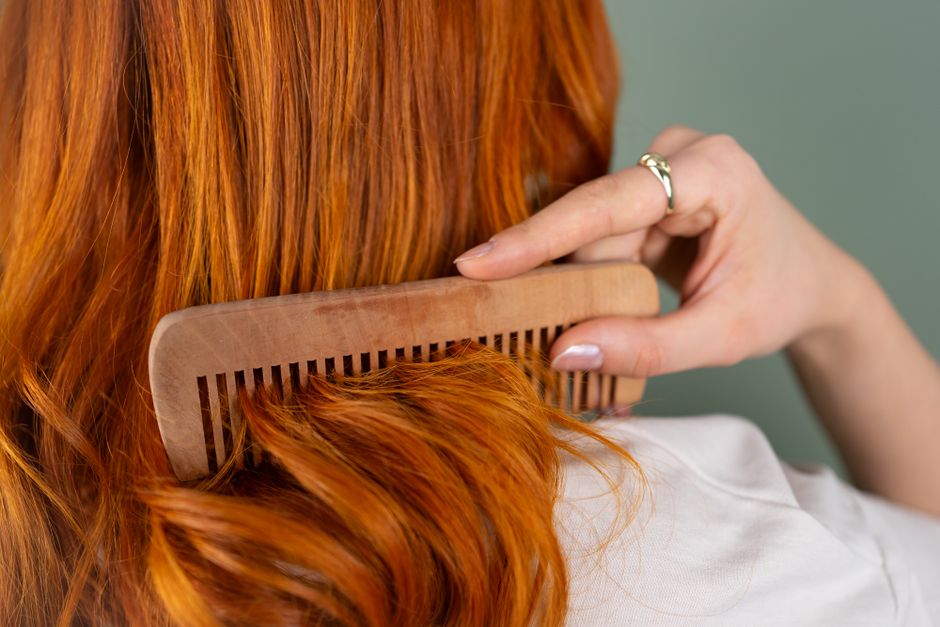
Matted hair forms when individual strands wrap around each other and tighten into knots that normal brushing cannot separate. The fix is to work from the ends upward, use a slippery conditioner or detangling product as a lubricant, and separate the mass with your fingers or a wide-tooth comb before any fine-tooth tool touches it. Ripping a brush through a mat is the single most common mistake, and it is the one most likely to break hair and damage the scalp.
This guide explains why hair mats, how to detangle it safely at home, and when a mat is a sign of something that needs medical attention.
Why Does Hair Become Matted?
Hair tangles because of the structure of the hair shaft itself. Each strand has an outer layer of overlapping scales called the cuticle. When hair is dry, damaged, or rough, those scales lift and catch on neighboring strands like shingles running the wrong way. Add friction, moisture loss, and movement, and strands weave together into a mat.
Several conditions make this far more likely:
- Curly, coily, or very fine hair, because the bend in the strand encourages strands to wrap around each other
- Chemically treated, bleached, or heat-damaged hair, where the cuticle is already compromised
- Dry environments and dry indoor heating, which strip moisture from the shaft
- Friction from pillowcases, hats, scarves, and tight hairstyles
- Not detangling regularly, so small tangles have time to tighten
One detail people often miss: mats are not just cosmetic. A tight mat pulls on the scalp continuously. That tension can cause pain, and over time it can contribute to traction-related hair loss if the pulling is ongoing.
How To Detangle Matted Hair Step By Step
Start with dry hair and your fingers, not a brush. Fingers can feel where a knot begins and ends. A brush cannot.
Here is the sequence that works for most mats:
- Loosen first. Gently pull the mat apart with your fingers, working from the outer edges toward the center. Do not pull down through the mat.
- Wet and condition. Apply a generous amount of a slippery conditioner or a dedicated detangling spray. Water alone increases friction in some hair types; conditioner reduces it.
- Let it sit. Give the product a few minutes to soften the strands. Rushing this step is why detangling hurts.
- Work in sections. Divide the mat into smaller pieces. Small sections detangle faster than one large mass.
- Comb from the ends up. Use a wide-tooth comb. Start an inch or two from the bottom, comb through the loose ends, then move up. Never start at the scalp and drag downward.
- Repeat with more product. Add conditioner as needed. Slippery hair separates; dry hair tears.
If you hit a knot that will not move, stop. Forcing it is how hair breaks. Move to a different part of the mat and come back to the stubborn spot later, once the rest is looser.
What Tools Actually Help?
The right tool matters more than technique alone. A wide-tooth comb is the workhorse for mats because the teeth are spaced far enough apart to pass through tangles without yanking. A detangling brush with flexible bristles can help on looser tangles but is usually too aggressive for a dense mat.
What does not help: fine-tooth combs, metal picks, and ordinary brushes used on a tight mat. These concentrate force on a small number of strands and snap them.
For very stubborn mats, some people use a small amount of oil, such as coconut or olive oil, worked into the knot. This can add slip, though there is no strong clinical evidence that any specific oil outperforms a standard conditioner. It is a reasonable option, not a proven one.





Does Hair Type Change The Approach?
Yes, and this is where a lot of generic advice fails.
Straight, fine hair mats differently from coily hair. Fine hair tangles easily but separates with less force. Coily and textured hair forms tighter, denser mats, and dry detangling can cause significant breakage. For textured hair, detangling is usually done on wet, conditioned hair, in small sections, often with fingers first and a wide-tooth comb second.
If you have textured hair and are not used to caring for it, a stylist who specializes in your hair type can show you the sectioning and combing method in person. That is worth more than any written guide.
When Mats Are A Sign Of Something More Serious
Occasional matting is normal. Severe, sudden, or repeated matting can point to an underlying issue, and it is worth taking seriously.
Conditions that can contribute to heavy matting or make it hard to manage include:
- Scalp conditions such as seborrheic dermatitis or psoriasis, which cause scaling and inflammation
- Hair loss conditions, where remaining hair tangles more easily
- Thyroid disorders, which can change hair texture and shedding
- Nutritional deficiencies, which can weaken the hair shaft
A mat that is accompanied by scalp pain, redness, swelling, open sores, a foul smell, or hair loss in the area needs a medical evaluation. So does matting that appears suddenly without a clear cause. A doctor or dermatologist can examine the scalp and check for conditions that a detangling routine will not fix.
In some cases, a mat becomes so tight and dense that it cannot be safely combed out at home. A professional stylist or dermatologist may need to cut or trim the mat. This is not a failure. Cutting a mat that is pulling on the scalp can relieve pain and prevent further damage.
How To Prevent Mats From Forming
Prevention is mostly about moisture, gentle handling, and consistency.
- Detangle regularly, before small tangles become mats
- Condition after every wash, and use a leave-in conditioner on dry hair types
- Sleep on a satin or silk pillowcase to reduce friction
- Avoid tight hairstyles that pull on the scalp for long periods
- Loosen braids, buns, and ponytails before washing
- Trim split and damaged ends, which catch on other strands
For people with limited mobility, illness, or who are bedbound, matting can develop quickly because hair is not being moved and detangled normally. In those situations, gentle daily or every-other-day brushing and keeping hair braided or tied loosely can help reduce matting. Caregivers can follow the same step-by-step method above.
What Not To Do
Most damage during detangling comes from a handful of mistakes. Avoiding them protects both hair and scalp.
- Do not detangle dry, unconditioned hair with a fine brush
- Do not pull downward from the scalp through a mat
- Do not use scissors to cut into the middle of a mat unless you have decided to remove it entirely
- Do not ignore scalp pain, or a mat that keeps returning
Patience is the actual technique. A mat that took weeks to form will not come out in two minutes, and trying to force it is what causes the breakage people are trying to avoid.
Frequently Asked Questions
How do you detangle matted hair without cutting it?
Work conditioner or a detangling product into the mat, separate it with your fingers, and comb from the ends upward with a wide-tooth comb. If the mat is too tight to loosen safely, a professional may need to trim it.
Does vinegar or oil help remove hair mats?
Oils can add slip and make a mat easier to separate, and some people find diluted vinegar helps smooth the hair shaft. There is no strong clinical evidence that either works better than a standard conditioner.
Why does my hair keep matting no matter what I do?
Frequent matting can be related to hair type, damage, dryness, or an underlying scalp or medical condition. If it keeps happening despite regular detangling and conditioning, it is worth having a doctor or dermatologist check your scalp and hair.
Can matted hair cause scalp problems?
Yes. A tight mat pulls on the scalp and can trap oils, dead skin, and debris, which may lead to irritation or infection. Scalp pain, redness, swelling, or a bad smell with a mat needs medical attention.
