
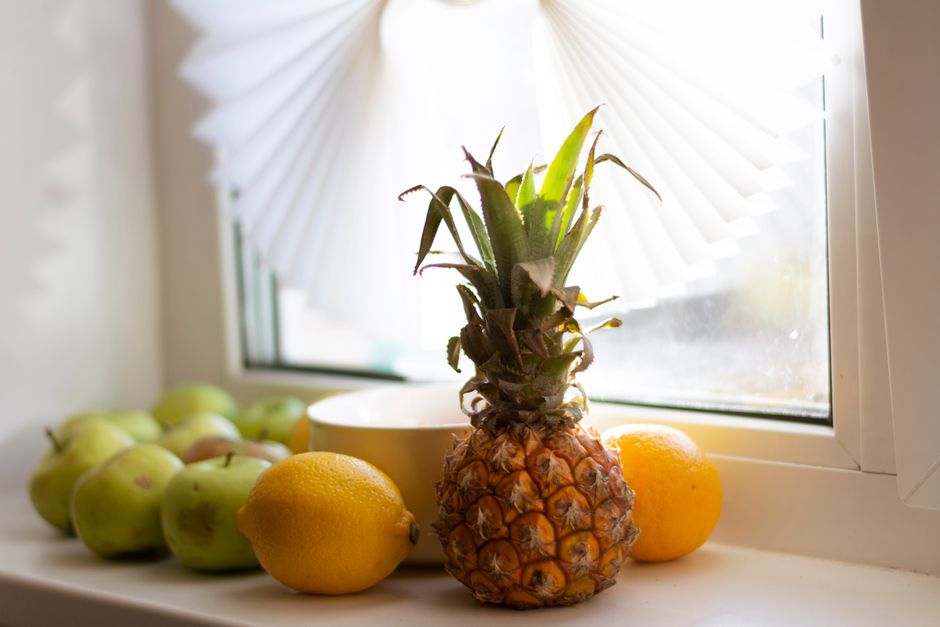
An ananas — a pineapple — is easiest to cut by first slicing off the top and bottom, standing it upright, and trimming the skin down in strips from top to bottom. Then cut it into quarters or rounds, remove the tough center core, and slice or cube the fruit. A sharp knife and a steady cutting board do most of the work.
The word “ananas” comes from the same plant we call pineapple, and it is the common name for the fruit in many languages. Cutting one is not hard once you know the sequence. The trick is dealing with three things: the spiky skin, the fibrous core, and the “eyes” — the small dark spots that sit just under the surface.
What Is an Ananas and Why Does It Matter How You Cut It?
An ananas is the fruit of a tropical plant native to South America. It is the same fruit sold as pineapple in the United States. The name differs by region, not by variety.
The fruit has a tough, segmented outer skin, a dense fibrous core running through the center, and flesh that is firm near the core and softer toward the edges. That structure is why a single cutting method does not fit every use. A fruit cut for snacking looks different from one cut for juicing or grilling.
One non-obvious point: the “eyes” are not seeds. They are individual flower remnants, and each one sits in a shallow spiral groove that runs around the fruit. If you cut too shallow, the eyes stay behind and feel gritty in the mouth. Cutting deep enough to remove them is the difference between good and annoying pineapple.
What Tools Do You Need to Cut an Ananas?
A long, sharp chef’s knife does the job. A serrated knife can also work for the skin, but a straight-edged blade gives cleaner cuts through the flesh.
- A large cutting board with a lip or a groove to catch juice
- A sharp chef’s knife or a long utility knife
- A smaller paring knife for trimming eyes and the core
- A bowl for the cut fruit
- Paper towels to grip the slippery fruit
You do not need a special pineapple corer or slicer. Those tools exist and work, but a knife handles the task for most people. A corer can be convenient if you eat pineapple often, but it is not required.
How To Cut An Ananas Step by Step
Work on a stable surface. A pineapple is heavy and slippery, and the skin is rough enough to scratch. Go slowly until the fruit is trimmed.
- Lay the fruit on its side. Cut off the leafy top about one inch below the crown. Cut off the base about half an inch up. You now have a flat top and bottom.
- Stand it upright on the flat base. This is the safest position for the next cuts.
- Trim the skin downward. Starting near the top, slice down along the curve, following the shape of the fruit. Remove strips of skin about an inch wide. Rotate and repeat until all skin is gone.
- Remove the eyes. Look for the shallow spiral of dark spots. Cut narrow V-shaped grooves along the spiral to lift them out, or shave a thin layer off the surface until the flesh is clean.
- Cut into quarters or rounds. For quarters, slice the fruit lengthwise into four pieces. For rounds, cut crosswise into slices about half an inch thick.
- Remove the core. On each quarter, cut away the firm triangular strip of core that runs along the inner edge. On rounds, cut out the small circle in the center.
- Slice or cube. Cut quarters into wedges, or lay them flat and cut into cubes.
If you plan to juice or blend the fruit, you can skip removing the core. The core is edible and contains fiber. It is just tougher and less sweet than the rest of the flesh, which is why many people cut it out for eating fresh.





Does the Core Need to Be Removed?
No. The core is safe to eat and contains dietary fiber. Whether to remove it is a texture choice, not a safety issue.
Fresh pineapple flesh is a good source of vitamin C. According to USDA nutritional data, one cup of raw pineapple chunks provides roughly 79 milligrams of vitamin C. That is close to the daily amount most adults need. The core has less sugar and more fiber than the outer flesh, so some people keep it for smoothies.
If you are cutting the fruit for a fruit salad or for serving guests, removing the core gives a more uniform texture. For blending or juicing, leaving it in adds fiber and reduces waste.
Why Does Pineapple Sometimes Burn Your Mouth?
Pineapple contains an enzyme called bromelain. This enzyme breaks down proteins, and it can irritate the lining of your mouth and tongue. That tingling or burning feeling is real, not imagined.
The effect is usually mild and short-lived. It tends to be stronger when you eat a lot of fresh pineapple at once. Canned pineapple generally causes less irritation because the canning process heats the fruit, and heat deactivates bromelain.
Bromelain is also the reason fresh pineapple can keep gelatin from setting and can make your hands feel slippery while you cut it. It is not a sign of spoiled fruit.
How Do You Pick and Store an Ananas?
A ripe pineapple smells sweet at the base. The skin shifts from green toward yellow-gold as it ripens, though color alone is not a reliable sign. A fruit that is firm with a little give when squeezed is usually ready.
Once cut, pineapple should be refrigerated. Store it in a sealed container and use it within a few days. Cut fruit left at room temperature for long periods can grow bacteria, so refrigerate promptly.
Whole, uncut pineapple keeps at room temperature for a few days and longer in the refrigerator. It does not continue to ripen much after harvest, so a fruit that is underripe when you buy it will stay that way.
Common Mistakes When Cutting an Ananas
Most problems come from cutting too shallow or rushing the skin removal.
- Leaving the eyes behind. Cutting only the outer skin leaves the spiral of eyes, which are tough and gritty.
- Cutting on a slippery surface. A wet board or a rounded fruit is a common cause of knife slips.
- Using a dull knife. A dull blade forces you to press harder, which increases the chance of slipping.
- Cutting off too much flesh. Trimming the eyes with deep cuts wastes fruit. Shallow V-shaped grooves remove them with less waste.
Take the skin off in strips rather than trying to peel it in one motion. It is faster and safer.
Can You Cut an Ananas Without a Knife?
Not really. The skin is too tough to remove by hand, and the fruit is too firm to pull apart. A knife is the practical tool for the job.
Some people twist off the crown and pull individual sections free, but this only works on very ripe fruit and leaves the eyes and core behind. For a clean result, a knife is the reliable option.
Frequently Asked Questions
Do you have to remove the core of a pineapple?
No, the core is edible and contains fiber. It is tougher and less sweet than the outer flesh, so many people remove it for texture rather than safety.
Why does fresh pineapple burn my mouth?
Pineapple contains bromelain, an enzyme that breaks down proteins and can irritate the mouth and tongue. The effect is usually mild and short-lived, and canned pineapple causes less irritation because heat deactivates the enzyme.
How do you know when a pineapple is ripe?
A ripe pineapple smells sweet at the base and gives slightly when squeezed. Color alone is not a reliable sign, and the fruit does not ripen much after it is harvested.
How long does cut pineapple last in the fridge?
Cut pineapple stored in a sealed container in the refrigerator is generally best used within a few days. Refrigerate it promptly after cutting to limit bacterial growth.
