
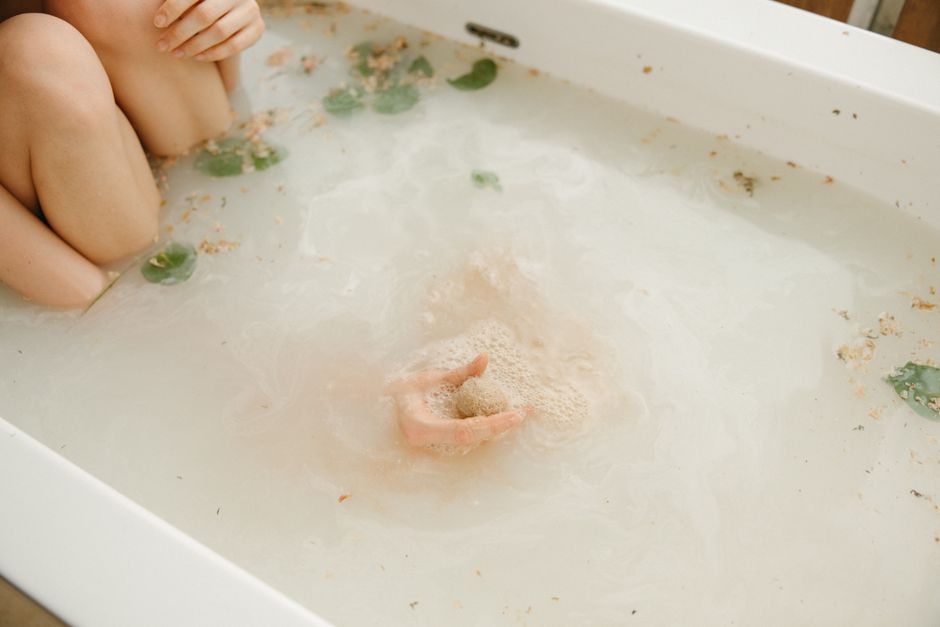
A bubble bath is simply warm water, a surfactant that creates lather, and the mechanical force of moving water to trap air into bubbles. The surfactant lowers the surface tension of water so air can be held in thin films, and the force of a running tap or your hand swishing through the water is what actually forms the bubbles. Without agitation, even the best bubble bath product will just sit there as a layer of soapy water.
What Actually Makes Bubbles Form?
Water on its own has high surface tension. That tension is why water beads up and why plain water does not hold foam. A surfactant — the main ingredient in bubble bath, shampoo, or dish soap — breaks that tension. One end of the surfactant molecule clings to water and the other end points toward air. When air gets mixed into the water, these molecules arrange themselves into thin, flexible films around each pocket of air. Those films are the bubbles.
The key variable is agitation. Pouring water from a height, aiming the faucet jet at the surface, or swirling your hand through the tub all drag air into the water. The more air you fold in, the more bubbles you get. This is why a bubble bath that looks flat often just needs more movement, not more product.
Water temperature matters too. Warm water makes surfactants dissolve and spread more easily, and warm air inside the bubbles expands slightly, which can make bubbles look bigger. Very hot water is not better for bubbles and raises the risk of scalding, so there is no reason to push the temperature up for foam.
How To Create A Bubble Bath That Actually Lasts
Start with a clean tub. Oils, soap scum, and body lotion residue coat the water surface and pop bubbles on contact. A quick rinse before you fill the tub makes a real difference.
Add the product while the water is running, not after. Pour it directly under the faucet stream or into the path of the water so the falling water does the mixing for you. A common mistake is adding bubble bath to a full, still tub and then wondering why nothing happens.
- Use the amount the product label states. More is not better — excess surfactant can leave a slippery film and does not produce proportionally more foam.
- Aim the faucet jet at the water surface to maximize the air being dragged in.
- Keep the water warm, not scalding. Comfortable bathwater is generally around 98–100°F (37–38°C), close to body temperature.
- Swish the water with your hand for a few seconds after the tub is about half full to build the foam layer.
- Add more product only if the label allows it and the foam is genuinely thin.
Hard water is a real obstacle. Minerals like calcium and magnesium bind to some surfactants and reduce lather. If your tap water is hard, you may simply get less foam from the same amount of product. That is chemistry, not a bad bottle.
Does the Type of Product Matter?
Products labeled “bubble bath” are formulated to foam and to be gentler on skin than dish soap. Beyond that, the category is broad. Some are thin liquids, some are gels, and some are powders. All rely on the same basic surfactant mechanism.
What differs is the added ingredients — fragrances, dyes, and moisturizers. These do not make more bubbles. They affect how the product feels and smells, and they are also the ingredients most likely to irritate sensitive skin. If you have reacted to a bubble bath before, the fragrance or dye is often the culprit rather than the surfactant itself.
Dish soap and shampoo will produce bubbles, but they are formulated for other purposes. Dish soap is designed to cut grease and can be harsh on skin. Shampoo is milder but is not made for soaking in. Using a product made for baths is the more sensible choice if you plan to sit in the water.





Is It Safe to Soak in a Bubble Bath?
For most healthy adults, an occasional bubble bath is not a health concern. The main issues are skin irritation and urinary tract irritation, and both are more about frequency and duration than about a single soak.
Soaking for a long time in any soapy water can strip oils from the skin and leave it dry or itchy. Fragrances and dyes in bath products are common triggers for irritation in people with sensitive skin or eczema. If you notice redness, itching, or dryness after a bath, the product or the soak length is the likely reason.
There is a widely repeated claim that bubble baths cause urinary tract infections, especially in children. The evidence here is limited and largely based on the idea that soap residue can irritate the urethra. Some clinicians advise against frequent, prolonged bubble baths for young children, particularly girls, but this is not a strongly established cause-and-effect finding. It is a precaution, not a proven mechanism.
For people with a history of recurrent UTIs or sensitive skin, it is reasonable to keep bubble baths occasional and short. This is general guidance, not a rule backed by large trials.
What About Children and Babies?
Bubble bath products are not recommended for infants. A baby’s skin is thinner and more permeable, and the fragrance and surfactant load is unnecessary for cleaning. Plain warm water is enough for most infant baths.
For young children, the general guidance from pediatric sources is to use bubble bath sparingly, keep the soak short, and rinse the skin with plain water afterward. No clinical guidelines specify an exact safe frequency or duration for children, because that data does not exist. The cautious approach — occasional use, brief soaks, and a rinse — reflects that uncertainty rather than a proven threshold.
Supervision matters more than the product. Young children can slip in a slippery tub, and drowning risk is real even in shallow water. Never leave a child alone in the bath for any reason.
Why Do Bubbles Disappear So Fast?
Bubbles pop when the thin film of water between the air and the outside drains away or when something disrupts the surface. A few things speed this up.
- Oil and dirt. Body oils, lotion, and sweat break the film. This is why bubbles fade as you soak.
- Hard water minerals. They interfere with the surfactant layer.
- Time. Water drains from the films by gravity, so bubbles naturally thin and burst.
- Air movement. A fan, draft, or dry air pulls moisture from the films and weakens them.
You can slow the fade a little by keeping the water still and avoiding adding oils or bath melts to the same tub. But some fading is unavoidable. Bubbles are a temporary structure by nature, and no product changes that.
Can You Make a Bubble Bath Without a Store-Bought Product?
You can, using liquid Castile soap or a mild liquid soap, but the foam will generally be less stable than a purpose-made bubble bath. Castile soap is plant-oil based and is often chosen by people avoiding synthetic fragrances. It still needs agitation to foam.
Adding glycerin, a common skin-conditioning ingredient, can help films hold together slightly longer, but the effect is modest and not well studied for bath foam specifically. There is no reliable homemade recipe that outperforms a formulated product, and claims that a particular kitchen mixture produces thick, lasting bubbles are not supported by evidence.
One caution: do not add essential oils directly to bathwater in large amounts. Essential oils are concentrated and can irritate skin or, in some cases, cause sensitization. If you want scent, a product already formulated for baths is the safer route.
Practical Summary
A good bubble bath comes down to three things: a surfactant product, warm water, and agitation. Add the product under the running tap, keep the water at a comfortable temperature, and swish to build foam. Skip the temptation to over-pour, and rinse your skin afterward if it tends to be dry or sensitive.
For most adults, an occasional bubble bath is a low-risk pleasure. For infants, it is best avoided, and for young children, occasional and brief is the cautious approach. The evidence on bubble baths and urinary irritation is limited, so treat that concern as a reasonable precaution rather than a settled fact.
Frequently Asked Questions
How do you make a bubble bath with lots of bubbles?
Add the product under the running faucet and aim the water jet at the surface so it drags in air. Warm water and a clean tub help, and swishing the water with your hand builds extra foam.
Can I use dish soap or shampoo instead of bubble bath?
Both will produce bubbles because they contain surfactants, but dish soap can be harsh on skin and neither is formulated for soaking. A product made for baths is the better choice.
Is it safe to take a bubble bath every day?
For most healthy adults, daily use is unlikely to cause harm, but frequent long soaks can dry out skin and fragrances may irritate sensitive skin. If you notice dryness or itching, cut back.
Why do my bubbles disappear so quickly?
Body oils, hard water minerals, and simple drainage of the water films all cause bubbles to pop over time. Some fading is normal and no product prevents it completely.
