
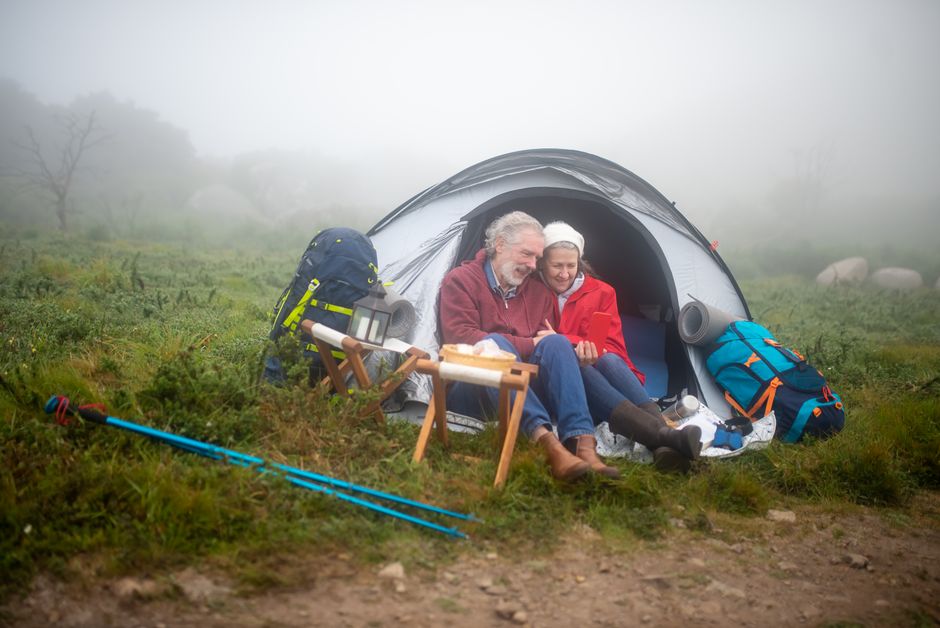
You can absolutely camp with a CPAP. It just takes planning around one number: how much power your machine draws per night, and how you plan to replace it. Most standard CPAP machines use between roughly 30 and 60 watts during normal therapy, though that figure shifts with your pressure setting, humidity use, and mask leak rate. Your job is to match that draw to a power source that can outlast your trip.
How To Camp With A CPAP: Power Options And Tips
The right power setup depends on three things: how many nights you’re camping, whether you have access to a vehicle or outlet, and whether you use a heated humidifier. That last one matters more than most people realize.
Heated humidification and heated tubing can push power use far higher than therapy alone. Many experienced CPAP campers turn humidity off entirely or switch to a passive (non-heated) water chamber. This single change often extends battery life more than any other adjustment.
Here are the main power routes people use, from simplest to most self-sufficient:
- Car battery with an inverter — works for car camping, but you must understand the risk of draining your starter battery.
- Dedicated CPAP battery — portable, designed for the machine, and the most reliable for tent camping.
- Portable power station — larger capacity, can run other devices too, but heavier.
- Deep-cycle marine battery — high capacity for longer trips, but very heavy.
- Solar panels — a supplement, not a primary source, unless you size the system carefully.
Each has real trade-offs. None is universally best.
How Long Will a CPAP Battery Actually Last?
Battery life is where most campers get surprised. Manufacturers often quote run times based on low pressure settings and no humidifier. Real-world use with higher pressure or humidity can cut that time substantially.
To estimate your own run time, you need your machine’s power draw in watts and your battery’s capacity in watt-hours. A battery rated at 300 watt-hours running a machine that draws 30 watts per hour gives you roughly 10 hours — about one night. But that math assumes ideal conditions and no humidifier.
Add heated humidity and that same battery might last a fraction of the night. This is why the honest answer is: run your own test at home before you rely on any setup in the field.
Do this at home first. Set up your battery, use your normal settings, and see how long it lasts. That single test tells you more than any spec sheet.
What Is the Safest Way to Power a CPAP While Camping?
The safest approach is a battery or power source designed specifically for medical devices or CPAP machines. These are built to deliver steady power and often include the correct DC adapter for your model.
Using a car’s 12-volt outlet or a standard inverter can work, but there are real cautions. Running a CPAP off your car’s starting battery overnight can leave you unable to start the vehicle. Some people carry a separate jump-starter for that reason, but relying on that as your plan is risky.
If you use an inverter, check that it can handle your machine’s continuous wattage, not just its peak. And confirm the inverter produces the type of current your CPAP power supply expects.
One detail worth knowing: many CPAP machines actually run on DC power internally, and the wall plug converts AC to DC. Using a proper DC adapter can be more efficient than converting battery DC to AC and back to DC. That efficiency gain can meaningfully extend battery life. Not every machine supports this, so check your specific model’s documentation.




Do You Need a Prescription to Buy a CPAP Battery?
In the United States, CPAP machines and many related supplies require a prescription. Batteries and power accessories are generally not prescription devices, so most can be bought without one.
That said, some insurance plans and durable medical equipment suppliers treat certain power accessories differently. If you’re trying to get a battery covered, check with your supplier before assuming it’s covered or not. Coverage rules vary widely.
How Do You Handle Humidity and Water While Camping?
This is the part most guides skip. If you use a heated humidifier at home, camping changes that. Heating water takes significant power, and in cold conditions the humidifier may not perform the way it does indoors.
Many campers switch to a passive humidifier — a water chamber with no heat — or skip water entirely. If you skip water, expect dryness in your nose and throat, which can be uncomfortable but is usually manageable.
If you do use water, use distilled water when you can. This is standard CPAP guidance because it reduces mineral buildup in the chamber. In the backcountry, distilled water may not be available, so plan ahead or accept that you’ll need to clean the chamber more carefully afterward.
Cold weather adds another wrinkle. Condensation, sometimes called “rainout,” can build up in the tubing when warm humidified air meets cold air. Heated tubing helps at home but draws power. In a tent, some people use a tube cover or simply reduce humidity to limit rainout.
What Should You Pack for CPAP Camping?
A short checklist prevents most problems. Beyond your machine and mask:
- Your battery or power source, fully charged
- The correct DC adapter or power supply for your model
- Spare mask cushions or a backup mask
- Extra filters
- Distilled water if you use a humidifier
- A dry bag or waterproof case for the machine
- Extension cord if you’re near power
Protecting the machine from moisture and dust matters. A tent can get damp overnight, and dust from trails can clog filters faster than indoor use.
Can You Use Solar Power for a CPAP?
Solar can work, but it’s rarely a simple plug-and-play solution. The panels need to generate enough power during daylight to recharge a battery that then runs the machine at night. Cloudy weather, tree cover, and short winter days all reduce output.
For a single night, a well-sized battery alone is often simpler and more reliable than depending on solar. For multi-night trips far from power, solar paired with a large battery becomes more practical — but you need to size the system to your actual usage, not to a marketing estimate.
A realistic approach: use solar to top up a battery, not as your only source. Treat it as a supplement unless you’ve tested the full system yourself.
Practical Tips That Make a Real Difference
Test your entire setup at home before your trip. Sleep one night on battery power exactly as you would in the tent. This catches problems while you can still fix them.
Lower your pressure settings only if your clinician approves. Changing therapy settings without guidance can reduce how well your sleep apnea is treated.
Keep your battery warm. Cold reduces battery capacity, sometimes significantly. A battery left in a cold tent or vehicle overnight may deliver less power than expected. Insulating it or keeping it near your body heat can help.
Bring a backup plan. If your battery dies mid-trip, know whether you have a vehicle outlet, a nearby power source, or a spare battery. For people with severe sleep apnea, missing a night of therapy can matter, so plan accordingly.
Talk to your sleep clinician before a big trip, especially if you’re going somewhere remote. They can advise on your specific machine and any concerns about going without therapy.
Frequently Asked Questions
Can I use my regular CPAP machine while camping?
Yes, your regular machine works fine as long as you have a compatible power source. You don’t need a special travel machine, though smaller travel units can be easier to pack.
How many nights can a CPAP battery last?
It depends on your machine’s power draw, your pressure setting, and whether you use a heated humidifier. Many batteries last about one night, and turning off humidity often extends that significantly.
Is it safe to run a CPAP off a car battery?
It can work with the right setup, but running it off your starting battery overnight risks draining it so the car won’t start. A separate battery or power station is generally safer.
Do I need a prescription to buy a CPAP battery?
Most batteries and power accessories do not require a prescription in the United States. Machines and many supplies do, so check with your supplier about your specific situation.
