
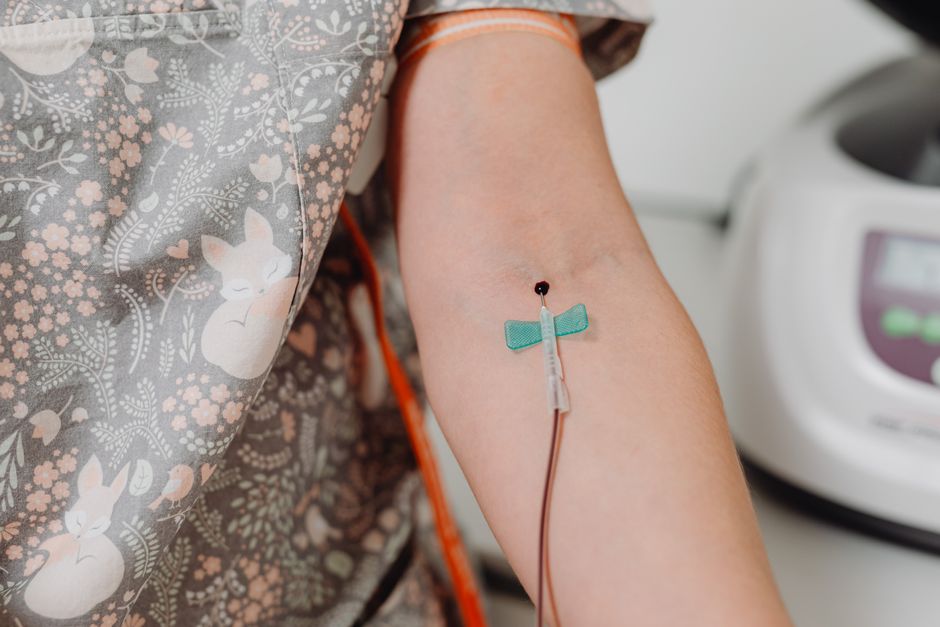
The agglutination blood group test is the standard laboratory method used to determine a person’s blood type. It works by mixing a sample of your red blood cells with antibodies that target specific antigens, or markers, on the cell surface. If the antibodies bind to the antigens, the red blood cells clump together — a process called agglutination — and that clumping reveals which blood group you have.
What Is Agglutination in Blood Testing?
Agglutination is the scientific term for clumping. In the context of blood typing, it happens when antibodies in a test reagent attach to antigens on the surface of red blood cells. Each red blood cell has multiple copies of the same antigen. When an antibody binds to those antigens, it can link two cells together. As more antibodies bind, the cells form visible clusters.
This reaction is highly specific. An antibody that targets the A antigen will only bind to cells carrying the A antigen. It will not bind to cells with only the B antigen. This specificity is what makes the test reliable. The visible clumping is a direct readout of a molecular interaction happening on the cell surface.
How The Agglutination Blood Group Test Works in Practice
The test itself is straightforward. A small blood sample is mixed with separate reagents containing anti-A antibodies, anti-B antibodies, and anti-D antibodies. The anti-D reagent checks for the Rh factor, which is the presence or absence of the D antigen. The mixture is observed for clumping.
If your blood clumps only with the anti-A reagent, you are type A. If it clumps only with anti-B, you are type B. If it clumps with both, you are type AB. If it clumps with neither, you are type O. The Rh result is read the same way: clumping with anti-D means you are Rh positive; no clumping means Rh negative.
This is called the forward typing method. It directly tests which antigens are present on your cells. It is the most common way blood typing is performed in clinical labs.
Why the Test Uses Two Different Methods
Most laboratories do not rely on forward typing alone. They also perform a reverse typing step. This second test uses your blood plasma, not your red cells. The plasma is mixed with known red blood cells that carry the A antigen and known cells that carry the B antigen.
Your body naturally produces antibodies against the blood type antigens you do not have. If you are type A, you have anti-B antibodies in your plasma. If you are type B, you have anti-A antibodies. If you are type O, you have both. If you are type AB, you have neither.
Reverse typing confirms the forward typing result. If forward typing says you are type A, reverse typing should show your plasma clumping B cells. When both methods agree, the result is considered confirmed. This dual approach catches errors that could occur from a weak reaction or a mislabeled sample.





What the Clumping Reaction Actually Tells You
The clumping reaction is a binary readout. Either agglutination occurs or it does not. But the strength of the reaction can vary. Some samples produce strong, immediate clumping. Others produce weaker, slower reactions. Laboratory staff are trained to interpret these variations, and the test is always read under controlled conditions.
Blood group systems are more complex than the simple A, B, and Rh categories most people know. There are over 40 known blood group systems, and hundreds of individual antigens. The ABO and Rh systems are the most clinically significant because they cause the most severe transfusion reactions. The agglutination test used in routine labs focuses on these systems because they matter most for safe blood transfusion.
How Agglutination Differs from Other Blood Tests
Agglutination is not the only way to determine blood type. Molecular testing, which looks directly at DNA, can also identify blood group genes. This method is more precise and can detect rare variants that agglutination might miss. However, it is significantly more expensive and takes longer to run.
Agglutination remains the standard because it is fast, inexpensive, and highly reliable for common blood types. A skilled technician can complete the test in under 15 minutes. This speed is critical in emergency situations where a patient needs blood immediately.
Some automated analyzers use gel card technology, which is a modified version of agglutination. The blood and reagent are placed in a gel-filled column. If agglutination occurs, the clumped cells cannot pass through the gel and remain at the top. If no agglutination occurs, the cells settle to the bottom. This method reduces human error and allows for high-volume testing.
Why Blood Type Accuracy Is Critical
Receiving incompatible blood triggers a severe immune response. Your body recognizes the foreign antigens on the donor cells as a threat and attacks them. This can cause a hemolytic transfusion reaction, where the donated red blood cells are destroyed. Symptoms range from fever and chills to kidney failure and shock. In severe cases, it can be fatal.
This is why the agglutination test is performed before every transfusion. The donor’s blood and the recipient’s blood are both tested. A crossmatch is then performed, where donor red cells are mixed with recipient plasma to confirm compatibility. This final check ensures the transfusion will be safe.
The same principles apply during pregnancy. If an Rh-negative mother carries an Rh-positive baby, her immune system may produce antibodies against the baby’s red cells. In subsequent pregnancies, these antibodies can cross the placenta and attack fetal red cells, causing hemolytic disease of the newborn. Routine blood typing of pregnant women identifies this risk early, allowing for preventive treatment.
Limitations of the Agglutination Test
The agglutination test is not perfect. Certain medical conditions can interfere with the results. People who have recently received a blood transfusion may have a mix of their own cells and donor cells, which can make the test difficult to interpret. People with certain autoimmune conditions may have antibodies that cause non-specific clumping.
Some individuals have weak or variant forms of the A or B antigens. These can produce weak or absent agglutination, leading to a possible misclassification. When this is suspected, additional testing is required to determine the correct blood type.
Very young infants, particularly those under four months old, do not produce their own antibodies against A and B antigens. Reverse typing is therefore not reliable in this age group, and the blood type is determined from forward typing alone. This is an established clinical limitation, not a failure of the test itself.
How to Interpret Your Blood Type Result
Your blood type is reported as a letter and a Rh status. Common results include A positive, A negative, B positive, B negative, AB positive, AB negative, O positive, and O negative. The letter indicates your ABO group. The positive or negative indicates your Rh status.
O negative blood is often called the universal donor because it lacks A, B, and Rh antigens. It can be given to patients of any blood type in emergency situations. AB positive is the universal recipient because people with this type can receive blood from any donor. These designations are based on the same antigen-antibody interactions that the agglutination test detects.
Knowing your blood type is useful for medical records and for blood donation. Donation centers always confirm your type before your blood is used. The test is safe, requires only a small sample, and carries minimal risk.
Frequently Asked Questions
How long does an agglutination blood group test take?
Routine blood typing results are typically available within 10 to 15 minutes. Automated systems may produce results even faster.
Can the agglutination test give a wrong blood type?
Errors are rare but possible, usually from sample mix-ups, weak antigen reactions, or recent transfusions. Laboratories use forward and reverse typing together to detect and correct these errors.
Is the agglutination test the same as a blood crossmatch?
No. Blood typing determines your blood group, while a crossmatch tests your plasma against a specific donor’s red cells before transfusion. Both use agglutination principles but answer different questions.
Does the agglutination test hurt?
The test requires a standard blood draw, which involves a brief needle stick. The discomfort is minimal and similar to any routine blood collection.
