
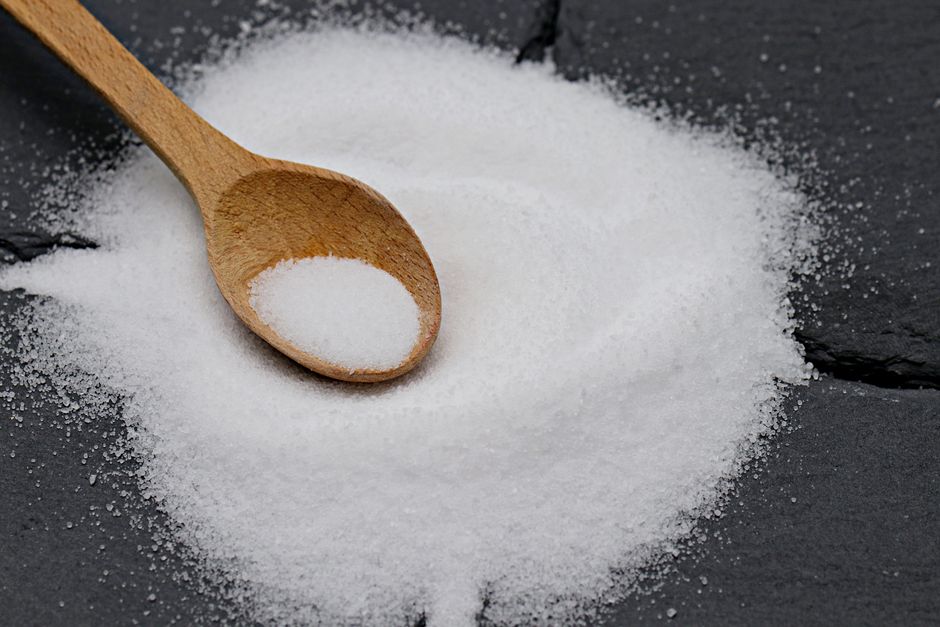
Salt is sodium chloride, and by weight it is about 40% sodium and 60% chloride. That means one gram of table salt contains roughly 400 milligrams of sodium. A single teaspoon of salt weighs about 5.7 grams, so it delivers around 2,300 milligrams of sodium — which happens to be the daily limit most US health guidelines recommend for adults.
That 40% figure is the key to everything else. Once you know it, you can look at any salt label, recipe, or nutrition panel and work out the sodium in seconds. It also explains why “salt” and “sodium” are not the same thing, even though people use the words interchangeably.
How Much Sodium Is in a Teaspoon of Salt?
A level teaspoon of table salt contains about 2,300 milligrams of sodium. That is the number to remember, because it lines up almost exactly with the daily sodium limit in the Dietary Guidelines for Americans.
The math is straightforward. One teaspoon of table salt weighs about 5.7 grams. Multiply that by 0.4 (the sodium fraction) and you get roughly 2.3 grams of sodium, which is 2,300 milligrams.
A few things shift that number slightly:
- Coarse salt like kosher salt or sea salt has larger crystals, so a teaspoon holds less salt by weight — and therefore less sodium. The difference can be substantial between brands.
- Fine salt packs more tightly, so a teaspoon may hold more sodium than the standard figure.
- Table salt is usually the reference point, and most iodized table salt is fortified with iodine, which matters for thyroid health.
This is why recipes that specify “kosher salt” versus “table salt” can turn out very differently. It is not a matter of taste preference. It is a real difference in how much sodium ends up in the food.
How Much Sodium Is in a Gram of Salt?
One gram of salt contains about 400 milligrams of sodium. This is the simplest conversion in all of nutrition, and it works for any amount.
To find the sodium in any quantity of salt, multiply the grams of salt by 0.4, then convert to milligrams.
- 1 gram of salt = 400 mg sodium
- 2 grams of salt = 800 mg sodium
- 5 grams of salt = 2,000 mg sodium
- 5.7 grams of salt = about 2,300 mg sodium (one teaspoon)
Nutrition labels outside the United States often list salt in grams rather than sodium in milligrams. If you are reading a UK or European label that says “salt: 1.5 g per serving,” that serving contains about 600 mg of sodium. The salt number is always roughly 2.5 times the sodium number, because sodium is 40% of salt by weight.
Salt vs. Sodium: What Is the Difference?
Sodium is a mineral. Salt is a compound made of sodium and chloride. You cannot have salt without sodium, but you can have sodium without salt.
This distinction matters because a lot of sodium in the American diet does not come from the salt shaker. It comes from processed and restaurant foods, where sodium shows up in forms that are not salt at all.
Common sources include:
- Sodium bicarbonate (baking soda)
- Sodium nitrite and nitrate (cured meats)
- Monosodium glutamate (MSG)
- Sodium benzoate and other preservatives
- Disodium phosphate and similar additives
All of these contribute to your total sodium intake even though none of them taste particularly salty. That is part of why sodium intake is so easy to underestimate. Research consistently shows that most people take in far more sodium than they realize, largely because it is added during food processing rather than at the table.





How Much Sodium Should You Have Per Day?
The Dietary Guidelines for Americans recommend limiting sodium to less than 2,300 milligrams per day for adults. That is about one teaspoon of salt. The American Heart Association suggests an ideal limit closer to 1,500 mg per day, especially for people with high blood pressure.
Average intake in the United States is well above both figures. Most adults take in somewhere in the range of 3,000 to 3,500 mg per day, though exact averages vary by survey and population.
Here is where the evidence gets more nuanced than headlines suggest. The link between very high sodium intake and elevated blood pressure is well established. What is debated is whether pushing sodium down to the lowest possible level benefits everyone equally. Some research suggests a J-shaped curve, where very low sodium intake is not associated with better outcomes and may even be associated with worse ones in certain groups. That research is not settled, and it does not change the general recommendation to reduce excess sodium. It does mean that “lower is always better” is an oversimplification.
People who benefit most from reducing sodium include those with existing high blood pressure, older adults, and people who are salt-sensitive — a trait that varies a lot between individuals.
How Do You Convert Salt to Sodium?
Multiply the grams of salt by 400 to get milligrams of sodium. This one-step conversion handles almost every real-world situation.
Going the other way, multiply milligrams of sodium by 2.5 to get milligrams of salt. So 500 mg of sodium equals about 1,250 mg of salt, or 1.25 grams.
| Salt (grams) | Sodium (mg) | Everyday equivalent |
|---|---|---|
| 1 g | 400 mg | A small pinch |
| 2.5 g | 1,000 mg | About 1/2 teaspoon |
| 5 g | 2,000 mg | Just under 1 teaspoon |
| 5.7 g | 2,300 mg | 1 level teaspoon |
| 10 g | 4,000 mg | About 1 3/4 teaspoons |
These figures assume standard table salt. Coarse salts will run lower per teaspoon because of the air gaps between crystals. If you are tracking sodium for medical reasons, weighing your salt is more accurate than measuring by spoon.
Which Salts Have Less Sodium?
No natural salt has meaningfully less sodium than another. Sea salt, kosher salt, pink Himalayan salt, and table salt are all roughly 40% sodium by weight. The differences people notice come from crystal size and trace minerals, not from a lower sodium content.
The one real exception is salt substitutes. These products typically replace part of the sodium chloride with potassium chloride. They can contain roughly 30% to 50% less sodium than regular salt, depending on the brand.
Potassium chloride is not a free pass, though. People with kidney disease or those taking certain medications — including ACE inhibitors, angiotensin receptor blockers, and potassium-sparing diuretics — may need to avoid extra potassium. Anyone in those groups should talk to a clinician before using a salt substitute.
Another point worth clearing up: sea salt is not healthier than table salt in any way that matters clinically. Both are sodium chloride. Table salt often has iodine added, which sea salt usually does not, and iodine is a nutrient many people do not get enough of. That makes ordinary iodized table salt the more nutritionally useful choice for most households.
Why Does the Sodium in Salt Matter?
Sodium is an essential mineral. Your body needs it to maintain fluid balance, transmit nerve signals, and contract muscles. The problem is not sodium itself — it is the amount.
When sodium intake is high, the body holds onto water to keep sodium concentrations in balance. That extra fluid raises blood volume, which can raise blood pressure. Over years, elevated blood pressure damages blood vessels and increases the risk of heart disease, stroke, and kidney disease.
Not everyone responds the same way. Some people can eat a high-sodium diet for decades without developing high blood pressure. Others see their blood pressure climb quickly. This variability is real and well documented, but there is currently no simple test to tell you which group you are in. That is one reason public health guidance aims at the whole population rather than trying to sort out who is sensitive.
Reducing sodium is only one lever. Potassium intake matters too. Diets rich in fruits, vegetables, and beans provide potassium, which helps the body excrete sodium and appears to blunt some of its blood pressure effects. The DASH eating pattern — which combines lower sodium with higher potassium and other dietary changes — has been shown in clinical trials to lower blood pressure.
Frequently Asked Questions
How much sodium is in 1 teaspoon of salt?
A level teaspoon of table salt contains about 2,300 milligrams of sodium. Coarse salts may contain somewhat less per teaspoon because larger crystals leave more air space.
Is 1 gram of salt the same as 1 gram of sodium?
No. One gram of salt contains about 400 milligrams of sodium, because sodium makes up roughly 40% of salt by weight. The rest is chloride.
Is sea salt lower in sodium than table salt?
No. Sea salt and table salt are both about 40% sodium by weight, so they contain essentially the same amount of sodium. Any difference you notice is about crystal size and flavor, not sodium content.
How many teaspoons of salt is 2,300 mg of sodium?
About one level teaspoon of table salt. That is the daily sodium limit recommended for adults in the Dietary Guidelines for Americans.
