
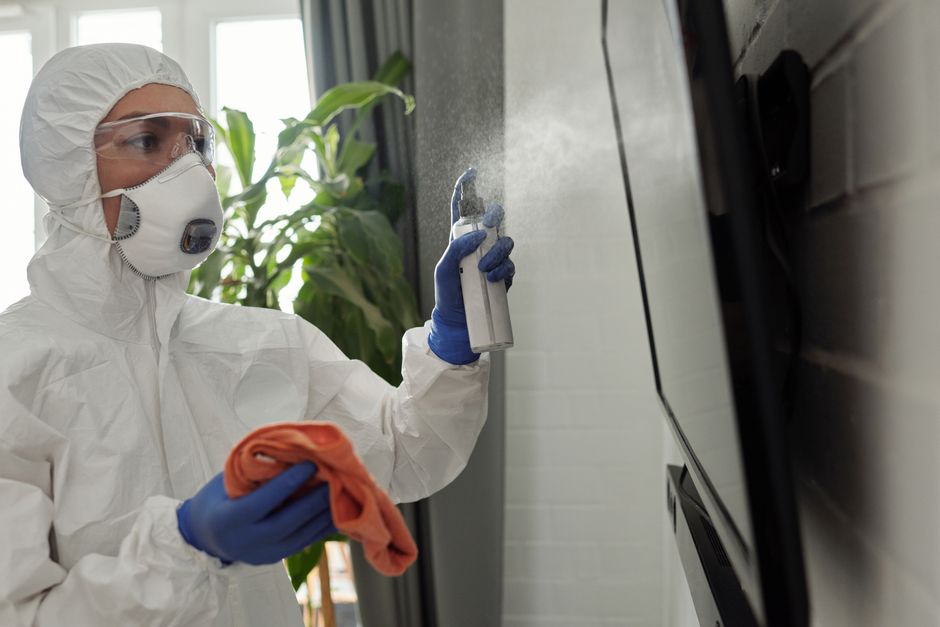
Sodium hypochlorite does kill mold. It also bleaches the mold’s dark pigment almost instantly, which is why the surface looks clean within seconds. That visual change is real, but it happens faster than the kill, and it does nothing about the mold’s root-like structures buried in porous material. So the honest answer is both: it kills what it touches, and it can absolutely hide what it does not reach.
The confusion comes from a simple mismatch between what you see and what is actually happening. Bleaching is a chemical reaction with color. Killing is a chemical reaction with living cells. They are not the same event, and they do not happen at the same speed or depth.
Does Sodium Hypochlorite Actually Kill Mold?
Yes. Sodium hypochlorite is the active ingredient in household chlorine bleach, and it is a genuine antimicrobial. It damages proteins and cell membranes in fungi, and it inactivates mold spores on contact with a wet surface.
This is not marketing. Chlorine-based disinfectants have been used to control microbial growth on hard surfaces for well over a century, and their antimicrobial action is well established. When a bleach solution contacts mold on a non-porous surface and stays wet long enough, the mold is killed rather than just lightened.
Two conditions matter for that to be true:
- Contact time. The surface has to stay wet with the solution long enough for the chemical to act. Wiping immediately and moving on is not the same as disinfecting.
- Surface type. Non-porous surfaces like tile, glass, sealed countertops, and metal can be disinfected. Porous surfaces cannot.
That second point is where most of the “just hides it” reputation comes from, and it is well earned.
Why Does Mold Look Gone When It Is Not?
Because bleach removes mold’s color long before it removes mold.
The dark green, gray, and black you associate with mold growth is largely pigment, including melanin. Sodium hypochlorite oxidizes that pigment quickly. The stain fades within seconds of contact. The fungus underneath may still be alive at that moment, and its deeper structures were never touched at all.
This is the mechanism behind the classic complaint: a bathroom ceiling looks spotless after treatment and the dark patches return weeks later. The color came back because the organism was never fully removed from the material.
There is a second reason bleach underperforms on porous surfaces. Sodium hypochlorite is a strong oxidizer, and it reacts with organic material as it travels. Grout, drywall paper, wood, and caulk are full of organic material. The hypochlorite gets consumed neutralizing surface grime before it ever reaches mold growing inside those pores.
Can Bleach Reach Mold Growing Inside Drywall, Wood, or Caulk?
No. This is the clearest limitation, and it is not a matter of using more bleach or leaving it on longer.
Mold does not just sit on surfaces. It sends thread-like structures called hyphae into whatever it is growing on. On a painted wall, that means into the paint film, into the drywall paper, and sometimes into the gypsum core. On wood, it means into the grain. On caulk, it means into the rubbery matrix itself.
Liquid bleach solution applied to the surface wets the surface. It does not penetrate deeply into these materials, and even if some liquid soaks in, the hypochlorite is largely spent reacting with the material itself before it reaches the mold.
This is why the same patch of mold keeps returning after repeated bleach treatments. The visible growth was killed. The material it grew into was not, and the surviving hyphae regrow.



Is Bleach Recommended for Mold Cleanup?
For hard, non-porous surfaces, chlorine bleach is a reasonable disinfectant and is widely used. For porous materials, the general direction from public health and remediation guidance has moved away from bleach as the primary tool.
The practical logic is straightforward. If the mold is only on the surface of a hard material, killing it and wiping it away solves the problem. If the mold has colonized a porous material, no surface treatment solves it, because the problem is not on the surface. In those cases the standard approach is removal of the affected material rather than disinfection of it.
There is also a safety dimension that gets lost in the “bleach kills everything” framing. Mixing sodium hypochlorite with ammonia produces chloramine vapors. Mixing it with acids produces chlorine gas. Both can cause serious respiratory injury. Bleach also irritates skin and eyes and can damage some surfaces and fabrics.
Anyone using it should follow the product label, use it in a ventilated space, wear gloves and eye protection, and never combine it with other cleaning products.
What Actually Fixes a Mold Problem?
Moisture control. Mold cannot grow without water, and that single fact drives everything about solving it.
Removing visible mold without fixing the water source guarantees it comes back. The mold is a symptom. The leak, the condensation, the high indoor humidity, or the flooding is the cause.
What tends to work, in order:
- Find and stop the moisture source. A roof leak, a plumbing drip, a window that sweats, a basement that floods.
- Dry the area thoroughly and quickly. Mold can begin growing on wet materials within a day or two, so speed matters.
- Remove porous materials that have been colonized. Drywall, insulation, carpet, and ceiling tiles generally cannot be cleaned back to a mold-free state.
- Clean hard surfaces with a suitable cleaner and let them dry completely.
- Keep indoor humidity in check, generally in the 30 to 50 percent range, which is a common recommendation for reducing mold growth.
For large affected areas, or for mold that follows a sewage or flood event, professional remediation is the appropriate route rather than a homeowner with a spray bottle.
Does Vinegar or Other Cleaner Work Better Than Bleach?
The evidence here is mixed, and it is worth being honest about that.
Some studies suggest vinegar, meaning dilute acetic acid, can inhibit mold growth on certain surfaces. Other studies find it less effective than commercial disinfectants. Results vary by mold species, surface, and concentration. No large human trials have established one household cleaner as reliably superior for mold removal across materials.
What is better supported is the general principle: on porous materials, no cleaner fully solves the problem, because the problem is inside the material. On hard surfaces, several products can work if used correctly with adequate contact time.
Hydrogen peroxide is another option some people use. Evidence for it against household mold is limited and varies by surface and species.
The takeaway is not that one product beats another. It is that the material and the moisture source determine the outcome far more than the bottle does.
How Do You Know If Treatment Worked?
You will not know from appearance alone, because appearance is exactly what bleach manipulates.
The real test is time and moisture. If the area stays dry and the discoloration does not return over the following weeks, the treatment plus moisture control worked. If it returns, the mold was never fully removed from the material, or the moisture source is still active.
That is the practical difference between killing and hiding. Killing shows up as a problem that stays solved. Hiding shows up as a problem that comes back.
Frequently Asked Questions
Does sodium hypochlorite kill mold spores?
Yes, sodium hypochlorite inactivates mold spores on hard, non-porous surfaces when the surface stays wet with the solution long enough. It cannot reach spores that have settled inside porous materials like drywall or wood.
Why does mold come back after I bleach it?
Because the bleach killed the surface growth and removed its color, but the mold’s deeper structures inside the material survived. If the moisture source is still present, that surviving mold regrows.
Is bleach or vinegar better for killing mold?
The evidence is mixed, and neither is clearly superior across all surfaces and mold species. On porous materials, no liquid cleaner fully solves the problem because the mold is inside the material, not on it.
Can I just paint over mold after bleaching it?
No. Painting over mold that has not been removed traps it under the coating, and it typically returns. Porous materials with established mold growth generally need to be removed and replaced.
