
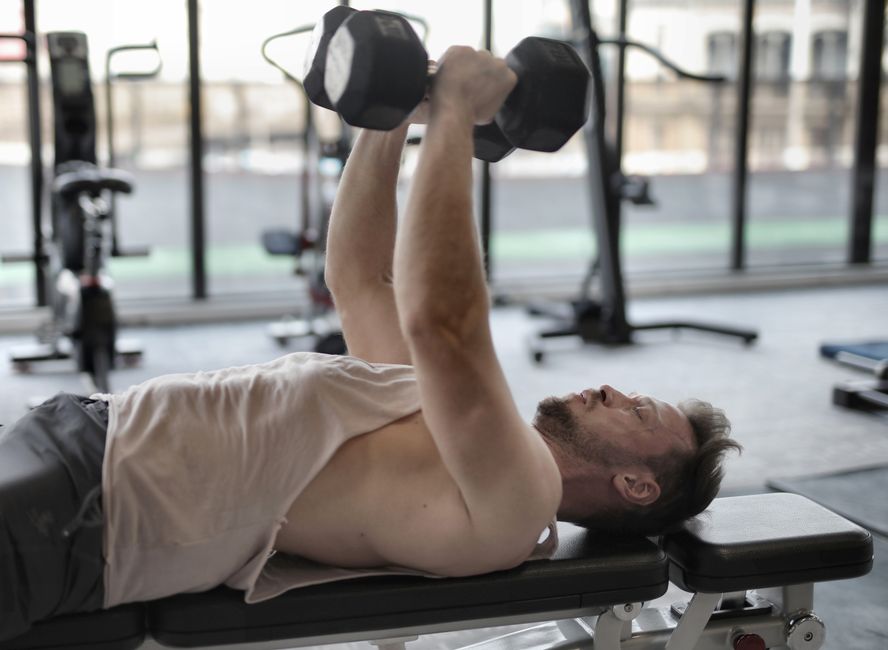
The dumbbell bench press is a staple exercise for building chest, shoulder, and triceps strength. Unlike a barbell, dumbbells require each arm to work independently, which means your stabilizing muscles must work harder. There is no single “correct” weight for everyone; your ideal load depends on your training experience, body weight, and goals. For a beginner, starting with a weight you can control for 8–12 repetitions with good form is the most reliable guide, rather than chasing a specific number.
What Is the Average Dumbbell Bench Press Weight?
Research on average lifting strength often focuses on the barbell bench press, not the dumbbell version. Because dumbbells are harder to stabilize, most people can lift roughly 10–20 percent less weight per hand than they could with a barbell. For example, a man who can barbell bench press 135 pounds might dumbbell press 50–60 pounds in each hand for the same number of reps.
General observations from gym populations suggest that a beginner male might press 30–50 pound dumbbells per hand. An intermediate lifter with a year or more of consistent training might use 60–80 pound dumbbells per hand. Advanced lifters often press over 100 pounds per hand. For women, these numbers are typically lower, with beginners often using 15–25 pound dumbbells per hand and intermediate lifters progressing to 35–50 pounds.
These are broad ranges, not rules. Body weight plays a significant role. A 200-pound man will generally press more than a 150-pound man of similar training experience. Comparing yourself to others is less useful than tracking your own progress over time.
How to Determine the Right Weight for You
The most practical method is to use a repetition range that matches your goal. For general strength and muscle growth, the 8–12 rep range is standard in most programs. Choose a weight where you reach muscle failure at or near the end of that range.
Here is a simple self-test. Pick a weight you think is challenging. Perform the exercise with strict form. If you can complete 12 reps but feel you could easily do 5 more, the weight is too light. If you struggle to finish 6 reps with clean technique, the weight is too heavy. The right weight is one where reps 10, 11, and 12 are hard but you complete them without compromising your form.
This approach is called “working to near failure.” It is a well-established training principle. It allows your body to adapt and grow stronger without the injury risk of lifting to absolute failure on every set.
How Much Should I Dumbbell Bench Press Compared to Barbell?
If you know your barbell bench press max, you can estimate your dumbbell weight. A common formula is to take your barbell one-rep max and divide by two. Then reduce that number by about 10–15 percent to account for the added stabilization demand.
For instance, if your barbell max is 200 pounds, half is 100 pounds per hand. Reducing by 10–15 percent gives you roughly 85–90 pounds per dumbbell. This is an estimate, not a precise calculation. Some lifters find the difference is smaller, especially if they train regularly with dumbbells.
Your non-dominant arm is often the limiting factor. Dumbbells expose strength imbalances between sides. If your left arm is weaker, your left side will fail first. This is not a flaw in the exercise; it is a benefit. Over time, dumbbell pressing can help correct these imbalances, but it may temporarily lower the weight you can handle compared to a barbell.





Does Body Weight or Experience Matter More?
Training experience matters more than body weight for predicting how much you can press. A beginner who weighs 180 pounds may press less than a trained lifter who weighs 150 pounds. Muscle coordination, neural adaptation, and technique all improve with practice. These factors account for a large portion of strength gains in the first year of training.
Body weight still sets a baseline. Heavier individuals generally have more muscle mass to start with, particularly in the upper body. This gives them a strength advantage early on. However, as training experience increases, the gap between lifters of different sizes narrows relative to their body weight.
Strength is also specific to the movement. Someone who runs or cycles daily will not press as much as someone who lifts weights regularly, regardless of body size. Consistent practice with the dumbbell bench press is the single most important factor in improving your numbers.
How Fast Should You Increase the Weight?
Progressive overload is the principle of gradually increasing the demands on your muscles over time. This is how strength gains happen. Without it, your body has no reason to adapt.
A reasonable pace for a beginner is to add 2.5 to 5 pounds per hand every few weeks when you can comfortably complete the top of your rep range with good form. For intermediate lifters, progress slows. You might add weight only every month or two, or you might add a single rep instead of more weight.
Do not rush the process. Adding weight too quickly often leads to poor form, which increases injury risk. It also creates plateaus because your nervous system cannot adapt fast enough. Slow, consistent progress is more sustainable and safer.
An important note: strength gains are not linear. You will have weeks where the weight feels heavier for no obvious reason. Sleep, stress, and nutrition all affect performance. If you have a bad session, it does not mean you are getting weaker. It means you need rest.
Common Mistakes That Limit Your Dumbbell Bench Press
Several technique errors can hold your numbers back. The most common is using too much weight and bouncing the dumbbells off your chest. This turns the exercise into a momentum move, not a strength move. It also puts unnecessary stress on your shoulders and wrists.
Another mistake is flaring your elbows out to 90 degrees from your torso. This position places the shoulder joint in a vulnerable angle. Research on shoulder mechanics consistently shows that keeping your elbows at roughly a 45-degree angle from your torso is safer and allows for more force production. Tuck your elbows slightly toward your body as you lower the weights.
Not lowering the dumbbells far enough is also common. A partial range of motion does not build strength through the full movement. Lower the dumbbells until your upper arms are at least parallel to the floor. Going slightly deeper is fine for most people, provided there is no shoulder pain.
Finally, do not lock your elbows aggressively at the top of the movement. Stop just short of a hard lockout. This keeps tension on the chest muscles and protects the elbow joints.
How to Progress Safely Over Time
Follow a structured plan rather than lifting randomly. A simple approach is to pick a weight you can press for 8 reps with good form. Each week, aim to add one rep. When you reach 12 reps, increase the weight by the smallest increment available and drop back to 8 reps.
This method is called double progression. It is widely used and supported by coaching experience. It provides a clear path forward and prevents the guesswork of choosing a new weight each session.
Rest between sets matters. For strength-focused work, rest 2–3 minutes between sets. This allows your muscles to recover enough to perform at a high level. Shorter rest periods of 60–90 seconds are fine for muscle growth but will limit the weight you can lift on later sets.
Warm up properly before heavy pressing. A few light sets with increasing weight prepare your joints and muscles for the work ahead. Cold muscles are more prone to injury, and a warm-up improves your performance on your working sets.
Frequently Asked Questions
What is a good dumbbell bench press weight for a beginner?
A good starting point is a weight you can press 8–12 times with clean form, often 20–40 pounds per hand for men and 10–25 pounds per hand for women. Start lighter than you think you need and focus on technique first.
How much dumbbell bench press should I do compared to my barbell weight?
Use roughly 40–45 percent of your barbell bench press max in each hand as a starting estimate. So if you barbell press 200 pounds, try 80–90 pound dumbbells per hand.
How often should I increase my dumbbell bench press weight?
Add weight when you can complete 12 clean reps with your current weight for all your working sets. This may happen every 2–4 weeks for beginners and less often for advanced lifters.
Is it better to use heavier weights with fewer reps or lighter weights with more reps?
Both approaches build muscle, but heavier weights with 6–10 reps are more efficient for pure strength gains. Lighter weights with 12–20 reps build muscular endurance and still stimulate growth, but progress may be slower for maximal strength.
