
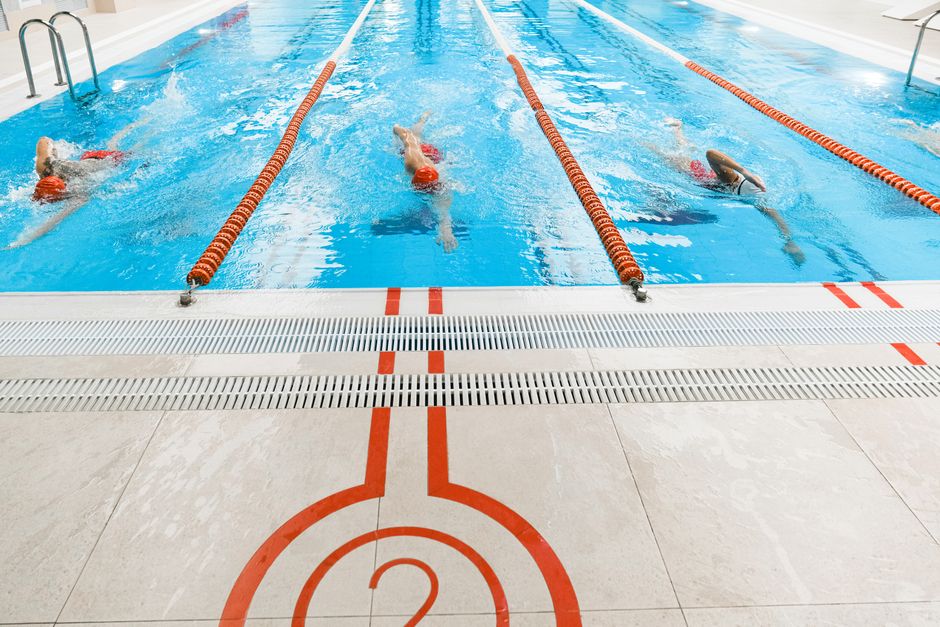
There is no single lap count that makes a workout “good,” but there is a reliable starting point: most healthy adults get a solid workout from roughly 30 to 45 minutes of continuous or interval swimming. In a standard 25-yard pool, that works out to about 40 to 60 laps for a moderate-effort session. In a 50-meter pool, the same workout is about 20 to 30 laps. The number matters less than how hard you swim and how long you keep moving.
Lap counting trips people up because “lap” means different things to different swimmers. In most US pools, one lap means one length of the pool — wall to wall. Some swimmers and coaches count a lap as a full round trip (down and back). That single difference doubles or halves your number. Always confirm what your pool and your workout plan mean by “lap” before you start.
How Many Laps Should I Swim For A Good Workout?
A good workout comes from duration and effort, not a fixed lap target. Swimming guidelines from the US Department of Health and Human Services recommend adults get at least 150 minutes of moderate-intensity aerobic activity per week, or 75 minutes of vigorous activity. Swimming counts toward both. Spread across a week, that is roughly 30 minutes of moderate swimming five days a week.
Here is a practical way to translate that into laps. These are general starting points for healthy adults, not clinical prescriptions:
- Beginner, moderate effort: 20 to 30 laps (25-yard pool) with rest breaks as needed
- Intermediate, steady effort: 40 to 60 laps in 30 to 45 minutes
- Advanced, continuous effort: 60 to 80 laps or more, often with intervals and varied strokes
Those ranges assume a 25-yard pool. In a 25-meter pool, laps are slightly longer. In a 50-meter pool, cut the count roughly in half for the same distance.
The better question is not “how many laps” but “how long and how hard.” A swimmer who covers 30 laps with short rests and a raised heart rate gets more fitness benefit than someone who drifts through 60 laps at a chatty pace.
Does Pool Length Change How Many Laps I Need?
Yes, and this is the most common source of confusion. A lap in a 25-yard pool covers 25 yards. A lap in a 50-meter pool covers about 54.7 yards — more than twice as far. So 40 laps in a short pool is a very different workout than 40 laps in a long-course pool.
Most US gyms and community pools are 25 yards. Competitive “short course” meets use 25 yards or 25 meters. “Long course” meets use 50 meters. If you train in different pools, track your distance in yards or meters rather than laps. That keeps your workouts consistent no matter where you swim.
A rough conversion: one length of a 50-meter pool equals about two lengths of a 25-yard pool plus a little extra. Swimmers who move between pool sizes often find it simpler to think in total distance — say, 1,000 yards — and then divide by the pool length to get their lap count.
How Hard Should I Be Swimming?
Effort level is what turns a swim into a workout. The talk test is the simplest gauge. If you can hold a conversation but not sing, you are likely at moderate intensity. If you can only speak a few words before needing a breath, you are at vigorous intensity.
Heart rate offers another check. A commonly used estimate for maximum heart rate is 220 minus your age, though this formula is a rough population average and varies widely between individuals. Moderate intensity generally falls around 64 to 76 percent of that estimated maximum, and vigorous intensity around 77 to 93 percent, according to the American College of Sports Medicine. These are broad guidelines, not precise targets for any one person.
Swimming has a quirk worth knowing. Because you are horizontal and often cooler in the water, your heart rate can run lower than it would during land exercise at the same perceived effort. Relying on heart rate alone in the pool can make you work less hard than you think. Use the talk test alongside it.
Interval swimming — alternating harder efforts with easier recovery — is a well-established way to raise intensity without swimming endless laps. A simple version: swim one or two lengths hard, then one easy, and repeat. You may cover fewer total laps but get more cardiovascular benefit per minute.





What Should a Beginner Swim Workout Look Like?
Beginners do best starting with shorter, frequent sessions rather than one long grind. A common approach is three sessions a week of 20 to 30 minutes, building gradually as comfort and stamina improve.
A simple beginner structure:
- Warm up with 4 to 6 easy laps of any stroke
- Swim 2 laps at a steady effort, rest 30 to 45 seconds, and repeat 5 to 8 times
- Cool down with 2 to 4 easy laps
That totals roughly 20 to 30 laps including rest. Rest is not failure — it lets you keep your form and effort up. Sloppy, exhausted laps build less fitness and raise injury risk, especially in the shoulders.
Beginners should focus on breathing rhythm and relaxed technique before chasing distance. Many new swimmers tire quickly not from poor fitness but from holding their breath or fighting the water. A few lessons or a coach’s eye can make a bigger difference than adding laps.
How Does Swimming Compare to Running or Cycling?
Swimming delivers strong cardiovascular and muscular benefits, but it is not a perfect one-to-one swap with land exercise. Because water supports your body weight, swimming is low-impact and easier on the joints. That makes it a strong option for people with arthritis or joint pain, and it is often recommended for them.
The trade-off is bone health. Weight-bearing exercise like running and walking stresses bones in a way that helps maintain bone density. Swimming is not weight-bearing, so it does not provide that same stimulus. Current evidence does not show swimming builds bone density the way land-based impact exercise does. Swimmers who want bone benefits should include some weight-bearing activity too.
Calorie burn depends heavily on effort, stroke, and body size, so exact numbers vary too much to state reliably. In general, vigorous swimming burns calories at a rate broadly comparable to other vigorous aerobic activity, but the range across individuals is wide.
How Can I Track My Laps Without Losing Count?
Losing count is a near-universal swimmer problem. The repetitive motion and monotony make it easy to drift. A few practical fixes work well:
- Break the workout into sets (for example, 10 sets of 4 laps) and count sets instead of individual laps
- Use a pace clock or watch and swim by time rather than distance
- Use a waterproof lap counter or fitness watch designed for swimming
- Move a water bottle or kickboard along the deck each set as a physical marker
Swimming by time is often the simplest solution. If your goal is a 30-minute workout, you do not need an exact lap count at all. You need to keep moving at the right effort for the duration. That approach sidesteps the counting problem entirely and keeps the focus on what actually drives fitness.
When Should You Check With a Doctor Before Swimming?
Swimming is generally well tolerated, but check with a healthcare provider before starting if you have heart disease, uncontrolled high blood pressure, a history of stroke, or a chronic condition that affects breathing or balance. The same applies if you have had recent surgery or an ongoing shoulder injury.
Stop and seek medical attention if you feel chest pain, severe shortness of breath, dizziness, or an irregular heartbeat during or after swimming. These are not normal responses to exercise at any fitness level.
Shoulder pain is the most common swimming complaint, particularly in freestyle swimmers who log high volume. Persistent shoulder pain that worsens with swimming deserves a professional assessment rather than pushing through. Technique problems and muscle imbalances often respond well to coaching and targeted strengthening, but that should be guided by a clinician or qualified coach.
Frequently Asked Questions
How many laps is a good swim workout?
Most healthy adults get a good workout from 30 to 45 minutes of swimming, which is roughly 40 to 60 laps in a 25-yard pool at moderate effort. Beginners can start with 20 to 30 laps including rest breaks.
Is 30 laps in a pool a good workout?
Yes, 30 laps in a 25-yard pool is about 750 yards, which is a solid workout for a beginner or intermediate swimmer when done at a steady effort. The benefit depends more on intensity and duration than the exact count.
How many laps should I swim to lose weight?
Aim for at least 150 minutes of moderate-intensity swimming per week, consistent with general physical activity guidelines, and pair it with a nutritious diet. Weight loss depends on total energy balance, not lap count alone.
Is 20 laps enough for a workout?
Twenty laps in a 25-yard pool is 500 yards, which can be a reasonable workout for a beginner or a shorter session for a more experienced swimmer. Increase duration or intensity as your fitness improves.
