
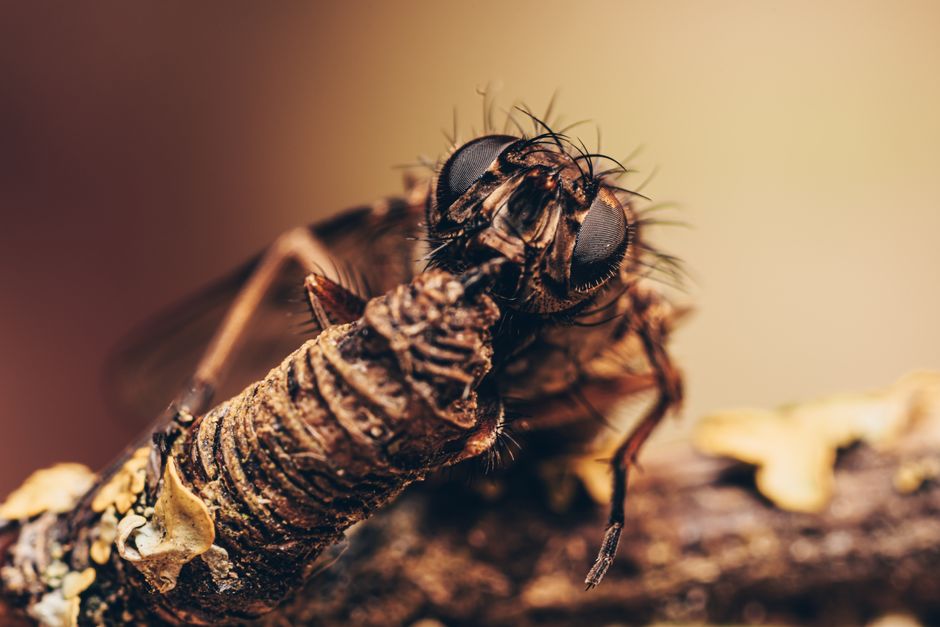
Most people are surprised to learn that flies do not have just two eyes. A housefly has five eyes. Two are large compound eyes on the sides of the head. Three are small simple eyes called ocelli on top of the head. Each type of eye serves a different purpose. The compound eyes see movement and color. The simple eyes detect light levels. Together, they give the fly a nearly 360-degree view of the world. This is not a myth or an exaggeration. This is what entomologists have confirmed through dissection and microscopic study.
How Many Eyes Do Flies Have And How Do They Work?
The answer is five. That is the number for most common fly species including the housefly and the fruit fly. The two large compound eyes are the ones you notice easily. Each compound eye contains thousands of tiny individual lenses called ommatidia. A housefly has about 4,000 ommatidia per compound eye. A dragonfly can have up to 28,000. Each ommatidium captures a small piece of the visual field. The fly’s brain stitches these pieces together into a mosaic image.
The three ocelli are much simpler. They sit in a triangle pattern on top of the head. Each ocellus has a single lens and a small cluster of light-sensitive cells. Ocelli do not form clear images. They detect changes in light intensity. This helps the fly stay stable during flight and orient itself toward the sky. When a fly turns upside down, the ocelli signal the brain to correct its position almost instantly.
What Do Compound Eyes See Compared to Human Eyes?
Compound eyes trade detail for speed and field of view. A human eye has a single lens that focuses light onto a retina with millions of cones and rods. This gives us sharp, high-resolution vision. A fly compound eye has no lens that focuses. Each ommatidium collects light from a narrow angle. The result is a pixelated image with much lower resolution. A fly probably sees the world like a very grainy security camera feed.
But flies see motion much faster than we do. Human eyes process about 60 frames per second. A fly eye processes around 250 frames per second. This is why it is so hard to swat a fly. The fly sees your hand moving in slow motion. It detects the threat and launches before your hand arrives. Research published in the Journal of Comparative Physiology found that fly photoreceptors respond to flickering light at frequencies that would look like a steady glow to humans.
Flies also see ultraviolet light. Their compound eyes have photoreceptors sensitive to UV wavelengths that humans cannot see at all. Many flowers have UV patterns that guide pollinators. To a fly, a white daisy may look like it has a dark bullseye in the center. This helps the fly find food quickly.
What Do the Three Simple Eyes (Ocelli) Do?
The ocelli are often ignored in casual explanations, but they matter. Each ocellus has a single lens and about 100 to 200 photoreceptor cells. That is tiny compared to the thousands of cells in a compound eye. But the ocelli are wired directly to the fly’s flight motor neurons. This gives them an express lane to the muscles that control wing movement.
When a fly tilts during flight, the ocelli detect the change in horizon light. They send signals that adjust wing angle within milliseconds. Studies using high-speed video show that flies with damaged ocelli crash more often during sharp turns. They also have trouble landing on vertical surfaces. The ocelli do not help with finding food or spotting predators. They are purely for flight stability and horizon detection.
Some insects like bees and wasps also have three ocelli. But not all insects do. Beetles and cockroaches have compound eyes but often lack functional ocelli. The presence of ocelli is linked to fast, agile flight. Flies that hover or make rapid direction changes rely on them the most.
| Feature | Compound Eyes (2) | Ocelli (3) |
|---|---|---|
| Number per fly | 2 | 3 |
| Total lenses | ~4,000 each | 1 each |
| Image quality | Pixelated mosaic | No image, light only |
| Color vision | Yes, includes UV | No |
| Motion detection | Very fast (250 fps) | Minimal |
| Primary function | Finding food, mates, threats | Flight stability, horizon sensing |




How Do Fly Eyes Compare to Other Insects?
Not all insects have five eyes. The number varies by species. Bees also have five eyes — two compound and three ocelli. Their compound eyes have about 6,900 ommatidia each. That gives them better resolution than flies. Bees also see UV light and polarized light, which helps them navigate using the sun even on cloudy days.
Ants are different. Most ants have compound eyes but only two or three ocelli depending on the species. Worker ants that live underground often have tiny eyes or no functional eyes at all. They rely on pheromones and touch instead. Dragonflies have two massive compound eyes that cover most of the head. They have three ocelli as well. Dragonfly compound eyes have up to 28,000 ommatidia each. This gives them nearly 360-degree vision and the ability to track a single moving target against a complex background.
Moths and butterflies have compound eyes with thousands of ommatidia but no ocelli. Instead they have two simple eyes called stemmata during their caterpillar stage. After metamorphosis, the stemmata are gone and the compound eyes take over. This is a reminder that eye structure is not fixed across insects. It evolves to match the insect’s lifestyle and environment.
Do Flies Have Good Eyesight at Night?
Flies are active during the day. Their eyes are designed for bright light. Each ommatidium is surrounded by pigment cells that block light from entering neighboring ommatidia. This prevents blurring in bright conditions but reduces sensitivity in dim light. At night, a fly’s vision drops sharply. They cannot see well in the dark.
Some insects have adaptations for night vision. Moths and cockroaches have compound eyes with wider ommatidia and less pigment shielding. This lets more light in but produces a blurrier image. Flies do not have this adaptation. If you see a fly buzzing around a light at night, it is confused by the artificial light. It is not hunting or navigating effectively. The fly is essentially disoriented.
Research from the University of Lund in Sweden showed that houseflies have a light sensitivity threshold about 1,000 times higher than that of a dark-adapted human eye. That means a fly needs much more light to see anything at all. In practical terms, a fly is nearly blind in a dimly lit room. This is why flies settle on surfaces and stop moving when the lights go out.
Common Misconceptions About Fly Eyes
One widespread myth is that a fly sees thousands of tiny copies of the same image. That is not true. Each ommatidium sees a different angle. The brain combines them into a single mosaic image. It is more like a tiled picture than a hall of mirrors.
Another myth is that flies have 360-degree vision. They come close but not quite. The compound eyes wrap around the head but there is a small blind spot directly behind the fly. The ocelli on top of the head cover the upward view but not the rear. A fly can see almost everything around it except a narrow zone directly behind its body. That is why sneaking up from directly behind can sometimes work, though the fly’s motion detection still makes it hard.
Some people believe that a fly can see individual pixels like a digital camera. That is an oversimplification. The mosaic image is not sharp enough to resolve fine detail. A fly cannot read text or recognize faces. It detects movement, color, and UV patterns. That is enough for finding food, avoiding threats, and mating.
- Flies do not see multiple identical images. They see one composite image.
- Flies do not have full 360-degree vision. There is a small rear blind spot.
- Flies do not see in high resolution. Their vision is grainy and motion-focused.
- Flies see UV light. Humans do not.
- Flies have three extra eyes on top of their head, not just two.
Can Flies See Color?
Yes, flies see color. Their compound eyes contain photoreceptors sensitive to green, blue, and ultraviolet wavelengths. They do not have a receptor for red light. A red object looks dark or black to a fly. This is why some insect traps use red light to avoid attracting flies. It is also why many flowers that attract flies have blue or purple petals. The fly sees those colors clearly.
Research published in Nature Communications found that fruit flies have four types of photoreceptor cells in their compound eyes. Each type responds to a different wavelength. This gives them tetrachromatic color vision. Humans have trichromatic vision — red, green, blue. Flies trade red for UV. Their world has colors we cannot imagine. A fly may see UV patterns on a leaf that signal a good place to lay eggs. Those patterns are invisible to us without special cameras.
Color vision in flies is not as sharp as in humans. The resolution is lower because each ommatidium captures only a small spot of color. But the range of colors a fly can detect is broader than ours. They sacrifice detail for spectral range.
Frequently Asked Questions
How many eyes does a housefly have?
A housefly has five eyes total. Two are large compound eyes and three are small simple eyes called ocelli on top of the head.
Do flies see better than humans?
No. Flies see motion much faster than humans but their visual resolution is far worse. They see a grainy pixelated image compared to human vision.
Why do flies rub their eyes with their legs?
Flies clean their compound eyes by rubbing them with their legs. Dust and debris can block individual lenses so grooming keeps their vision clear.
Can flies see in the dark?
No. Flies need bright light to see. Their eyes are not adapted for low light and they are nearly blind in darkness.
