
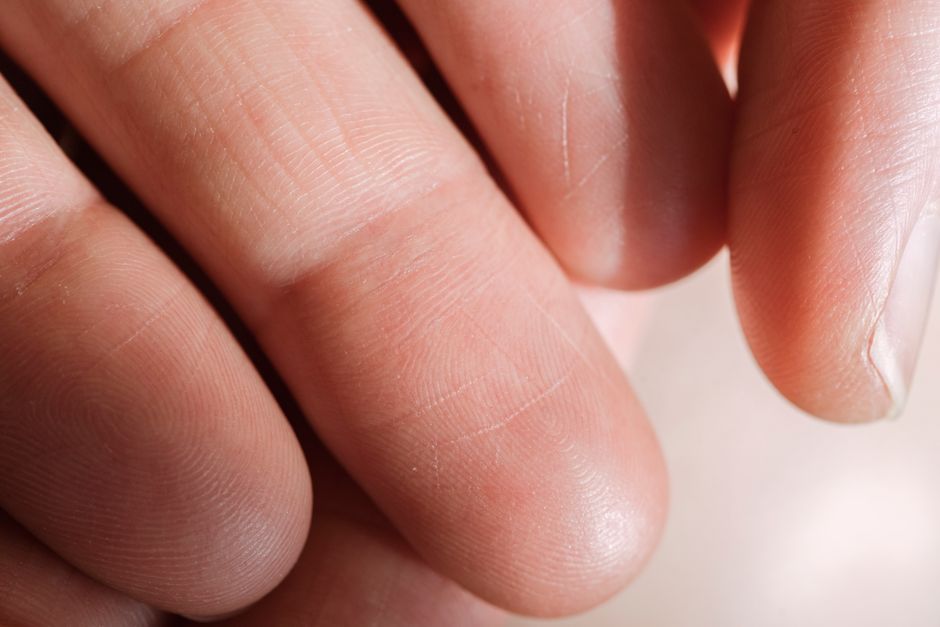
Your fingerprints are the unique pattern of ridges on your fingertips. They form in the womb and stay the same throughout your life. The biology behind these ridges starts with the way your skin layers grow together during development. These ridges serve a practical purpose: they help you grip objects and improve your sense of touch.
How are fingerprints formed?
Fingerprints begin to develop between the 10th and 24th week of pregnancy. The skin has two main layers: the outer epidermis and the deeper dermis. During this early stage, both layers grow rapidly. The epidermis buckles and folds inward where it meets the dermis. This creates the raised ridges and the sunken valleys that make up your fingerprint pattern.
The exact shape of those folds depends on several factors. Genetics provides a blueprint, but random events during growth also play a role. The position of the fetus, the pressure of amniotic fluid, and even the rate of cell growth all influence the final pattern. That is why identical twins, who share the same DNA, still have different fingerprints.
Once the ridges are fully formed, they do not change. The pattern is set by the end of the second trimester. New skin cells constantly replace old ones, but the ridge structure stays the same.
What is the biological purpose of fingerprints?
Fingerprints have two well‑established functions. First, they improve grip. The ridges create friction between your skin and the surface you touch. This makes it easier to hold objects without them slipping. Smooth skin would provide much less traction.
Second, fingerprints enhance your sense of touch. The ridges are packed with nerve endings called Meissner’s corpuscles. These are touch receptors that respond to light pressure and texture. When your finger moves across a surface, the ridges vibrate slightly. That vibration stimulates the nerve endings, sending detailed information to your brain about what you are touching.
The sweat pores on each ridge also play a role. Sweat helps moisten the skin, which can improve grip on dry surfaces. However, too much sweat can reduce friction. This is why people with overly sweaty hands sometimes struggle with grip.
What makes fingerprints unique?
No two fingerprints are exactly alike, not even on different fingers of the same hand. The uniqueness comes from the combination of genetic and random factors during development. The main genes involved control how the skin layers interact and grow. But small, unpredictable variations in cell movement, growth rate, and physical forces inside the womb create the final pattern.
Fingerprints have three basic pattern types: loops, whorls, and arches. Loops are the most common, found on about 60–65% of fingerprints. Whorls appear on about 30–35% of fingers. Arches are the rarest, seen in about 5% of the population. Within each type, the finer details—called minutiae—make every print unique. These include ridge endings, bifurcations (where a ridge splits), and dots (short ridges).
Some research suggests that fingerprint patterns are linked to certain genetic conditions. For example, people with Down syndrome often have a higher frequency of ulnar loops and a single transverse palmar crease. But fingerprint patterns alone are not used to diagnose any condition.





How Do Fingerprints Work The Biology Behind Your Ridges?
The biology of fingerprints comes down to how the ridges interact with the surface you touch. Each ridge is a raised line of skin, about 0.2 to 0.5 millimeters wide. The valleys between ridges are slightly deeper. When you press your finger against a surface, the ridges compress and spread out slightly. This increases the contact area and creates more friction.
At the same time, the nerve endings inside the ridges detect pressure and movement. The Meissner’s corpuscles are located right below the epidermis in the ridge tips. They respond best to low‑frequency vibrations, like those produced when you rub your finger over a textured surface. Another type of nerve ending, called Pacinian corpuscles, is located deeper in the dermis and responds to deeper pressure and high‑frequency vibrations.
Sweat glands open through the sweat pores on each ridge. The sweat and oils from the skin leave a residue on any surface you touch. This is what forms a fingerprint impression. The ridges act like a stamp, transferring the pattern of sweat and oil onto glass, metal, or paper. The biology of your ridges ensures that no two people leave the same mark.
Do fingerprints change over time?
Fingerprints do not change naturally as you age. The ridge pattern remains the same from birth until death. However, injuries can alter fingerprints temporarily or permanently. A deep cut that reaches the dermis can scar the tissue and change the ridge pattern. Superficial cuts, burns, or blisters that only affect the epidermis usually heal without changing the print.
Some skin conditions can also affect fingerprints. Eczema, psoriasis, and chronic hand dermatitis can inflame the skin and make ridges harder to see. Once the condition resolves, the original pattern typically returns. Very rarely, a serious injury or disease can destroy enough dermal tissue to permanently alter the fingerprint pattern.
Aging itself does not change the ridge pattern, but the skin becomes thinner and less elastic with age. This can make fingerprints slightly harder to capture accurately. The ridges may flatten somewhat, but the underlying structure remains the same.
Can health conditions affect fingerprints?
Yes, several health conditions can affect fingerprints. The most well‑known is a rare genetic condition called adermatoglyphia. People with this condition are born without any fingerprint ridges. They have smooth fingertips. This is caused by mutations in the SMARCAD1 gene. The condition is very rare—only a few families worldwide are known to have it.
Some diseases can also cause fingerprints to disappear temporarily. Chemotherapy drugs, especially capecitabine (a drug used for certain cancers), can cause a side effect called hand‑foot syndrome. This can lead to peeling skin on the palms and soles, including the fingertips. The fingerprints may become faint or absent during treatment, but they usually grow back after treatment ends.
Severe eczema or contact dermatitis can also cause temporary changes. The inflammation and thickening of the skin can blur the ridge pattern. Once the skin heals, fingerprints normally return. No medical condition permanently erases fingerprints except for severe scarring or adermatoglyphia.
Are fingerprints truly unique?
Yes, fingerprints are considered unique to each individual. No two people have been found with the same fingerprint pattern, not even identical twins. There is no known scientific proof that two fingerprints from different people are exactly alike. The probability of a match is estimated to be extremely low—well under one in a billion.
The uniqueness of fingerprints is based on the level of detail in the minutiae. A typical fingerprint has between 40 and 100 minutiae points. Forensic experts compare the relative positions and types of these points. The chance that two people have the same arrangement of multiple minutiae is so small that it has never been documented in a real case.
However, no database contains everyone’s fingerprints. So absolute certainty is not possible. But based on all available evidence, fingerprints are considered a reliable form of identification.
Frequently Asked Questions
At what age do fingerprints fully form?
Fingerprints are fully formed by the 24th week of pregnancy. They remain the same for the rest of your life.
Can fingerprints be permanently erased?
Only deep scarring that damages the dermis can permanently change or erase a fingerprint. Surface injuries heal without changing the pattern.
Do twins have the same fingerprints?
No, even identical twins have different fingerprints. Random factors during development make each pattern unique.
Why do doctors check fingerprints during pregnancy?
Doctors do not routinely check fingerprints during pregnancy. The pattern is used after birth for identification, not for medical diagnosis.
