
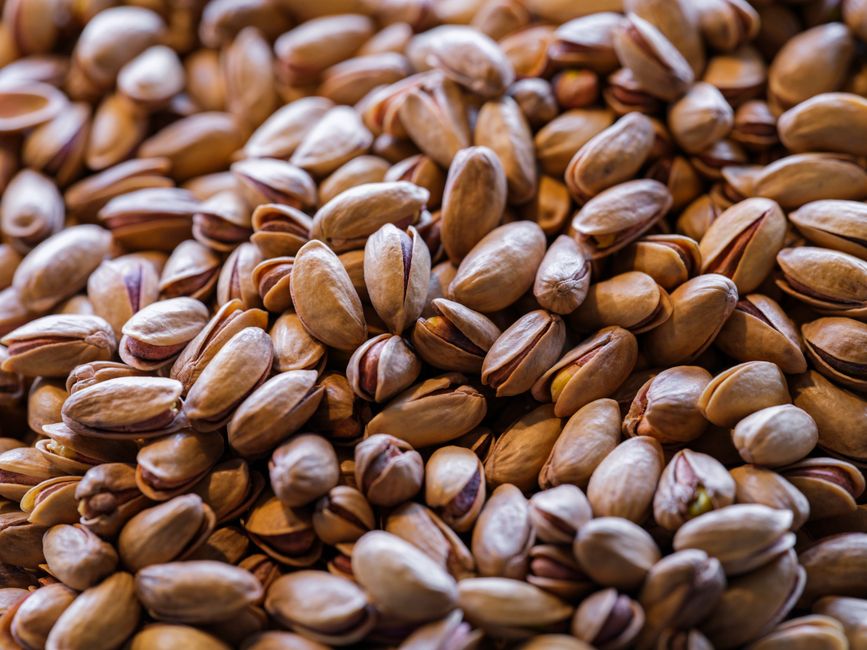
Pistachios grow on small deciduous trees — Pistacia vera — that are native to arid regions of Central Asia and the Middle East. The trees take roughly five to seven years from planting before they produce a meaningful crop, and they alternate between heavy and light harvest years. The nuts develop inside a hard shell surrounded by a fleshy hull, and the shell splits open on its own as the kernel inside matures.
How Does Pistachio Nuts Grow on a Tree?
Pistachio trees produce clusters of small, oval fruits that hang from the branches much like grapes. Each fruit is technically a drupe — a fruit with a fleshy outer layer and a hard inner shell. Inside that shell sits the green kernel most people recognize as a pistachio.
The growing cycle starts in spring with small reddish flowers. Pistachio trees are dioecious, which means male and female flowers grow on separate trees. Wind carries pollen from male trees to female trees. No bees or other insects are needed. A female tree will only produce nuts if a male tree is growing nearby.
After pollination, the fruit develops through summer. The outer hull stays soft and fleshy while the shell hardens inside it. As the kernel fills out, it presses against the shell from within. This pressure causes the shell to split along its seam — a natural process that happens while the nut is still on the tree. That distinctive split is not done by machines or roasting. It is how the tree releases a mature nut.
What the tree looks like
- Height: typically 20 to 30 feet at maturity
- Leaves: compound, with three to five leaflets, deciduous
- Lifespan: trees can live and produce for decades
- Roots: deep taproot, which helps the tree survive drought
The tree’s tolerance for heat and dry conditions is one reason commercial production is concentrated in places like California’s Central Valley, Iran, Turkey, and parts of the Mediterranean.
How Long Does It Take for a Pistachio Tree to Produce Nuts?
A pistachio tree does not produce a commercial crop quickly. Most trees begin bearing a small number of nuts around year four or five. A full, economically meaningful harvest usually arrives somewhere between year seven and year ten.
Even after the tree matures, production is not steady year to year. Pistachio trees are known for alternate bearing — a heavy crop one year tends to be followed by a lighter crop the next. The tree uses a large amount of stored energy to produce a heavy load of nuts, and it needs a recovery cycle before it can do it again. Growers manage this with pruning and nutrition, but they cannot eliminate the pattern entirely.
This slow timeline is part of why pistachios are more expensive than many other nuts. An almond tree can produce a crop within three to four years. A pistachio orchard is a long-term investment, and growers wait years before seeing a return.
What Climate and Conditions Do Pistachio Trees Need?
Pistachio trees need hot, dry summers and cool winters. They are well adapted to places with long, intense growing seasons and low humidity.
One requirement stands out: the trees need a certain amount of winter chill — hours spent at cool but not freezing temperatures — to break dormancy and flower properly in spring. Without enough chill hours, flowering is poor and the crop suffers. This is one reason pistachios are not grown widely in tropical regions.
Humidity is another limiting factor. In humid climates, a fungal disease called Botryosphaeria and related pathogens can attack the hull and cause significant crop loss. The dry air of places like central Iran or California’s interior valley reduces that pressure.
The trees are also drought tolerant once established, thanks to deep roots. But commercial orchards still need irrigation to produce a reliable crop, especially in regions with low rainfall.
Soil and water needs
Pistachios do best in well-drained soils. They are sensitive to waterlogged roots and will decline in heavy clay that holds water. Growers often plant on slopes or in sandy loam. Irrigation is typically managed carefully to avoid overwatering, which can cause root problems.




How Are Pistachios Harvested and Processed?
Harvest happens in late summer to early autumn, depending on the region. In California, the harvest typically runs from late August into September. In Iran and Turkey, it may start earlier.
Timing matters a great deal. The hull around the shell softens and turns from green to a yellowish or reddish color as the nut ripens. If harvest is delayed too long, the hull can deteriorate and stain the shell, and the risk of fungal growth rises. Growers often shake the trees mechanically to bring the nuts down onto catching frames or tarps.
Once harvested, the nuts need to be processed quickly. The fleshy hull is removed, usually within 24 hours, to prevent spoilage and staining. Then the nuts are dried to a safe moisture level for storage. After drying, they may be roasted and salted, or sold in-shell or shelled.
Some pistachios are sold with the hull and shell removed entirely — these are the green kernels used in cooking and baking. The green color comes from chlorophyll in the kernel, and it fades with age or heat exposure.
Why Are Some Pistachios Closed and Others Open?
An open shell usually means the nut matured fully on the tree. The kernel grew large enough to split the shell naturally. A closed shell often means the kernel did not fill out completely, or the nut was harvested before it fully matured.
This is different from the way some people assume it works. The split is not a sign of roasting or processing. It happens in the orchard. A closed pistachio is not necessarily bad — it may simply be an immature nut or one from a tree under stress. But in-shell pistachios sold at retail are often sorted so that mostly open ones reach the consumer, because they are easier to crack by hand.
There is a common belief that a closed shell means the nut is empty or worthless. That is not always true. A closed shell can still contain a usable kernel, though it may be smaller.
Where Are Pistachios Grown Commercially?
Pistachios are grown in a relatively small number of regions worldwide, because the trees are picky about climate. The main producing countries include Iran, the United States (mostly California), Turkey, and Syria. Other producers include Afghanistan, Greece, and parts of North Africa.
The United States entered commercial pistachio production relatively recently compared with Iran, which has grown them for centuries. California’s Central Valley now produces most of the U.S. crop. The region’s hot, dry summers and cool winters match what the trees need.
Climate change is a concern for growers in some regions. Warmer winters can reduce the chill hours trees need, and heat extremes during flowering or nut fill can affect yield. Researchers and growers are studying whether new rootstocks or shifting orchard locations can help, but the long lifespan of the trees makes adaptation slow.
Do Pistachios Grow in the Wild?
Wild pistachio species exist across parts of Central Asia and the Middle East. These are often small, tough trees that produce nuts with hard shells and small kernels. They are related to the commercial pistachio but not the same as the cultivated varieties sold in stores.
The cultivated pistachio, Pistacia vera, has been shaped by centuries of selection for larger kernels, thinner shells, and better splitting. Wild trees often have thicker shells and less reliable crops. Some wild species are used as rootstock for cultivated trees because they tolerate poor soil or drought better than the commercial variety.
What About Nutrition and Health Claims?
Pistachios are a source of protein, fiber, and unsaturated fats. According to USDA nutritional data, a one-ounce serving of dry-roasted pistachios provides about 160 calories, 6 grams of protein, and 3 grams of fiber. They also contain vitamin B6, thiamine, and potassium.
Some studies suggest that eating nuts, including pistachios, as part of a balanced diet is associated with heart health benefits. But it is important to be precise here. The evidence for specific health claims about pistachios alone — as opposed to nuts in general — is limited. No large human trial has confirmed that pistachios prevent any specific disease.
What is well established is that nuts are a nutrient-dense food and can fit into a healthy eating pattern. What is not established is that pistachios do something unique that other nuts do not. Marketing claims that pistachios “support heart health” or “help with weight management” go beyond what the evidence clearly shows.
Frequently Asked Questions
How long does it take for a pistachio tree to produce nuts?
Most pistachio trees begin producing a small crop around year four or five and reach full production between year seven and ten. Production also alternates, with a heavy year typically followed by a lighter one.
Do pistachios grow on trees or bushes?
Pistachios grow on trees, specifically Pistacia vera, which typically reaches 20 to 30 feet tall at maturity. They are not bushes or ground plants.
Why do some pistachio shells stay closed?
A closed shell usually means the kernel did not fill out enough to split the shell naturally on the tree. It is not a sign of processing or roasting.
Can you grow a pistachio tree from a store-bought nut?
It is possible but unreliable, because most store-bought pistachios are roasted and will not germinate. Raw, unroasted nuts have a better chance, but the tree still needs the right climate and years to produce.
