
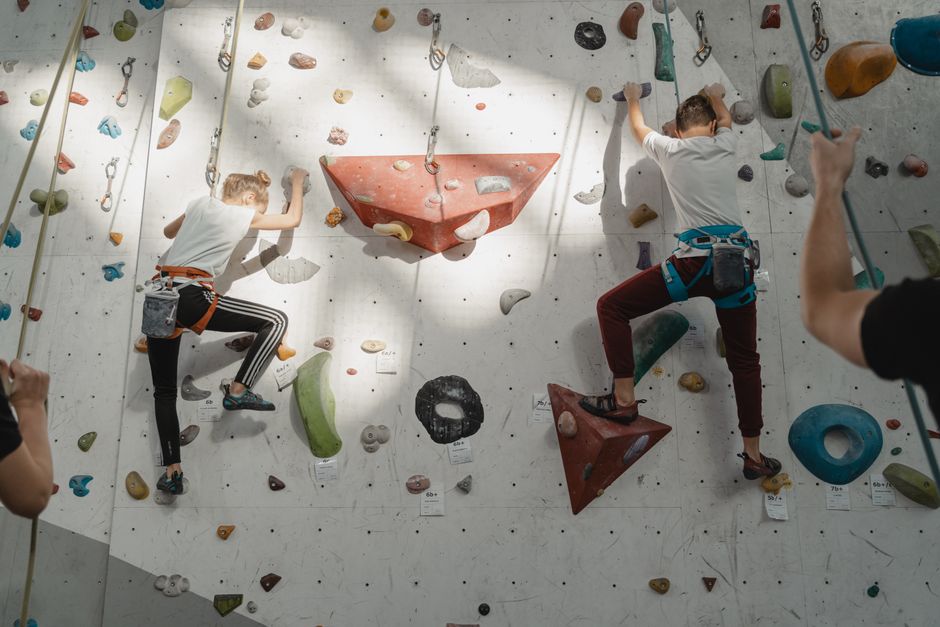
Lead climbing is a form of rock climbing where you clip your rope to protection points on the wall as you go up, rather than having a rope already anchored above you. On indoor sport routes, that protection means pre-placed metal bolts. You carry the rope up with you, clip it into quickdraws along the way, and if you fall, you drop roughly twice the distance to your last clip before the rope catches you. It is a real step up from top-rope climbing in skill and risk, and beginners should learn it through structured instruction before trying it independently.
How Does Lead Climbing Work for Beginners?
The basic mechanics are simple to understand even if the execution takes practice. The rope is tied to your harness. The other end runs through a belay device held by your partner on the ground. As you climb, you pass the rope through quickdraws — two carabiners connected by a short fabric sling — that are clipped into bolts fixed to the wall.
Each quickdraw acts as a checkpoint. The rope slides through it as you move up. Your belayer manages the rope from below, feeding slack when you need it and locking off if you fall.
The critical difference from top-rope climbing is fall distance. On top rope, the rope is already above you, so a fall is short. On lead, you are always climbing above your last clip. A fall means you drop to that clip and then some. The higher you are above your last clip, the farther you fall. That is why lead climbing demands more attention to clipping position and rope management.
Most gyms require you to pass a lead test before you can climb on their lead walls. These tests check that you can clip efficiently, manage the rope, and belay a lead climber safely. Requirements vary by gym, but the pattern is consistent: you demonstrate competence before you get access.
What Gear Do You Need to Start Lead Climbing?
You need more equipment than top-rope climbing, and some of it is specialized. The good news is that most of it lasts for years.
- Climbing harness — any harness works, but one with gear loops and a comfortable fit for hanging is better
- Climbing shoes — same as what you already use
- Chalk bag — standard
- Belay device — a tube-style device or an assisted-braking device. Some gyms require specific types for lead belaying
- Locking carabiner — for attaching your belay device to your harness
- Quickdraws — typically 12 to 18 for outdoor routes, though gyms usually have them pre-hung
- Rope — a dynamic climbing rope, typically 60 to 70 meters for most routes. Gyms usually provide ropes or have them fixed
- Personal anchor system — for outdoor climbing, used to secure yourself at the top when cleaning the route
Inside a gym, you often only need your harness, shoes, chalk, belay device, and a locking carabiner. The quickdraws and rope are usually already in place. Outdoors, you carry everything.
Do not buy gear based on a single article. Go to a climbing shop, talk to staff who climb, and if possible try before you buy. Fit matters more than brand.
What Is the Difference Between Lead Climbing and Top-Rope Climbing?
The difference comes down to where the rope is and what happens when you fall.
In top-rope climbing, a rope runs from your belayer, up to an anchor at the top of the wall, and back down to you. You are always on a tight tether from above. Falls are short and soft. The barrier to entry is low.
In lead climbing, you start with the rope at the ground. You clip as you go. If you fall before your first clip, you hit the ground — this is called a ground fall, and it is the most dangerous moment in lead climbing. After the first clip, falls get progressively longer as you move away from your last piece of protection.
Lead climbing also requires you to manage the rope while climbing. You have to find stances where you can clip safely, pull up the right amount of rope, and clip without fumbling. That multitasking is what makes lead climbing harder mentally than physically for most beginners.
Top-rope climbing is not a lesser form of the sport. It is how most people learn movement, build strength, and enjoy climbing. Lead climbing adds risk and consequence. Both are valid. Many strong climbers spend most of their time on top rope.





How Do You Learn to Lead Climb Safely?
Take a class. That is the honest answer. Lead climbing involves skills that are difficult to self-teach safely, and the consequences of getting them wrong are serious.
Most climbing gyms offer lead climbing courses. A typical course covers clipping techniques, rope management, fall practice, belaying a lead climber, and communication. Some courses run over two sessions. Others are a full day. The specifics vary by gym.
After the class, you usually need to pass a lead test at your gym. The test confirms you can clip correctly, belay safely, and handle common situations. Once you pass, you can lead climb at that gym. Other gyms may have their own tests.
If you want to climb outdoors, the learning curve is steeper. Outdoor lead climbing introduces anchor building, route finding, and self-rescue skills that gym climbing does not teach. Many people spend months or years climbing indoors before transitioning outdoors, and some take additional courses specifically for outdoor lead climbing.
One non-obvious point: falling practice is not optional. Taking falls — controlled, planned falls — is how you learn to trust the system and your belayer. Without that practice, the fear of falling can make you climb stiffly and hesitate at clips, which actually increases risk. Most lead courses include falling practice for this reason.
What Are the Main Risks of Lead Climbing?
The risks are real and worth understanding clearly before you start.
Ground falls are the most serious. If you fall before clipping your first bolt, or if you fall while clipping the second bolt from a low position, you can hit the ground. This is why many gyms and outdoor areas have specific rules about how the first few clips are handled.
Long falls happen when you are far above your last clip. The farther you are, the more distance you drop. This is not inherently dangerous if the wall is overhanging and the fall is clean, but it can lead to impact with ledges or the wall itself on less vertical terrain.
Clipping errors — back-clipping (clipping the rope so it runs backward through the carabiner) or z-clipping (clipping the rope through the wrong quickdraw in a way that traps it) — can cause the rope to fail to catch you properly or create dangerous rope drag. These are preventable with attention and practice.
Belayer error is a significant risk. A belayer who gives too much slack, stands in the wrong spot, or fails to lock off during a fall can turn a manageable fall into a serious one. This is why belay competence is tested at gyms.
Rockfall and environmental hazards are outdoor-specific concerns. Helmets are standard for outdoor climbing for this reason.
No activity that involves falling from height is risk-free. Lead climbing manages risk through skill, equipment, and judgment. It does not eliminate it.
How Long Does It Take to Learn Lead Climbing?
You can learn the basic skills in a weekend course. Most gym lead courses take one to two days. Passing a gym lead test typically happens at the end of the course or shortly after.
Being comfortable and competent takes longer. Most climbers need months of regular practice to feel solid on lead. The physical skills — clipping, rope management — come fairly quickly. The mental side — trusting falls, staying calm, making good decisions when tired — takes longer.
There is no standard timeline. It depends on how often you climb, how much you practice falling, and how much guidance you get. Some people progress quickly. Others take a year or more to feel confident. Both are normal.
If you are transitioning from top-rope climbing, you already have a foundation in movement and belaying. That helps. But lead climbing is a distinct skill set. Do not assume top-rope experience translates automatically.
Do You Need a Partner to Lead Climb?
Yes. Lead climbing requires a belayer. You cannot lead climb alone with standard equipment.
Your belayer needs to be competent at lead belaying, which is different from top-rope belaying. Lead belaying involves managing slack, moving with the climber, and giving a soft catch when the climber falls. A belayer who only knows top-rope belaying is not ready to belay a lead climber.
Many gyms have partner-finding boards or social media groups. Some gyms run belay meetups. If you do not have a regular partner, these are good places to start. Be honest about your experience level, and do not belay someone on lead until you have been trained and tested.
Communication between climber and belayer matters. Standard commands — “on belay,” “climbing,” “take,” “falling,” “off belay” — exist to reduce confusion. Learn them and use them consistently.
Frequently Asked Questions
Is lead climbing harder than top-rope climbing?
Yes, lead climbing is harder both physically and mentally. You carry the rope, clip as you go, and face longer falls, which adds difficulty that top-rope climbing does not have.
Can you lead climb indoors?
Yes, many climbing gyms have lead walls with pre-placed quickdraws. Most gyms require you to pass a lead test before you can climb or belay on these walls.
What happens if you fall while lead climbing?
You fall to your last clipped quickdraw and then some, with the distance depending on how far above that clip you were. The rope catches you, but the fall is longer than a top-rope fall.
Do you need a certification to lead climb?
No universal certification exists, but most gyms require you to pass their own lead test. For outdoor climbing, there is no formal certification requirement, though training is strongly recommended.
