
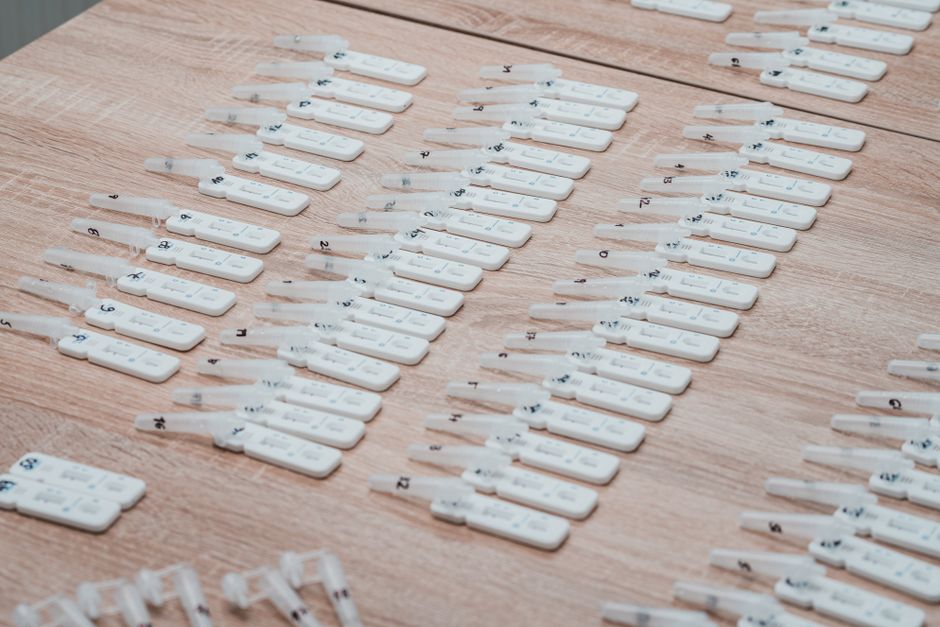
Radon is a radioactive gas that forms naturally when uranium breaks down in soil, rock, and water. You cannot see it, smell it, or taste it. A radon test works by placing a detector in your home for a set period, then sending it to a lab that measures how much radioactive decay occurred inside the device. That measurement tells you the radon concentration in the air where the detector sat.
The test itself is simple. Understanding what the results mean — and what to do next — matters more than the device you choose.
How Does A Radon Test Work, Step By Step?
Every radon test relies on the same principle: radon decays and releases alpha particles. A detector captures evidence of that decay.
When radon gas enters a testing device, it continues to decay. Alpha particles strike a special material inside the detector. That material records a tiny mark — a track, a discoloration, or an electrical signal depending on the device type. The longer the detector sits in place, the more marks accumulate.
After the testing period ends, you seal the device and mail it to a laboratory. The lab counts the marks or measures the accumulated signal. From that count, the lab calculates the average radon level in the air over the testing period. Results come back in picocuries per liter (pCi/L), the standard unit used in the United States.
One detail that surprises many people: the detector does not measure radon directly. It measures radon decay products. The lab then works backward to estimate the radon gas concentration. This is why proper handling matters. If the detector is opened, stored improperly, or exposed to extreme conditions during shipping, the measurement can be thrown off.
What Types Of Radon Test Kits And Detectors Exist?
Consumer radon tests fall into two broad categories: short-term and long-term. Each uses different detection technology, and each answers a slightly different question.
Short-Term Tests
Short-term tests stay in place anywhere from a few days to about 90 days. The most common type is the activated charcoal canister. Charcoal adsorbs radon gas from the air. At the lab, technicians heat the charcoal to release the trapped radon and measure it.
Another short-term option is the alpha track detector, which uses a plastic film that alpha particles pit as they strike it. The lab counts the pits under a microscope.
Short-term tests are inexpensive and fast. Their weakness is that radon levels fluctuate day to day and season to season. A short test captures only a snapshot.
Long-Term Tests
Long-term tests run for more than 90 days, often six to twelve months. Most use alpha track technology or electret ion chambers. Because they average across seasons, they give a more reliable picture of your year-round exposure.
If you have time, a long-term test is the better choice. It smooths out the swings caused by weather, open windows, and seasonal soil conditions.
Continuous Monitors
Electronic continuous radon monitors are available for home use. They measure radon levels in real time and display hourly readings. Some cost several hundred dollars. These devices can be useful for tracking patterns, but their accuracy varies by model. Not all consumer-grade monitors perform as well as laboratory-processed detectors. If you use one and get a high reading, confirm it with a laboratory test before making major decisions.
Where Should You Place A Radon Test?
Placement determines whether your result means anything. A detector in the wrong spot can understate or overstate your exposure.
Radon enters a home mainly through the lowest level — cracks in the foundation, sump pumps, gaps around pipes, and crawl spaces. The lowest livable level of the home is where testing matters most.
- Place the detector on the lowest level where someone regularly spends time.
- Keep it at least 20 inches above the floor.
- Keep it away from exterior walls, drafts, heat sources, and high humidity.
- Do not place it in a bathroom, kitchen, laundry room, or hallway.
- Leave it undisturbed for the full testing period.
Closed-house conditions matter for short-term tests. Windows and doors should stay closed as much as possible, except for normal entry and exit. Opening windows during a short test can dilute indoor radon and produce a falsely low result. Long-term tests are less sensitive to this because they average over many months.





How Do You Read Radon Test Results?
Radon results are reported in picocuries per liter (pCi/L). The U.S. Environmental Protection Agency has set an action level of 4 pCi/L. That is not a safety threshold — it is a level at which the EPA recommends you take action to reduce radon.
The World Health Organization recommends a lower reference level, around 2.7 pCi/L (100 Bq/m³). No level of radon exposure is considered risk-free.
| Result (pCi/L) | What It Generally Means |
|---|---|
| Below 2 | Low, but not zero risk. Retesting every few years is reasonable. |
| 2 to 4 | Consider mitigation, especially if the lowest level is used regularly. |
| 4 or above | EPA recommends action to reduce levels. |
If a short-term test returns 4 pCi/L or higher, the EPA recommends following up with either a second short-term test or a long-term test. Radon levels vary, so a single reading is not the final word. Two elevated readings are a stronger signal.
Radon is measured in picocuries per liter in the U.S. Other countries use becquerels per cubic meter (Bq/m³). One pCi/L equals 37 Bq/m³. If you see a result in Bq/m³, convert before comparing it to U.S. guidance.
What Affects The Accuracy Of A Radon Test?
Test accuracy depends on both the device and how you handle it. Laboratory-processed detectors are calibrated and generally reliable when used correctly. Problems usually come from the testing conditions, not the technology.
Common issues that skew results:
- Testing during unusual weather, like a stretch of high winds or heavy rain
- Placing the detector in a room with drafts or direct sunlight
- Opening windows during a short-term test
- Disturbing or opening the sealed detector before the lab receives it
- Testing for too short a period during a season with naturally low radon
Radon levels tend to be higher in winter in many homes. That is because the stack effect — warm indoor air rising and escaping through the upper levels — pulls more soil gas into the home when the ground is cold and the house is closed up. A test run in summer with windows open may read lower than your actual winter exposure.
This is one reason long-term testing is more dependable. It captures the full range of conditions your home actually experiences.
Do You Need A Professional Radon Test?
You can test your own home with a kit from a hardware store or online retailer. Many kits cost under $30 and include laboratory analysis and return shipping. That approach works well for most homeowners.
Professional testing makes sense in certain situations. If you are buying or selling a home, a certified radon professional can test as part of the transaction. Some states require disclosure of radon results during real estate sales. A trained tester follows standardized protocols that reduce the chance of placement errors.
If you want a professional, look for someone certified by the National Radon Proficiency Program or the National Radon Safety Board. These are the two main certification bodies in the U.S. A certified mitigator can also install a radon reduction system if your results call for one. These systems typically use a vent pipe and fan to draw soil gas from beneath the foundation and exhaust it above the roofline.
Testing is not a one-time event. Radon levels can change after home renovations, foundation work, or changes in soil conditions. Retesting every two to five years is a reasonable practice, and sooner if you make significant changes to the home’s structure or ventilation.
What Should You Do After Getting Your Results?
If your result is below 2 pCi/L, your exposure is relatively low. Keep the report. Retest periodically.
If your result is between 2 and 4 pCi/L, consider mitigation, particularly if you spend significant time on the lowest level. The decision involves weighing your result against how much time you actually spend in that space.
If your result is 4 pCi/L or higher, the EPA recommends taking action. Start by confirming the result with a follow-up test. Then contact a certified radon mitigator to evaluate your home. Mitigation systems are a well-established approach to reducing indoor radon, and they can lower levels substantially. The exact reduction depends on the home and the system design.
Radon is the second leading cause of lung cancer in the United States, after smoking. For people who smoke, the combined risk of radon and tobacco is considerably higher than either alone. Testing is the only way to know your level. The test is inexpensive, the process is straightforward, and the result gives you information you can act on.
Frequently Asked Questions
How long does a radon test take?
Short-term tests run from a few days up to 90 days, while long-term tests run longer than 90 days. A long-term test of six months or more gives the most reliable average.
Can I test for radon myself?
Yes. Do-it-yourself kits are widely available and include laboratory analysis. Follow the placement and closed-house instructions carefully to get an accurate result.
What radon level is considered safe?
No level of radon is considered completely risk-free. The EPA action level is 4 pCi/L, and the World Health Organization recommends a reference level around 2.7 pCi/L.
Does opening windows lower radon test results?
Yes. Opening windows during a short-term test can dilute indoor radon and produce a falsely low reading. Keep windows and doors closed as much as possible during the test period.
