
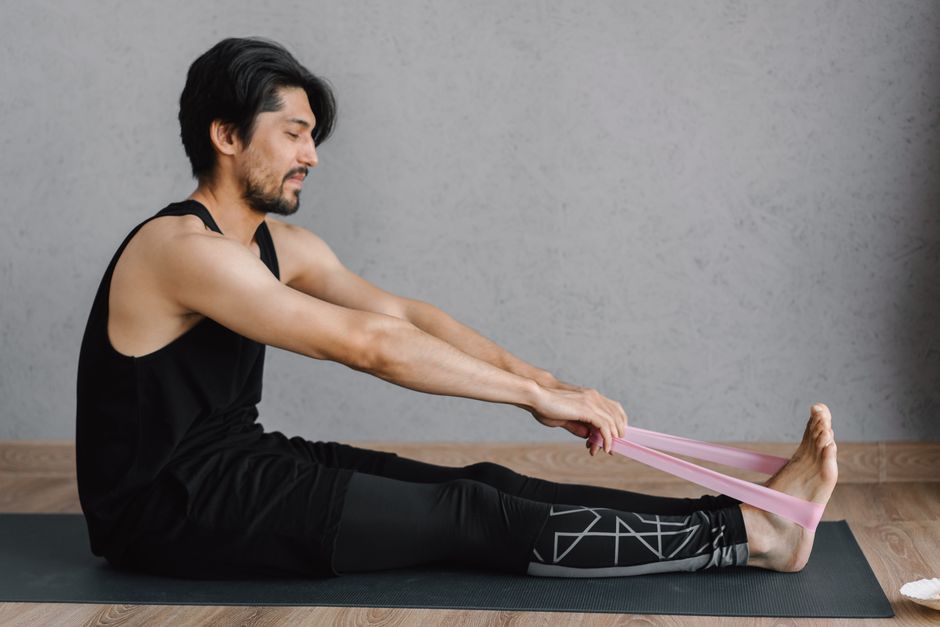
To stretch your IT band, you actually stretch the muscles and tissues attached to it, because the IT band itself is a thick, inelastic band of connective tissue that does not lengthen much. The most effective approach combines targeted stretches for the glutes, hips, and outer thigh with foam rolling and strengthening exercises. A classic standing stretch involves crossing one leg behind the other, leaning toward the opposite side, and pushing your hip out to feel a stretch along the outside of your leg.
What Exactly Is The IT Band?
The iliotibial (IT) band is a long, thick band of fascia that runs down the outside of your thigh. It starts at your hip, attaches to a muscle called the tensor fasciae latae (TFL), and connects to the top of your shinbone just below the knee.
Think of it like a strong rope or a thick piece of elastic that does not stretch much. Because it is so rigid, the goal of stretching is not to make the band itself longer. Instead, you target the muscles around it — especially the glutes, TFL, and hip muscles — to reduce tension on the band.
How Do You Stretch The IT Band Properly?
The most common and effective way to stretch the IT band area is the standing IT band stretch. Here is how to do it correctly:
- Stand upright with your feet together.
- Cross your right leg behind your left leg.
- Reach your right arm overhead and lean your torso to the left.
- Push your right hip out to the side until you feel a stretch along the outside of your right leg.
- Hold for 20 to 30 seconds.
- Switch sides and repeat.
You should feel a strong but comfortable stretch. If you feel sharp pain, stop and adjust your position. The stretch should never hurt.
Another effective option is the seated figure-four stretch. Sit on the floor with your legs extended. Cross your right ankle over your left knee, then gently lean forward. This targets the glutes, which are often the real source of IT band tightness.
Why Stretching Alone Often Does Not Fix IT Band Pain
Research consistently shows that stretching alone rarely resolves IT band syndrome. The condition is usually caused by weakness in the hip and glute muscles, not just tightness.
When your glutes are weak, other muscles like the TFL have to work harder. The TFL attaches directly to the IT band. When it overworks, it pulls on the band and creates friction at the knee.
So the real fix is often strengthening, not just stretching. Exercises like side-lying leg lifts, clamshells, and hip bridges target the gluteus medius and maximus. These exercises help take the load off the IT band.
Some studies suggest that combining stretching with strengthening produces better results than stretching alone. If you only stretch and never strengthen, you may not see lasting improvement.





Foam Rolling: Does It Actually Help?
Foam rolling the IT band is extremely popular. Many people roll the outside of their thigh and feel immediate relief. But the evidence is mixed on whether this actually changes the tissue.
Some research suggests that foam rolling can temporarily reduce pain and improve range of motion. However, the IT band itself is too thick and tough for a foam roller to change its structure. What you are likely feeling is pressure on the underlying muscles and fascia.
If foam rolling feels good, there is no harm in doing it. But do not expect it to be a cure. Use it as a warm-up before stretching or exercise, not as your only treatment.
When you foam roll, focus on the muscles around the band — the glutes, TFL, and quadriceps — rather than rolling directly on the band itself. This is often more effective and less painful.
What Causes IT Band Tightness In The First Place?
IT band tightness usually develops from repetitive motion. Runners, cyclists, and people who do lots of squatting or lunging are most at risk.
Common contributing factors include:
- Sudden increases in training intensity or distance
- Running on banked surfaces or always running in the same direction on a track
- Weak hip abductor muscles
- Poor footwear or worn-out shoes
- Muscle imbalances between the quadriceps and hamstrings
Addressing the cause matters more than the stretch itself. If you keep doing the same activity that caused the tightness, stretching will only provide temporary relief.
How Often Should You Stretch?
For general tightness, stretching the IT band area two to three times per day is reasonable. Hold each stretch for 20 to 30 seconds and repeat two to three times per side.
If you are preparing for exercise, a dynamic warm-up may be more useful than static stretching. Leg swings, walking lunges, and hip circles prepare the muscles for activity without overstretching cold tissue.
Static stretching is best done after exercise or as a separate session. Stretching a cold muscle can increase injury risk, so warm up first with light activity like walking or jogging for five minutes.
When Stretching Is Not Enough: Other Treatment Options
If you have tried stretching and strengthening for several weeks without improvement, consider other options. A physical therapist can assess your movement patterns and identify specific weaknesses.
Some clinicians recommend massage therapy or dry needling for IT band syndrome. The evidence for these treatments is limited, but some people report benefit. No large human trials have confirmed that these treatments cure IT band syndrome.
Anti-inflammatory medications like ibuprofen can reduce pain in the short term, but they do not address the underlying cause. Use them sparingly and only as directed.
In rare cases, surgery is considered for IT band syndrome that does not respond to conservative treatment. This is uncommon and only recommended after months of failed therapy.
How Long Does It Take To See Improvement?
Most people notice some improvement within two to four weeks of consistent stretching and strengthening. Full recovery from IT band syndrome can take six to eight weeks or longer.
Return to high-impact activities gradually. If you are a runner, reduce your mileage and avoid hills until pain subsides. Increasing activity too quickly is one of the most common reasons people relapse.
Listen to your body. Mild discomfort during exercise is common, but sharp or worsening pain means you need to back off.
Can You Prevent IT Band Tightness?
Yes, prevention is largely about maintaining balanced strength and avoiding sudden spikes in activity. Incorporate hip and glute strengthening into your routine two to three times per week.
Replace worn-out shoes regularly. For runners, this typically means every 300 to 500 miles, but the exact number depends on your body weight, running style, and surface.
Vary your training surfaces when possible. Running on flat, even ground is gentler on the IT band than constant hills or banked tracks.
Finally, do not ignore early warning signs. If you feel a twinge on the outside of your knee during activity, address it early with stretching and strengthening before it becomes a full injury.
Frequently Asked Questions
Can you actually stretch the IT band itself?
No, the IT band is too thick and rigid to lengthen significantly. You stretch the surrounding muscles like the glutes and TFL to reduce tension on the band.
How long should you hold an IT band stretch?
Hold each stretch for 20 to 30 seconds and repeat two to three times per side. Never bounce or force the stretch.
Is foam rolling better than stretching for IT band pain?
Neither is clearly better, and combining both is common. Foam rolling provides temporary relief, but strengthening the hips and glutes is the most evidence-backed approach.
Should you stretch a painful IT band?
Mild stretching is fine, but stop if you feel sharp pain. Pain during stretching can indicate inflammation that needs rest rather than more stretching.
