
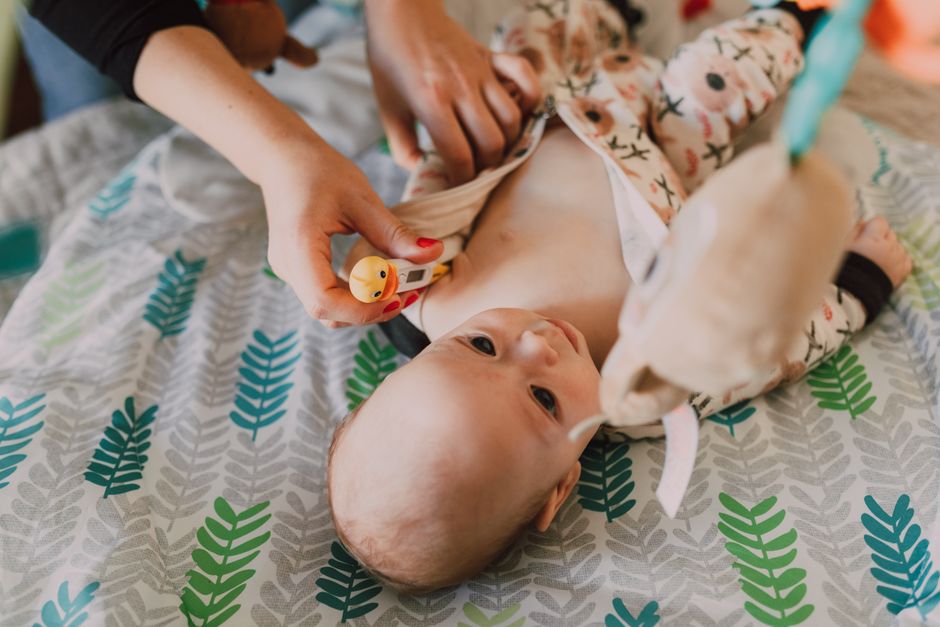
Newborn jaundice is common, and most cases are harmless. But the best way to prevent it from becoming dangerous is to make sure your baby feeds well and often in the first days of life. Frequent feeding helps babies pass stool, which removes bilirubin from the body. This is the single most effective prevention strategy available.
What Causes Newborn Jaundice?
Jaundice happens when a baby’s blood has too much bilirubin. Bilirubin is a yellow pigment produced when red blood cells break down. Newborns produce more bilirubin than older children and adults because they have more red blood cells, and those cells break down faster.
Normally, the liver filters bilirubin out of the blood and sends it into the intestines. The body then gets rid of it through stool. A newborn’s liver is immature. It cannot process bilirubin quickly enough in those first few days. This is why up to 60 percent of full-term newborns develop some degree of jaundice.
This type is called physiological jaundice. It usually appears on the second or third day of life and resolves within one to two weeks.
How Do You Prevent Jaundice In Newborns?
The most reliable way to prevent significant jaundice is to ensure your baby is feeding adequately from birth. Breastfed babies should nurse 8 to 12 times per day in the first week. Formula-fed babies typically need 1 to 2 ounces every 2 to 3 hours.
Feeding does two important things. First, it provides calories and hydration. Second, it stimulates the digestive system to produce stool. Bilirubin leaves the body through stool, so more feeding means more stool and more bilirubin removed.
If a baby is sleepy and does not wake to feed, parents should wake them. A baby who is not feeding well may need to be seen by a pediatrician. Some sleepy babies need help with feeding, and occasionally a baby needs a short hospital stay for observation.
No vitamin, supplement, or home remedy has been shown to prevent jaundice. Sunlight exposure is not recommended as a treatment or prevention method because it is unreliable and can cause sunburn. Phototherapy is a medical treatment, not a prevention tool.
Who Is at Higher Risk for Jaundice?
Some babies are more likely to develop jaundice that needs treatment. Knowing these risk factors helps parents and doctors monitor more closely.
- Premature birth: Babies born before 37 weeks have livers that are even less mature.
- Bruising during birth: A difficult delivery can cause extra red blood cell breakdown.
- Blood type incompatibility: If the mother’s blood type differs from the baby’s, the baby’s red blood cells may break down faster.
- Poor feeding: Babies who do not feed well produce less stool and retain more bilirubin.
- A sibling with jaundice: A family history of significant jaundice increases the chance it will happen again.
- East Asian or Mediterranean ancestry: Some studies show these groups have higher rates of jaundice.
If any of these risk factors apply, the pediatrician may check bilirubin levels earlier or more often. This is not a reason to panic. It is a reason to be watchful.



How Is Jaundice Detected?
Jaundice first appears as a yellow tint on the face. It then spreads downward to the chest, abdomen, and legs. The yellowing is easiest to see in natural light. Pressing gently on the skin can help reveal the color.
The most accurate way to check is a bilirubin test. A small handheld device called a transcutaneous bilirubinometer can measure bilirubin through the skin without a needle. If the number is high, a blood test may be ordered to confirm the exact level.
It is important to understand that visible jaundice is not a reliable indicator of severity. Some babies look very yellow but have safe bilirubin levels. Others look only mildly yellow but have levels that need treatment. This is why pediatricians rely on measurements, not just appearance.
When Does Jaundice Become Dangerous?
Jaundice becomes a concern when bilirubin levels climb high enough to enter brain tissue. This condition is called acute bilirubin encephalopathy. If it is not treated, it can cause permanent neurological damage known as kernicterus.
Kernicterus is rare. It affects approximately 1 in 10,000 to 1 in 30,000 newborns. But it is preventable, which is why monitoring matters.
Parents should contact a doctor immediately if their baby shows any of these signs:
- Jaundice spreading to the arms or legs
- Extreme sleepiness or difficulty waking for feeds
- A high-pitched cry
- Poor sucking or feeding
- Arched back with neck extended backward
- Fever
These symptoms can indicate that bilirubin levels are rising too fast. Do not wait to see if they improve. Call your pediatrician or go to urgent care.
What Treatment Looks Like If Jaundice Develops
If bilirubin levels reach a certain threshold, treatment begins. Phototherapy is the standard treatment. The baby lies under special blue lights with their eyes covered. The light breaks down bilirubin in the skin so the body can excrete it more easily.
Phototherapy is safe and effective. It is used routinely in hospitals and sometimes at home with a special light blanket. The treatment usually lasts one to two days.
In rare, severe cases, an exchange transfusion is needed. This procedure replaces the baby’s blood with donor blood to rapidly lower bilirubin levels. It is reserved for the most extreme situations and is performed in a neonatal intensive care unit.
More feeding is almost always part of treatment. If a breastfed baby needs phototherapy, the mother is encouraged to keep breastfeeding or pumping. Some babies need supplemental formula temporarily if they are not feeding well. This is a medical decision made with the pediatrician, not a judgment on breastfeeding.
Can Jaundice Be Prevented Entirely?
No. Physiological jaundice cannot be completely prevented because it is a normal part of newborn development. The goal is not to eliminate jaundice but to keep bilirubin levels from reaching dangerous heights.
Frequent feeding is the only prevention strategy with strong evidence behind it. Other approaches, such as giving water or glucose water, are not recommended and can actually make jaundice worse by reducing formula or breast milk intake.
Parents should trust their pediatrician’s monitoring schedule. Many babies have their bilirubin checked before leaving the hospital and again within a few days. These checks catch problems early, when treatment is simple and effective.
Frequently Asked Questions
How long does newborn jaundice last?
Physiological jaundice usually appears on day two or three and resolves within one to two weeks. If jaundice lasts longer than two weeks in a full-term baby, the pediatrician should investigate other causes.
Should I stop breastfeeding if my baby has jaundice?
No. Breastfeeding should continue even when a baby has jaundice. In rare cases, a doctor may recommend supplementing with formula temporarily, but this is a medical decision made case by case.
Can I prevent jaundice by giving my baby water?
No. Giving water or glucose water is not recommended and can interfere with feeding. It does not lower bilirubin levels and may cause other problems.
What bilirubin level requires treatment?
Treatment thresholds depend on the baby’s age in hours, weight, and whether they were born full-term or premature. A pediatrician uses a standardized chart to determine when phototherapy is needed. There is no single number that applies to all babies.
