
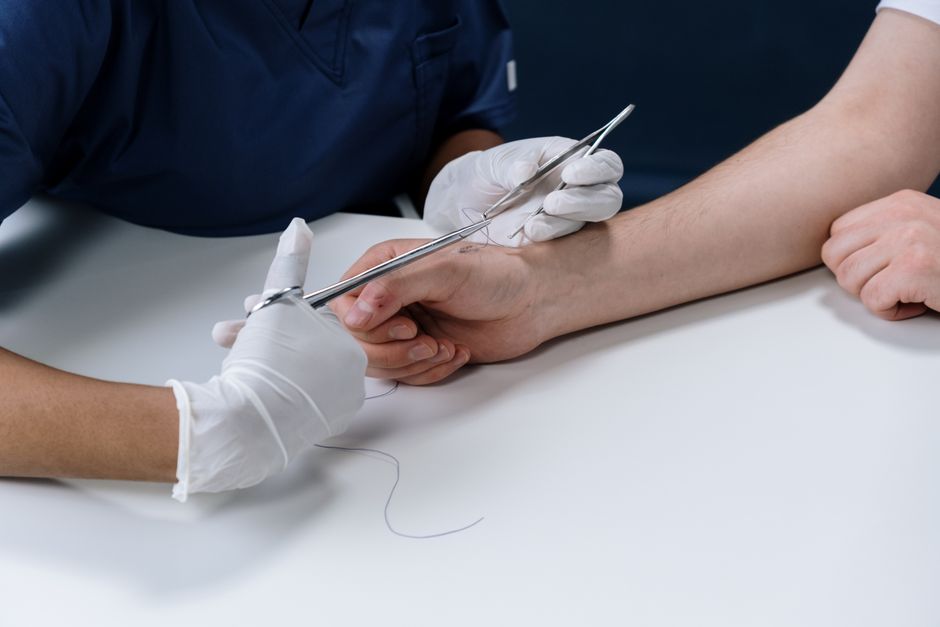
Vicryl sutures are made of a synthetic polymer that the body breaks down on its own, so no stitch removal is needed. They hold wound edges together while collagen rebuilds the tissue underneath, then they dissolve through a process called hydrolysis. That means water in your tissues gradually breaks the material apart, and the pieces are absorbed and cleared away. The timing matters: the suture has to stay strong long enough for the wound to gain its own strength, but not so long that it becomes a problem.
What Are Vicryl Sutures Made Of?
Vicryl is a brand name for a suture material called polyglactin 910. It is a copolymer — a chain built from two related molecules, glycolide and lactide, joined in a fixed ratio. This is a synthetic absorbable suture, meaning it is made in a lab, not from animal tissue, and your body eventually eliminates it.
The material is braided rather than a single strand. Braiding gives it good handling and knot security, but it also creates tiny spaces between the fibers. That texture is one reason some surgeons prefer a different material in certain situations, which we will get to below.
Polyglactin 910 is one of several absorbable options. Plain surgical gut and chromic gut are older biological absorbables. Poliglecaprone 25 and polydioxanone are other synthetic absorbables with different strength and absorption profiles. Each has trade-offs in how long it holds and how quickly it disappears.
How Do Vicryl Sutures Work In The Healing Process?
They work by holding the wound closed during the early phase of healing, when the tissue has almost no strength of its own, and then dissolving as that strength returns. The suture is essentially a temporary scaffold.
When tissue is cut, the body cannot instantly glue it back together. It takes days for new collagen to be laid down and weeks for that collagen to organize and cross-link into something strong. During that window, the wound edges need mechanical support. That is the suture’s job.
Two timelines run in parallel, and the whole design depends on them overlapping correctly:
- The suture loses strength over time. Polyglactin 910 is absorbed by hydrolysis, and its breaking strength declines steadily.
- The tissue gains strength over time. Collagen deposition and remodeling gradually make the wound self-supporting.
As long as the first timeline is slower than the second, the wound stays closed. Absorption is not the same as loss of strength, though. A suture can still be visibly present while it has already lost most of its holding power, and that distinction matters when clinicians choose a material.
Hydrolysis is worth understanding because it explains a lot. Unlike some older absorbable sutures that the body breaks down with enzymes, polyglactin 910 is degraded by water. Water attacks the polymer chains, splitting them into smaller fragments. Those fragments are eventually metabolized and cleared. Because this is a chemical process driven by water, it happens at a fairly predictable rate — which is why manufacturers can give general absorption timelines.
How Long Do Vicryl Sutures Take To Dissolve?
Polyglactin 910 loses most of its tensile strength within a few weeks and is largely absorbed over a period of roughly two to three months. These figures come from the manufacturer’s material data and are widely cited in surgical references.
Two things are happening on different clocks, and people often conflate them:
- Strength loss happens first. The suture stops providing meaningful support well before it disappears.
- Mass absorption happens later. The material is still physically there, breaking down, after it has stopped doing mechanical work.
So if you can still see or feel a stitch at week five, that does not mean it is still holding your wound together. It means the material has not fully cleared yet.
There is also a variant called Vicryl Rapide, which is treated to absorb faster. It is used in situations where the suture only needs to hold briefly — superficial skin closures, for example. It is not interchangeable with standard polyglactin 910, and the timelines are different.
Individual absorption can vary with the tissue involved, blood supply, and how much suture was used. The manufacturer timelines are general guides, not guarantees for a specific wound.




Where Are Vicryl Sutures Used?
They are used in a wide range of soft tissue closures where a surgeon wants the suture to disappear on its own. Common settings include:
- Deep layers of a surgical incision, where the suture is buried under the skin
- Muscle and fascia repair in some procedures
- Obstetric and gynecologic surgery, including perineal repair after childbirth
- Gastrointestinal and other internal soft tissue closures
- Some dental and oral surgery
Surgeons often use a layered closure. A strong, slowly absorbing suture holds the deep structural layer, while a finer absorbable suture closes the surface. This spreads the mechanical load and lets each layer heal on its own schedule.
The choice of suture is not automatic. Blood supply, tissue type, expected healing speed, infection risk, and cosmetic goals all influence it. A material that works well in one location may be a poor fit in another.
Why Do Some Wounds Get Vicryl and Others Don’t?
Absorbable sutures are not always the right answer. The decision comes down to how much strength the wound needs, for how long, and whether the suture itself could cause problems.
Non-absorbable sutures like nylon or polypropylene are used when a wound needs prolonged support or when the suture will be removed later. Skin staples and adhesive strips are options for certain surface closures. Each has a different balance of strength, handling, and removal needs.
One practical trade-off with braided absorbables is that the braided texture can harbor bacteria more readily than a smooth monofilament. This is a recognized consideration, and it is one reason some surgeons choose a monofilament absorbable suture in wounds with higher infection risk. That does not mean Vicryl causes infections — it means material choice is one factor among many in surgical decision-making.
Another consideration is tissue reaction. All sutures provoke some inflammatory response as part of normal healing. Absorbable materials are designed so that this response resolves as the material clears.
What Does Normal Healing Look Like After Vicryl Sutures?
Some redness, mild swelling, and a bit of tenderness around a fresh closure are expected in the first days. This is ordinary inflammation, part of how the body starts repairing tissue. It should ease over time, not worsen.
Signs that warrant prompt medical attention include:
- Increasing pain, redness, or swelling rather than improving
- Fever
- Pus or foul-smelling drainage
- Wound edges pulling apart
- Red streaks spreading from the wound
These can indicate infection or wound breakdown, and they need clinical evaluation. Do not wait to see if they resolve on their own.
Because Vicryl dissolves, there is usually nothing to remove. Occasionally a stitch works its way to the surface, or a small piece is visible as the material breaks down. If that happens, it is generally not an emergency, but it is reasonable to have a clinician look at it rather than pulling on it yourself.
Follow whatever wound care instructions you were given. Those instructions are specific to your procedure, your tissue, and your health history — general advice online cannot replace them.
Does Dissolving Mean the Wound Is Fully Healed?
No. Absorption of the suture and full healing of the wound are two separate events, and the suture usually finishes dissolving before the tissue has regained anything close to its original strength.
Scar tissue matures over a much longer period than the suture lasts. Collagen continues to remodel, reorganize, and cross-link for months after the wound looks closed. During that time the tissue is functional but not as strong as uninjured tissue.
This is why a wound can look healed while still being vulnerable. It is also why activity restrictions after surgery often extend well past the point where the sutures have dissolved. The restriction is about the tissue, not the stitch.
Understanding this distinction helps set realistic expectations. A closed wound is not a finished wound.
Frequently Asked Questions
How long do Vicryl sutures take to dissolve?
Polyglactin 910 loses most of its strength within a few weeks and is largely absorbed over roughly two to three months, based on manufacturer data. Individual timing can vary with the tissue and the wound.
Do Vicryl sutures need to be removed?
No, they are absorbable and dissolve on their own, so removal is not normally required. Occasionally a piece may surface as it breaks down, which a clinician can check.
Can you feel Vicryl sutures dissolving?
Most people do not feel the absorption process itself. Some notice mild irritation or a small bump near the closure, and any increasing pain, redness, or drainage should be evaluated.
Are Vicryl sutures safe for internal use?
Yes, they are widely used in internal soft tissue closures and buried layers, and this is an established surgical practice. Suitability for a specific procedure is a decision made by the surgeon based on the tissue and healing demands.
