
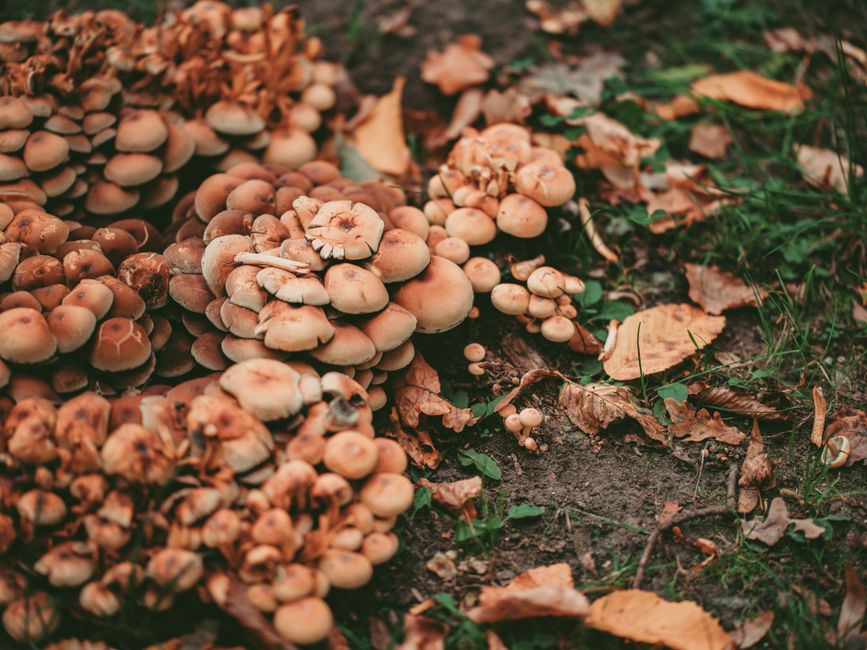
Fungi are the quiet giants of the natural world. While most people think of mushrooms on a pizza or mold on forgotten leftovers, fungi do far more than that. They are essential to life on Earth. Fungi break down dead material, feed plants, and even help clean up pollution. Without fungi, ecosystems would collapse. Soil would stop forming, plants would starve, and dead trees would pile up for centuries. These organisms are not just part of the environment — they hold it together.
How Do Fungi Help The Environment?
Fungi are nature’s recyclers. They release enzymes that break down dead plants and animals into simple nutrients. Those nutrients return to the soil, where new plants use them to grow. This process is called decomposition, and fungi are the most important organisms doing it. Bacteria also decompose matter, but fungi can break down tougher materials like wood and bark that bacteria cannot handle. Wood contains lignin, a complex compound that gives trees their strength. Only fungi can efficiently break lignin down. Without them, fallen forests would not rot away. The carbon locked inside dead wood would stay trapped, and new soil would never form.
Fungi also form partnerships with plant roots. About 90 percent of all plant species rely on this relationship. The fungus attaches to the roots and spreads its thread-like body through the soil. It absorbs water and minerals — especially phosphorus and nitrogen — that the plant’s own roots cannot reach. In return, the plant gives the fungus sugars it makes through photosynthesis. This exchange is called mycorrhizal association. It is not a minor benefit. It is how most plants on Earth survive. Research consistently shows that plants connected to these fungi grow larger, resist drought better, and survive poor soil conditions that would otherwise kill them.
What Do Fungi Do For The Soil?
Fungi physically change soil structure. Their thread-like networks, called hyphae, weave through the dirt and bind particles together. This creates stable clumps that hold water and air. Healthy soil needs these clumps. They allow roots to penetrate deeply and let oxygen reach soil organisms. Soil with active fungal networks absorbs rainwater more effectively and resists erosion. When heavy rain falls, soil held together by fungal threads stays put. Bare soil without fungi washes away.
Fungal networks also act like underground highways for nutrients. A single network can stretch for miles and connect many different plants. Nutrients move through this network from one plant to another. A dying tree can pass its stored nutrients to a young sapling through the shared fungal connection. This is not speculation. It has been demonstrated in controlled studies using isotope tracers. Carbon from one plant has been detected in neighboring plants connected by the same fungal network. Some researchers describe forests as superorganisms because of these connections, though that description is more poetic than strictly scientific. What is certain is that the network moves resources where they are needed.
Can Fungi Break Down Pollution?
Yes, and this is one of the most promising areas of environmental science. Some fungi can break down toxic pollutants that persist in soil and water. This process is called mycoremediation. The fungi secrete enzymes that dismantle complex pollutant molecules into less harmful forms. Petroleum products, certain pesticides, and some industrial chemicals have all been shown to degrade in the presence of specific fungi. Oyster mushrooms, for example, have been used experimentally to break down diesel-contaminated soil. The fungi digest the hydrocarbon chains, converting them into fungal biomass and carbon dioxide.
The evidence here is real but still developing. Laboratory studies show strong results. Field applications are more variable because soil conditions, competing organisms, and pollutant mixtures all affect how well the fungi perform. Some contaminated sites have been successfully treated with fungi. Others have shown partial results. This is not a miracle solution, but it is a genuine tool with demonstrated potential. Researchers are actively working to identify which fungal species degrade which pollutants most efficiently and how to scale these processes for real-world cleanup projects.





How Do Fungi Support Other Organisms?
Fungi are food for countless species. Insects, slugs, rodents, deer, and even some primates eat mushrooms and other fungal bodies. The fungal networks in soil are consumed by microscopic animals called nematodes and by springtails, which are tiny arthropods. These animals are then eaten by larger predators, passing the energy up the food chain. A forest without fungi would be a forest without much of its animal life.
Fungi also provide habitat. Some insects lay eggs inside mushrooms. Beetles bore into bracket fungi growing on tree trunks. Small mammals nest in the hollowed-out remains of trees that fungi have softened and decayed. The cavities that woodpeckers use for nesting are often carved into wood that has already been weakened by fungal decay. The fungi do not create the cavities themselves, but they make the wood soft enough for the birds to excavate. This is a chain of dependence that runs through the entire forest ecosystem.
What Is The Role Of Fungi In The Carbon Cycle?
Fungi are central to the global carbon cycle. When they decompose dead material, they release carbon dioxide back into the atmosphere. But they also store carbon. Fungal networks in soil hold enormous amounts of carbon in their cell walls. These walls contain chitin, a tough substance that resists breakdown. When fungi die, much of their body remains in the soil instead of decomposing immediately. This means carbon captured by plants stays locked in the ground for years rather than returning to the air quickly.
This matters for climate discussions. Soil holds more carbon than all plants and the atmosphere combined. Fungi are a major reason why. Some research suggests that fungal networks in soil store billions of tons of carbon globally. When land is cleared or tilled, these networks are destroyed, and the stored carbon escapes as carbon dioxide. Protecting fungal networks is therefore connected to protecting the climate, though the full scale of this effect is still being studied. The mechanism is clear. The magnitude requires more research.
Do Fungi Help Plants Survive Drought?
Evidence indicates that they do. Mycorrhizal fungi extend far beyond plant roots, reaching water in soil pores that roots cannot access. The fungal threads are much thinner than roots, so they can penetrate tiny spaces and extract moisture. They also produce a protein called glomalin, which helps soil hold water. Research shows that plants with strong fungal connections survive dry periods better than plants without them. This is one reason why restoring soil fungi is part of some agricultural drought-management strategies.
This does not mean fungi can save a crop during severe drought. They cannot create water that does not exist. But they improve the plant’s ability to access available moisture and maintain health under moderate stress. In practical terms, fields with healthy fungal populations may need less irrigation and withstand dry spells longer than fields with depleted fungal communities.
Frequently Asked Questions
Are all fungi good for the environment?
No. Some fungi cause diseases in plants and animals, including humans. But the vast majority of fungal species are harmless or beneficial, and the ecological services they provide are irreplaceable.
Can fungi help fight climate change?
They can help by storing carbon in soil, but they are not a substitute for reducing emissions. Protecting soil fungi keeps carbon locked underground where it contributes less to warming.
How long do fungal networks live?
Some individual fungi can live for decades or even centuries. The largest known organism on Earth is a honey fungus in Oregon estimated to be thousands of years old and spanning several square miles.
Do fungi work in gardens the same way they work in forests?
Yes, the same principles apply. Garden soil with active fungal networks holds water better, supplies nutrients to plants, and supports healthier growth. Adding compost and avoiding excessive tilling helps maintain these networks.
