
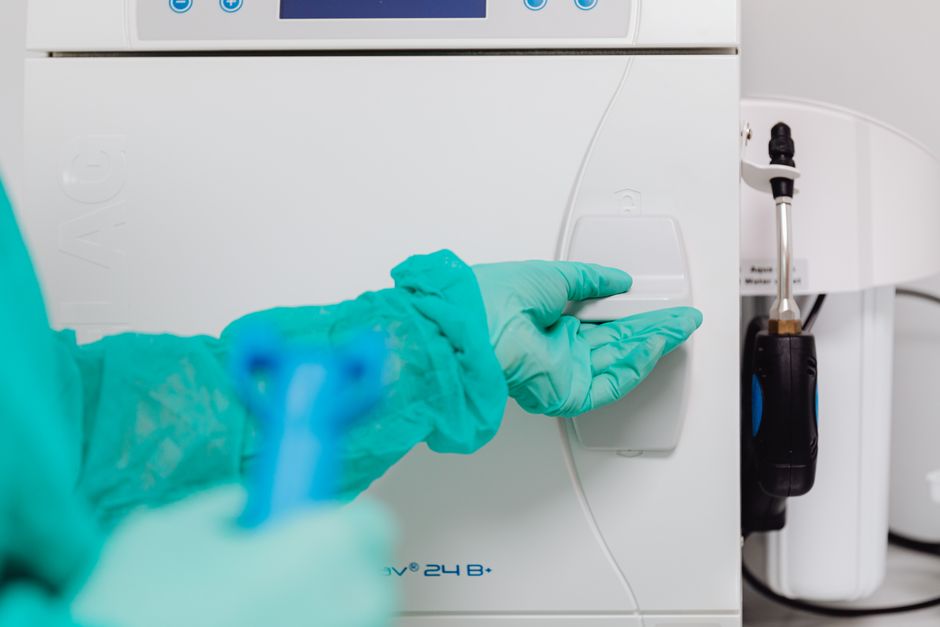
An autoclave sterilizes equipment by removing all air from its chamber, then filling it with saturated steam under pressure. The pressure raises the steam temperature well above the normal boiling point of water, and that hot, moisture-rich steam transfers heat into every surface it touches. Microorganisms die when they stay at the target temperature long enough, so pressure, time, and steam contact work together as one system.
That combination is why an autoclave is not just a fancy pressure cooker. Each of the three factors can fail on its own. When one does, sterilization does not happen even if the machine completes its cycle and the light turns green.
How Do Autoclaves Sterilize Steam Pressure Time?
Sterilization depends on saturated steam contacting every surface at a high enough temperature for a long enough time. Pressure is the tool that makes the high temperature possible.
Water normally boils at 100°C (212°F) at sea level. Raise the pressure inside a sealed chamber and water boils at a higher temperature. At roughly 15 pounds per square inch above atmospheric pressure, saturated steam reaches about 121°C (250°F). At around 27 pounds per square inch, it reaches about 132°C (270°F). These are the two temperature and pressure pairs most commonly used in healthcare and laboratory settings.
Heat kills microbes by damaging proteins and other essential molecules. Moist heat does this far more efficiently than dry heat, because water helps carry heat into cells and disrupts their structures. This is why steam at 121°C sterilizes in a fraction of the time dry heat at the same temperature would need.
Time is the third variable. The clock only counts once the load has actually reached the target temperature throughout. A cycle’s total length includes air removal, heating, the sterilization hold, and cooling. The part that matters for killing organisms is the hold time at temperature.
Why Must All Air Be Removed Before Sterilization?
Air is the most common reason an autoclave cycle fails. Steam and air cannot occupy the same space, and trapped air creates cool pockets that never reach the target temperature.
If a hollow instrument, a wrapped pack, or a dense load holds air, steam cannot penetrate that space. The chamber’s temperature sensor may read correctly because it measures steam in the open space, not the air pocket inside the load. The machine finishes its cycle, the indicator passes, and the item is still contaminated.
This is why autoclaves use one of two air removal methods:
- Gravity displacement: Steam enters at the top and pushes air out through a drain at the bottom. Air is heavier than steam, so it falls out. This works well for simple, loosely packed loads.
- Pre-vacuum: A pump pulls air out of the chamber and the load before steam enters. This is more effective for wrapped items, porous materials, and hollow instruments, where gravity displacement may leave air behind.
Loads that trap air are the hardest to sterilize. Long, narrow tubes, tightly wrapped packs, and items stacked too densely all resist steam penetration. That is a packaging and loading problem as much as a machine problem.
What Temperature and Time Combinations Are Used?
Standard autoclave cycles pair a specific temperature with a minimum hold time. The table below shows the combinations most widely used in healthcare and laboratory practice.
| Temperature | Pressure (above atmospheric) | Typical hold time | Common use |
|---|---|---|---|
| 121°C (250°F) | About 15 psi | 15–30 minutes | General instruments, liquids, media |
| 132–134°C (270–273°F) | About 27 psi | 3–4 minutes | Wrapped instruments, fast turnaround |
These figures describe the hold time at temperature, not the full cycle. A gravity cycle at 121°C may run 30 to 60 minutes from start to finish once heating and cooling are included. A pre-vacuum cycle at 134°C can be shorter overall because the hold itself is brief.
The exact time required depends on the load. A single unwrapped metal instrument heats fast. A large pack of wrapped textiles or a flask of liquid heats slowly and needs more time to reach temperature throughout. Manufacturers publish validated cycles for their equipment, and those instructions take priority over general figures.




What Actually Kills the Microorganisms?
Moist heat at sterilization temperatures destroys essential proteins and enzymes inside microbial cells. Once those molecules lose their shape, the cell cannot function or reproduce.
Bacterial cells in their active, growing state are relatively easy to kill this way. Bacterial spores are the hard part. Spores are dormant, highly resistant structures that some bacteria form to survive harsh conditions, and they resist heat far better than growing cells. Sterilization cycles are designed and validated against spores because killing them is the toughest test. If a cycle kills spores, it kills the more fragile organisms too.
Viruses and fungi are generally more heat-sensitive than bacterial spores, though resistance varies by type. This is why sterilization standards are built around spore kill rather than around the easiest organism to destroy.
How Do You Know the Cycle Actually Worked?
You cannot tell whether an item is sterile by looking at it. Verification relies on indicators, and they are not all equal.
Process indicators, such as autoclave tape, change color when they are exposed to heat. They confirm the item went through a cycle. They do not confirm it reached the right temperature for the right time, and they say nothing about steam penetration into the load.
Biological indicators are the strongest check. These contain a known quantity of highly resistant bacterial spores. After the cycle, the indicator is incubated. If the spores grow, the cycle failed. If they do not grow, the conditions were sufficient to kill even the toughest test organisms. This is the method most closely tied to actual sterilization.
Chemical indicators that respond to multiple parameters, such as time, temperature, and steam, sit between the two. They give more information than tape but are not a direct measure of spore kill.
Routine monitoring with biological indicators is standard practice in healthcare sterilization. The exact frequency depends on the setting and applicable standards, and facilities follow published guidelines for their equipment and use.
What Can Make an Autoclave Cycle Fail?
Most failures trace back to air, overload, or packaging rather than to the machine breaking. A few common causes:
- Overloaded chamber: Steam cannot circulate if items are packed too tightly or stacked against the chamber walls.
- Improper packaging: Containers that seal off steam, or wraps applied too tightly, block penetration.
- Trapped air in hollow items: Instruments with long lumens may need specific loading positions or pre-vacuum cycles.
- Wet steam: Steam containing condensed water droplets transfers heat less effectively than dry saturated steam.
- Incorrect cycle selection: Using a gravity cycle for a load that needs pre-vacuum, or a short cycle for a dense load.
Liquids need special handling. A sealed bottle can build pressure and break, and boiling liquid can erupt when the chamber pressure drops. Autoclaves use slow exhaust cycles for liquids for this reason. Following the manufacturer’s instructions for liquid loads is a safety matter, not just a quality one.
Why Is Pressure Necessary at All?
Pressure does not kill microbes directly. Its job is to raise the boiling point of water so steam can reach a temperature high enough to sterilize quickly.
Without pressure, steam tops out at 100°C at sea level. That temperature can kill many organisms given enough time, but it does not reliably destroy bacterial spores in a practical timeframe. Adding pressure pushes the temperature high enough that sterilization becomes fast and dependable.
This is the same principle that makes a pressure cooker work, though an autoclave is built to a different standard. It must remove air, hold precise conditions, and be validated against resistant spores. A kitchen pressure cooker is not designed or validated for sterilization, and it should not be treated as a substitute.
One detail worth knowing: it is saturated steam, not just hot air, that does the work. Dry heat requires much higher temperatures and much longer times to achieve the same result. The moisture is not incidental. It is central to how the process kills.
Frequently Asked Questions
How long does an autoclave take to sterilize instruments?
A typical cycle holds instruments at 121°C for 15–30 minutes, or at 132–134°C for 3–4 minutes. The full cycle is longer once air removal, heating, and cooling are included.
Does an autoclave kill all bacteria and viruses?
A correctly run and verified cycle kills bacteria, bacterial spores, fungi, and viruses on the items it reaches. Sterilization fails when air is trapped or steam cannot contact a surface.
Why can’t you use a regular pressure cooker instead of an autoclave?
A pressure cooker does not remove air from the load or verify spore kill, so it cannot confirm sterilization. It is not designed or validated for that purpose.
How do you know if something is actually sterile after autoclaving?
Biological indicators containing resistant spores are the strongest check, because they show whether the cycle killed the toughest test organisms. Autoclave tape only confirms the item went through a cycle.
