
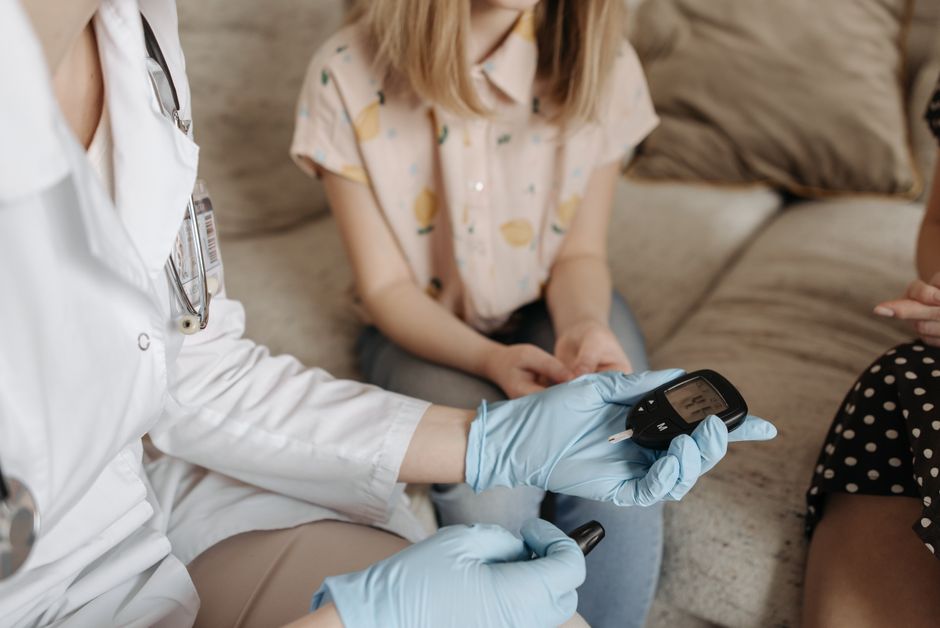
You can check your blood sugar at home with a small device called a glucose meter, which reads a drop of blood from your fingertip in about five seconds. You can also check it without a fingerstick using a continuous glucose monitor (CGM), a small sensor worn on the arm or belly that reads sugar levels in the fluid under your skin. Both methods give you a number in milligrams per deciliter (mg/dL), the standard unit used in the United States. Which method you use depends on whether you have diabetes, what your doctor recommends, and what your insurance covers.
What Do Blood Sugar Numbers Actually Mean?
Blood sugar, also called blood glucose, is the amount of sugar circulating in your bloodstream at the moment you test. It is not a single fixed number. It rises after you eat and settles when you have not eaten for a while.
For most adults without diabetes, a fasting blood sugar (tested after not eating for at least eight hours) falls between 70 and 99 mg/dL. Two hours after a meal, it usually stays below 140 mg/dL. These ranges come from the American Diabetes Association and are widely used as clinical reference points.
For people with diabetes, target ranges are often different and set by a doctor. A common general target before meals is 80 to 130 mg/dL, and less than 180 mg/dL one to two hours after a meal begins. These are starting points, not rules. Your doctor may adjust them based on your age, other health conditions, and how long you have had diabetes.
One thing worth knowing: a single high or low reading is not a diagnosis. Blood sugar moves constantly. Patterns over days and weeks matter more than any one number.
How Can You Check Your Blood Sugar Levels With a Glucose Meter?
A glucose meter, also called a glucometer, is the most common way to check blood sugar at home. It is small, portable, and widely available without a prescription in most US pharmacies.
Here is how the process works:
- Wash your hands with warm soap and water and dry them completely. Food residue or lotion on your fingers can skew the reading.
- Insert a test strip into the meter.
- Prick the side of your fingertip with a small lancet. The side of the finger hurts less than the center and gives good blood flow.
- Touch the drop of blood to the edge of the test strip.
- Wait a few seconds for the meter to display your result.
Most meters need only a tiny drop of blood, roughly the size of a pinhead. Results appear in about five seconds, though this varies by device.
Test strips are specific to each meter brand and model. A strip made for one meter will not work in another. Strips also expire, and expired strips can give false readings. Store them at room temperature and check the expiration date.
How Does a Continuous Glucose Monitor Work?
A continuous glucose monitor (CGM) uses a small sensor inserted just under the skin. The sensor measures glucose in interstitial fluid — the fluid between your cells — not directly in your blood. It sends readings to a receiver or smartphone every few minutes.
CGMs do not replace fingersticks entirely. Because they measure interstitial fluid rather than blood, there is a short lag between what your blood sugar is doing and what the sensor shows. That lag matters most when your glucose is changing quickly, such as during exercise or right after treating a low. In those situations, a fingerstick is more accurate.
Some CGMs require calibration with fingersticks. Others come factory-calibrated and do not. Your doctor or diabetes educator can tell you which type you have and whether you need to calibrate.
CGMs are more expensive than fingerstick testing and are not covered by all insurance plans for all people. Coverage varies widely. If cost is a concern, talk with your doctor about options.


When Should You Check Your Blood Sugar?
Timing depends on why you are checking and what your doctor has recommended. There is no single schedule that fits everyone.
Common times to check include:
- When you wake up, before eating (fasting)
- Before meals
- Two hours after a meal
- Before and after exercise
- Before driving, if you take insulin or medications that can cause low blood sugar
- When you feel symptoms of high or low blood sugar
People who take insulin often need to check more frequently than people who manage their diabetes with diet, exercise, or non-insulin medications. If you use insulin, checking before meals and at bedtime is common. Some people check four to ten times a day or more.
If you do not take insulin, your doctor may ask you to check less often — sometimes just a few times a week, or at specific times to see how certain foods affect you.
What Is an A1C Test and How Is It Different?
The A1C test is a blood test done at a lab or doctor’s office. It shows your average blood sugar over the past two to three months. It does not show what your blood sugar is right now.
A fingerstick or CGM tells you what is happening in this moment. A1C tells you the bigger picture. Both are useful, and they answer different questions.
For most adults with diabetes, the American Diabetes Association recommends an A1C goal below 7%. Your doctor may set a different goal based on your health, age, and risk of low blood sugar. An A1C below 5.7% is considered normal for people without diabetes. A result between 5.7% and 6.4% falls in the prediabetes range, and 6.5% or higher on two separate tests is used to diagnose diabetes.
Some conditions can make A1C less reliable — for example, anemia, recent blood loss, or certain hemoglobin variants. In those cases, your doctor may use other tests or rely more on fingerstick readings.
What About Checking Without a Fingerstick or CGM?
Some people ask about urine glucose testing. Urine test strips were once common but are rarely used now for daily monitoring. They only detect glucose that has spilled into urine, which usually happens after blood sugar has already been high for a while. They cannot detect low blood sugar at all. For these reasons, they are not a substitute for blood testing.
There is no reliable way to check blood sugar by how you feel. Symptoms of high and low blood sugar can overlap, and some people have no symptoms at all even when their numbers are out of range. This is one reason regular testing matters.
Some smartwatches and wearable devices claim to measure blood sugar without a fingerstick or sensor. As of now, no major health authority has approved these claims. The FDA has warned consumers about smartwatches and smart rings that claim to measure blood sugar non-invasively. If a device makes this claim without a sensor under the skin, treat it with caution.
What Affects the Accuracy of Your Reading?
Home glucose meters are not perfectly precise. The FDA requires meters to be accurate within 15% of a lab value 95% of the time. That means two meters can give slightly different numbers from the same drop of blood, and both can be within the acceptable range.
Things that can throw off a reading include:
- Unwashed hands, especially after handling fruit or juice
- Expired or improperly stored test strips
- Too little blood on the strip
- Extreme temperatures or high humidity
- Certain medications, such as high doses of vitamin C
If a reading does not match how you feel, wash your hands and test again with a new strip. If it still seems off, check your meter with a control solution, which is a liquid that mimics blood and verifies the meter and strips are working. Your meter’s instructions explain how to do this.
Bring your meter to doctor visits so your doctor can compare it with a lab result. This is a simple way to confirm your meter is working correctly.
When Should You Call Your Doctor?
Call your doctor if you get readings that are consistently outside your target range, if you have frequent low blood sugar episodes, or if you feel symptoms that do not match your readings. Also call if your meter seems to be giving unreliable results even after troubleshooting.
Seek emergency care for blood sugar below 54 mg/dL with confusion or loss of consciousness, or for very high blood sugar with symptoms such as vomiting, deep rapid breathing, or fruity-smelling breath. These can be signs of a medical emergency.
Frequently Asked Questions
Can I check my blood sugar without pricking my finger?
Yes, with a continuous glucose monitor (CGM), which uses a sensor under the skin to read glucose in interstitial fluid. However, CGMs still may require occasional fingersticks for calibration or when readings change quickly.
What is a normal blood sugar level?
For adults without diabetes, fasting blood sugar is typically 70 to 99 mg/dL, and two hours after a meal it is usually below 140 mg/dL. People with diabetes often have different targets set by their doctor.
How often should I check my blood sugar?
It depends on your treatment plan — people who take insulin often check four or more times a day, while those who do not may check less often. Your doctor will recommend a schedule based on your needs.
Are smartwatches that measure blood sugar accurate?
No. The FDA has warned that smartwatches and smart rings claiming to measure blood sugar without a sensor under the skin are not accurate and should not be used. No major health authority has approved these devices for that purpose.
