
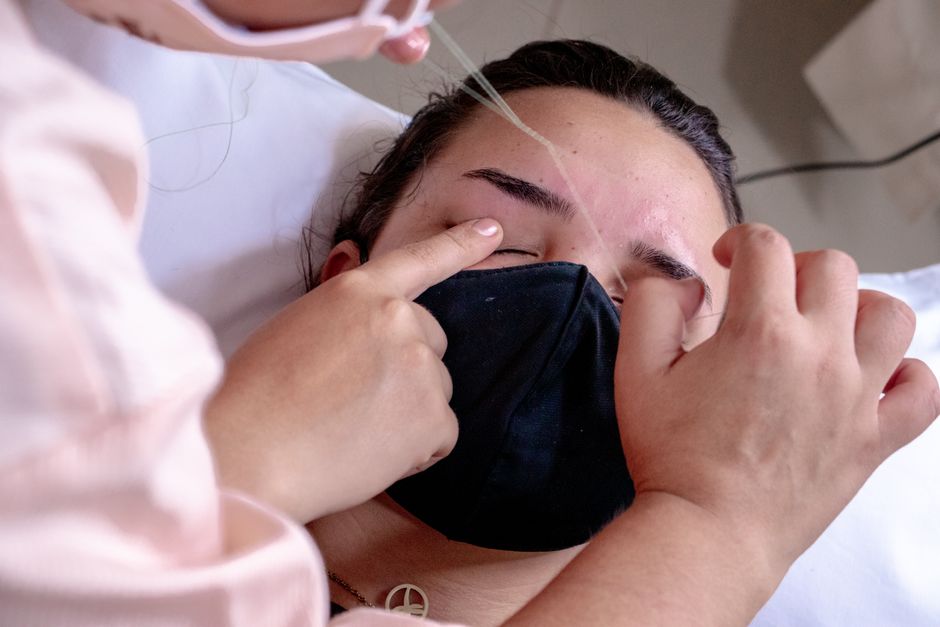
No, threading does not stop hair growth or slow it down. It removes hair by the root, which means the follicle has to grow a new hair from scratch — but the follicle itself is not damaged in any lasting way. Hair returns on its own schedule, usually within a few weeks.
That answer surprises people because threading can feel aggressive. The twist-and-pull motion looks like it should do more than waxing or tweezing. It doesn’t. The biology underneath the skin stays the same.
What Actually Happens to a Hair Follicle During Threading?
A hair follicle is a tiny organ embedded in the skin. At its base sits the bulb, where cells divide to build a hair shaft. Threading pulls the shaft out of the follicle, bulb included, but the follicle structure stays intact.
The follicle then enters a resting phase. After that, it cycles back into a growth phase and produces a new hair. This is the same process that happens after plucking with tweezers or after a wax pull. The method of removal changes how the hair comes out, not what the follicle does next.
Threading works by rolling a twisted cotton thread over the skin. The thread traps hairs in the twist and lifts them out. A skilled practitioner can shape a brow line very precisely this way. That precision is the main advantage — not any effect on future growth.
One detail worth knowing: the hair that grows back after threading is not thicker or darker. That idea is a visual illusion. A new hair has a blunt tip because it was cut or pulled at the surface. It looks coarser next to a fine, tapered tip of an older hair. The actual diameter of the shaft does not change.
Does Threading Slow Hair Growth Over Time?
Threading does not slow hair growth in any measurable, lasting way. What it can do is create a temporary delay before the next hair appears, simply because the hair has to regrow from the root.
Compare this to shaving. Shaving cuts hair at the surface. A new hair is visible again within a day or two. Threading removes the whole shaft, so the wait is longer — often two to four weeks for facial hair, depending on the person.
That delay is not the same as slowing growth. The follicle is still on its own internal clock. Some people notice hair seeming to come back finer or sparser after years of regular threading. The evidence for that is weak and mostly anecdotal. What is more likely happening is that repeated removal disrupts the growth cycle for some follicles, or that the person is simply comparing early regrowth to a fully grown-in area.
Hormones, genetics, and age drive how fast and how thick hair grows. Threading does not change any of those factors.
Why Do Some People Think Threading Stops Hair Growth?
Two things drive this belief. The first is timing. Because threading removes hair at the root, the regrowth period feels long. People mistake a longer gap for slower growth.
The second is the precision effect. A well-threaded brow looks clean and defined for longer than a shaved or trimmed one. That clean look can read as “less hair growing,” when really it is just a cleaner starting point.
There is also a persistent myth that repeated pulling weakens a follicle permanently. For most people, this is not supported by evidence. A follicle that is repeatedly plucked can become damaged in rare cases — this is a known cause of traction-related hair loss when pulling is forceful and constant over years — but ordinary eyebrow threading is not the same as the sustained tension that causes traction alopecia.
Traction alopecia is real and well documented. It is linked to tight hairstyles, braids, and extensions that pull continuously. Threading is intermittent and brief. The two should not be confused.





How Does Threading Compare to Waxing and Tweezing?
All three methods remove hair at or near the root. None of them stop or slow growth permanently. The differences are in precision, discomfort, and how the skin responds.
- Threading: Very precise, good for shaping. No wax or chemicals. Can cause redness and mild irritation.
- Waxing: Fast for large areas. Pulls a patch of hair at once. Can irritate sensitive skin and sometimes causes ingrown hairs.
- Tweezing: Precise but slow. Best for a few stray hairs, not full shaping.
None of these methods reaches the follicle in a way that shuts down future growth. That is the key point. If a method claims to stop hair permanently, it is not in this category.
Is There Anything That Actually Slows or Stops Hair Growth?
Yes, but not threading. A few approaches have evidence behind them, and they work differently than physical hair removal.
Prescription treatments. Eflornithine is a topical cream approved for slowing facial hair growth in women. It works on an enzyme involved in hair production. It does not remove hair — it slows how fast new hair appears, and results stop when you stop using it.
Laser and light devices. These target the pigment in hair and can damage the follicle enough to reduce or delay growth. Results depend on hair color, skin tone, and device. They reduce growth rather than guarantee permanent removal.
Electrolysis. A tiny probe delivers current to the follicle to destroy it. This is the only method widely described as permanent hair removal, though it often requires multiple sessions and results vary.
Hormonal treatment. When excess hair growth is driven by a hormonal condition, treating the underlying cause can reduce growth. This requires a medical evaluation, not a cosmetic fix.
Threading sits outside all of this. It is a removal method, not a growth-modifying treatment.
Does Threading Damage the Follicle or Skin?
For most people, threading does not cause lasting damage to the follicle or skin. Short-term effects are common and expected.
Redness, mild swelling, and tenderness right after a session are normal. They usually settle within hours. Some people get small bumps or a temporary rash, especially on sensitive skin.
Ingrown hairs can happen with any method that removes hair at the root. A new hair sometimes curls back into the skin instead of growing out. This shows up as a small bump and can be uncomfortable.
In rare cases, forceful or repeated pulling over a long period can contribute to follicle damage. This is not typical with standard eyebrow threading done at reasonable intervals. It is more of a concern when hair is pulled constantly and with strong tension.
If you have a skin condition, active acne, or a history of keloid scarring, it is worth talking to a dermatologist before regular threading in that area.
How Long Does Hair Take to Grow Back After Threading?
Most people see new hair within two to four weeks after threading. Facial hair tends to return on the shorter end of that range for some people and longer for others.
The exact timing depends on your individual hair growth cycle. Everyone has a growth phase, a transition phase, and a resting phase. The length of each phase varies from person to person and from one body area to another.
This is why two people can get threaded on the same day and see very different regrowth. It is not about the threading technique. It is about their biology.
If you want to stretch the time between sessions, there is no proven threading trick for that. What helps is consistency and, for some people, combining removal with a growth-slowing method that has actual evidence behind it.
What Should You Expect If You Thread Regularly?
Regular threading keeps an area looking groomed. It does not change the underlying growth pattern in any reliable way.
Over time, some people feel their hair comes back softer or less dense. This is a common report, but it is not strongly supported by research. It may reflect the growth cycle, the appearance of regrowth, or simply familiarity with the process.
The honest position: threading is an effective, precise way to remove hair. It is not a treatment for hair growth. If your goal is to reduce how much hair grows, threading alone will not get you there.
Frequently Asked Questions
Does threading stop hair from growing back?
No, threading does not stop hair from growing back. It removes hair at the root, but the follicle remains intact and will produce a new hair.
Does threading make hair grow back thinner?
Threading does not change the actual thickness of your hair. New hairs can look coarser because they have a blunt tip, but the shaft diameter stays the same.
How long does threading last before hair grows back?
Most people see regrowth within two to four weeks. The exact timing depends on your individual hair growth cycle and the area being treated.
Is threading better than waxing for slowing hair growth?
Neither threading nor waxing slows hair growth permanently. Both remove hair at the root, and both allow hair to return on its natural schedule.
