
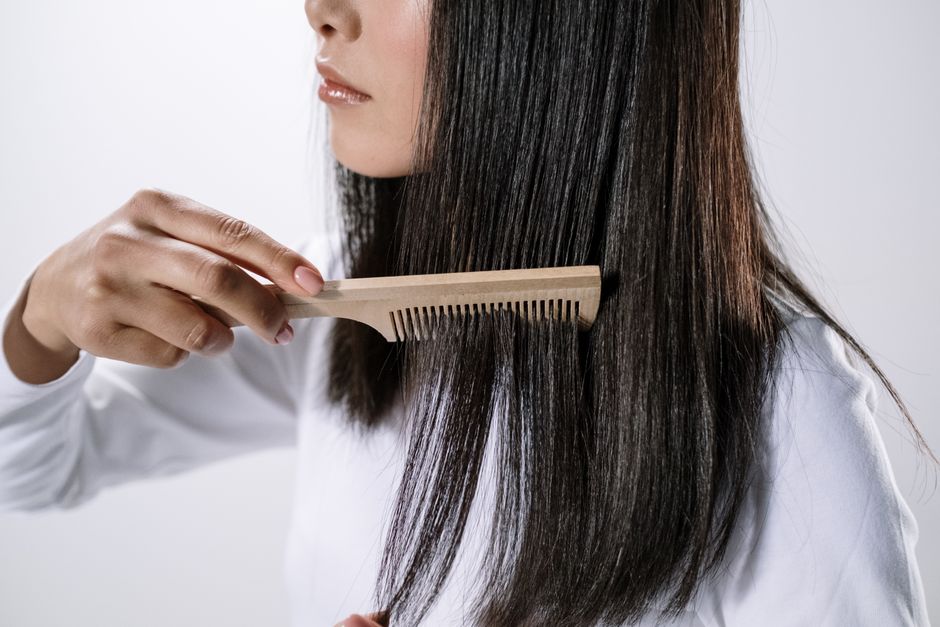
Hair grows at the same rate whether it is straight, wavy, curly, or coily. The follicle — the tiny organ under your scalp that produces each strand — pushes out hair at roughly half an inch per month regardless of the shape it takes. What changes is not the speed of growth but how much length you actually see.
Curly hair grows just as fast as straight hair. It simply takes longer to show that length because the hair curls back on itself, and because curls are more prone to breakage at the ends. Straight hair can appear to gain length faster because every new inch adds a visible inch. Curly hair can coil several inches of actual growth into a much shorter visible length.
So if your curly hair seems stuck at the same length while your straight-haired friend’s hair keeps getting longer, the growth rate is not the difference. The difference is geometry and how much of that growth survives.
How Fast Does Hair Actually Grow?
Hair grows about 0.5 inches (roughly 1.25 centimeters) per month. That works out to about 6 inches per year. This rate is well established in dermatology and applies across hair types.
The rate does vary somewhat from person to person. Genetics, age, hormones, and overall health all influence it. Hair also grows faster in summer than winter in many people, though the reason is not fully understood. What does not vary in any meaningful way is growth rate by curl pattern. A straight strand and a coily strand emerging from the scalp are both being pushed out by the same basic mechanism at roughly the same speed.
Each hair follicle cycles through three phases:
- Anagen — the growth phase, lasting two to seven years for scalp hair
- Catagen — a short transition phase of a few weeks
- Telogen — the resting phase, about three months, ending in shedding
How long your hair can get is mostly determined by how long the anagen phase lasts for you. Someone with a long anagen phase can grow very long hair. Someone with a shorter one will plateau at a shorter maximum length no matter what they do. This is genetic and is not something you can change with products.
Does Straight Hair Grow Faster Than Curly Hair?
No. Straight hair does not grow faster than curly hair. The follicle does not know or care about the shape of the hair it produces.
What people actually notice is visible length gain, and that is where straight and curly hair diverge. A straight strand lies flat. Add an inch at the root and you see an inch at the tip. A curly strand spirals. An inch of new growth at the root might only translate to a fraction of an inch of visible length because the hair is busy curling around itself.
Think of it like a coiled phone cord versus a straight wire. Both are the same length when stretched out. The coil just looks shorter because it is packed into less space. Curly hair works the same way.
There is a second factor that matters even more: breakage. Curly and coily hair has more natural fragility at the bends. Every sharp curve in the strand is a point of mechanical stress. Over time, daily handling, detangling, and dryness can cause the ends to snap off. If your hair is breaking at the ends as fast as it grows at the root, your length stays the same. That is not slow growth. That is breakage outpacing retention.
Why Does Curly Hair Seem to Grow Slower?
Curly hair seems to grow slower for two reasons: shrinkage and breakage. Both are about retention, not growth.
Shrinkage is the difference between your hair’s actual length when stretched and its length in its natural coiled state. For tightly coiled hair, shrinkage can be substantial — some people see their hair appear many inches shorter than it actually is. This is not damage or slow growth. It is just the nature of the coil.
Breakage is the more serious issue. Curly and coily hair tends to be drier because natural oils from the scalp have a harder time traveling down a winding strand than a straight one. Dry hair is less flexible and more likely to break. Add in tighter tangles, more friction during styling, and heat or chemical treatments, and the ends take a beating.
The result is that many people with curly hair are growing hair at a normal rate but losing length at the ends at a similar rate. The net effect looks like no growth at all.





What Actually Determines How Long Your Hair Gets?
Maximum hair length comes down to a few factors, and growth rate is only one of them.
The length of your anagen phase is the biggest genetic factor. If your follicles grow for six years before resting, you have a much higher ceiling than someone whose follicles grow for two years. This is why some people can grow hair to their waist and others plateau at shoulder length, even with identical care routines.
Retention is the second factor, and it is the one you have the most influence over. Hair that stays on your head accumulates length. Hair that breaks or sheds does not. This is where hair type genuinely matters — not because curly hair grows slower, but because curly hair faces more obstacles to staying intact.
Other factors that can affect growth rate or retention include:
- Age — growth tends to slow somewhat with age
- Hormonal changes, including pregnancy, menopause, and thyroid conditions
- Nutritional deficiencies, particularly iron and vitamin D
- Certain medications and medical treatments
- Stress, which can push hair into the shedding phase
- Heat damage, chemical treatments, and tight hairstyles that pull on the follicle
If you notice sudden changes in growth or shedding, that is worth discussing with a doctor. It can signal an underlying issue that has nothing to do with your curl pattern.
Do You Need Different Care for Curly Hair to Retain Length?
If your goal is length, the priority for curly hair is reducing breakage. Growth is happening either way. Keeping that growth is the challenge.
General approaches that many dermatologists and hair specialists suggest include:
- Moisturizing regularly, since curly hair loses moisture more easily
- Detangling gently, ideally when hair is wet and conditioned, using fingers or a wide-tooth comb
- Limiting heat styling and chemical straightening, both of which weaken the strand
- Avoiding tight hairstyles that pull at the roots over long periods
- Trimming damaged ends so splits do not travel up the strand
- Using satin or silk pillowcases to reduce friction overnight
These steps support retention. They do not speed up growth, because nothing reliably does. The evidence for most “hair growth” supplements and treatments is limited, and many products marketed for faster growth have no strong human trials behind them. If a product claims to double your growth rate, that claim is not supported by clinical evidence.
Does Straightening or Relaxing Change Growth Rate?
Straightening does not change how fast your hair grows. It changes how the hair looks and how it behaves, but the follicle underneath keeps producing hair at the same rate.
What straightening can change is retention, usually for the worse. Chemical relaxers and repeated high-heat straightening can weaken the hair shaft over time, making breakage more likely. That can make it seem like growth has slowed when actually the hair is breaking faster.
There is one visible upside. Straightened hair shows length more clearly because it no longer coils. So people who relax or straighten their hair often feel like it is suddenly “growing faster.” It is not. They are just finally seeing the growth that was there all along.
Frequently Asked Questions
Does straight hair grow faster than curly hair?
No. Hair grows at roughly the same rate regardless of curl pattern, about half an inch per month. Straight hair only appears to grow faster because it shows length more directly and tends to break less.
Why does my curly hair not seem to grow?
Curly hair usually is growing normally but losing length to shrinkage and breakage at the ends. Reducing breakage with gentle handling and moisture is the main way to retain length.
How much does curly hair shrink?
Shrinkage varies widely by curl pattern and can range from a small amount to well over half of the hair’s stretched length. It reflects the tightness of the coil, not slow growth.
Can I make my hair grow faster?
No product or supplement reliably speeds up hair growth beyond your genetic rate. You can support retention by limiting breakage, which helps you keep the length you grow.
