
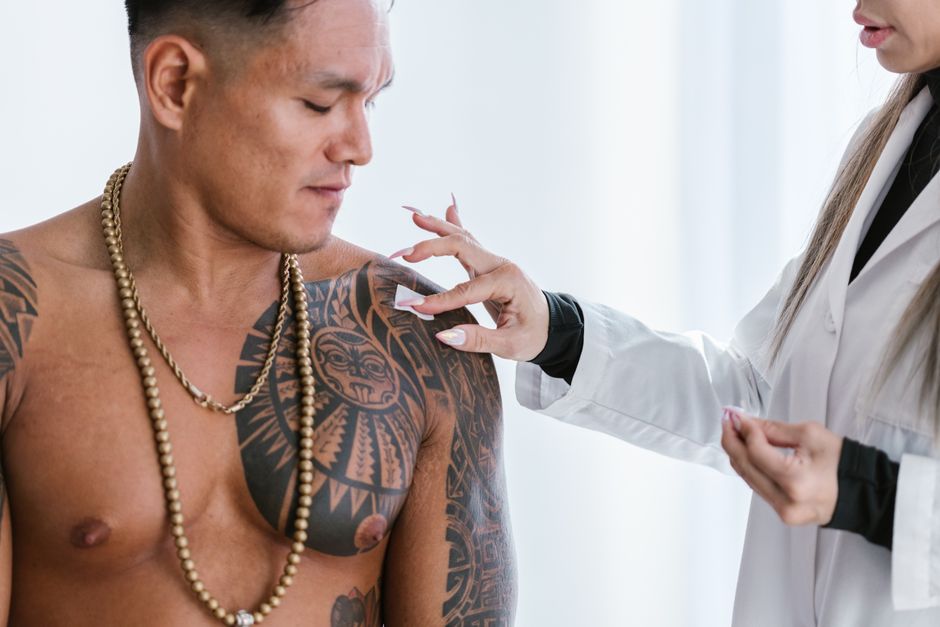
Yes, getting a tattoo hurts. There is no way around that fact, because a tattoo needle punctures your skin thousands of times to deposit ink below the surface. How much it hurts depends on where you get it, how long the session runs, and your own pain tolerance. Most people describe the sensation as a scratching or burning feeling rather than sharp agony, and many find it more tolerable than they expected.
What Actually Happens to Your Skin During a Tattoo
A tattoo machine drives a cluster of fine needles in and out of the skin at high speed. Each puncture carries pigment into the dermis, the layer beneath the outer skin. That depth is what makes the ink permanent and also what makes the process painful.
The dermis is packed with nerve endings and blood vessels. The epidermis, the thin outer layer, has far fewer pain receptors. When the needle reaches the dermis, it triggers those nerves directly. This is why a tattoo hurts more than a light scratch on the surface.
The needles move fast enough that individual punctures blur together into a continuous sensation. Your body responds with inflammation, which is normal and expected. The skin becomes red, warm, and tender. That response is part of healing, not a sign something is wrong.
One detail many people do not realize: the outline usually hurts more than the shading. Lining uses a single needle or a tight group to draw clean edges, and it tends to feel sharper. Shading spreads ink over a wider area and often feels more like a scrape.
Does It Hurt To Get A Tattoo in Different Body Locations?
Location changes the pain a lot. Areas with more nerve endings, thinner skin, or less fat and muscle cushioning tend to hurt more. Areas with thicker skin and more padding tend to hurt less.
This is not a perfect rule, and individual anatomy varies. But the general pattern holds well enough that most artists and clients recognize it.
More painful areas
- Ribs and sternum — thin skin directly over bone
- Feet, ankles, and toes — many nerve endings and little padding
- Hands and fingers — dense nerve supply
- Neck and throat — sensitive, thin skin
- Spine and collarbone — bone close to the surface
- Groin and inner thigh — sensitive skin
- Elbow and knee — thin skin over joints
- Head and face — highly sensitive
Less painful areas
- Upper outer arm and shoulder — thicker muscle and skin
- Forearm — moderate padding
- Back — large area with thicker skin
- Thigh — muscle and fat cushion the needle
- Buttocks — thick tissue and fewer nerve endings
- Calf — generally manageable for most people
Bony areas hurt because there is little tissue to absorb the needle’s movement. The vibration travels into the bone, which many people find uncomfortable in a way that is distinct from the surface pain.
How Much Does It Hurt Compared to Other Things?
People often ask for a comparison. The most common descriptions are a cat scratch, a bad sunburn being rubbed, or a hot scratching sensation. Some compare it to a bee sting, though that is usually sharper and shorter.
Pain scales are subjective. What one person rates a 4, another rates a 7. Research on pain perception consistently shows that anxiety and expectation shape how intense pain feels. People who expect the worst often report it was easier than they feared.
This does not mean it is painless. It means the mind plays a real role in how the experience registers.





How Long Does the Pain Last?
The pain during a tattoo lasts as long as the session does. A small piece might take 15 to 30 minutes. A large back piece can take multiple sessions of several hours each.
After the session ends, the skin stays sore for a few days. This is normal inflammation. Most people describe it as similar to a bruise or a scrape. The soreness fades as the skin begins to heal.
Full healing of the skin typically takes several weeks, though surface healing happens sooner. During that time the area may feel tender, itchy, or tight. Itching is common and usually peaks in the first week or two.
If pain gets worse instead of better after the first few days, or if redness and swelling spread, that can signal infection. That is a reason to see a doctor, not to wait it out.
What Affects How Much It Hurts?
Several factors change the experience from person to person and from session to session.
- Session length. Pain tends to build over time. The first hour often feels easier than the fourth.
- Your pain tolerance. This varies widely and is partly genetic.
- Anxiety and stress. Tense muscles and a racing mind can make pain feel worse.
- Sleep and hydration. Being run down tends to lower your threshold.
- Alcohol and blood thinners. These can increase bleeding and are generally discouraged before a session.
- Menstrual cycle. Some people report more sensitivity at certain points in their cycle, though the evidence is not strong.
- Artist technique. A skilled artist works efficiently and may cause less trauma.
One point worth stating clearly: no over-the-counter or prescription numbing product has been shown to eliminate tattoo pain entirely. Topical anesthetics can reduce surface sensation, and some artists use them, but they are not a guarantee. Anyone considering a numbing cream should discuss it with the artist first, because some products can affect how ink settles.
How Do People Manage the Pain?
Most people manage without medication. The strategies that help are practical rather than medical.
- Eat a solid meal beforehand. Low blood sugar makes pain feel sharper.
- Sleep well the night before.
- Stay hydrated.
- Bring something to squeeze or focus on.
- Take breaks if you need them.
- Breathe steadily rather than holding your breath.
- Bring headphones or a podcast to distract your mind.
Some people take an over-the-counter pain reliever before a session. This is a personal choice, and anyone on medication or with a health condition should check with a doctor first. Aspirin and other blood thinners are usually avoided because they increase bleeding.
Numbing creams exist, but their effectiveness varies and they are not a substitute for the pain of the needle reaching the dermis. They may dull the surface, not remove the deeper sensation.
Does It Hurt More Than Other Cosmetic Procedures?
Comparisons are hard to make fairly because procedures differ in duration, depth, and technique. What can be said is that tattooing involves repeated punctures to the dermis, which is a deeper and more sustained insult than many surface treatments.
Laser tattoo removal is often described as more painful than getting the tattoo. That is a common report, though individual experiences vary. The laser breaks up ink with short, intense pulses, and many people find the sensation sharper than the original needlework.
Piercings are a different kind of pain. A piercing is a single sharp event. A tattoo is a sustained one. Which feels worse depends on the person and the location.
Is There Anyone Who Should Not Get a Tattoo?
Some health conditions make tattooing riskier and warrant a conversation with a doctor first. These include bleeding disorders, certain heart conditions, active skin infections, and immune conditions. People taking blood thinners or immunosuppressants should seek medical advice before booking.
There is no clinical guideline that lists every condition that should rule out a tattoo. The honest position is that risk depends on the individual, and a doctor who knows your history is the right person to ask.
Regulations for tattoo studios vary by state and city. Choosing a licensed, reputable studio reduces the risk of infection and other complications, though it does not remove the pain.
Frequently Asked Questions
Does it hurt to get a tattoo?
Yes, getting a tattoo hurts because the needle punctures the dermis, which contains nerve endings. Most people describe it as a scratching or burning sensation rather than intense pain.
Which body part hurts most for a tattoo?
Areas with thin skin, many nerve endings, or little padding tend to hurt most, such as the ribs, feet, hands, neck, and spine. Individual pain tolerance still varies widely.
How long does tattoo pain last?
The pain lasts for the duration of the session, which can range from minutes to several hours. Soreness afterward usually fades over a few days as the skin begins to heal.
Can you get a tattoo without pain?
No. No product or method has been shown to remove tattoo pain entirely, because the needle must reach the dermis to deposit ink. Numbing creams may reduce surface sensation but do not eliminate the deeper feeling.
