
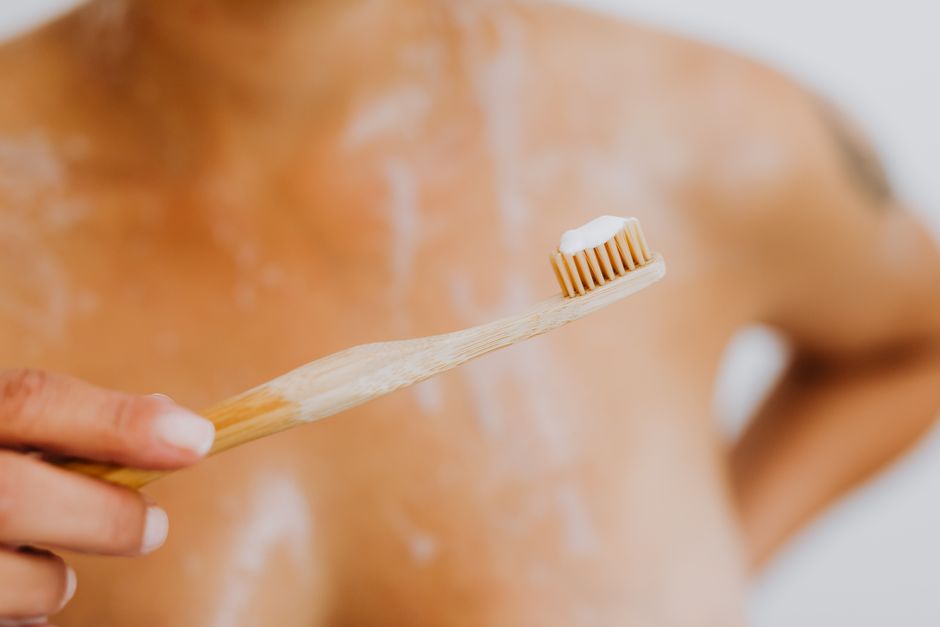
Making natural toothpaste at home usually means mixing a small number of ingredients you can buy at any pharmacy or grocery store: a mild abrasive, a humectant to keep it from drying out, a binder to give it body, and something to improve the taste. A basic recipe combines baking soda or calcium carbonate, coconut oil, a small amount of xylitol, and peppermint oil. The mixing takes about five minutes. The harder part is knowing what the evidence actually says about each ingredient, because a lot of what circulates online about homemade toothpaste is not supported by research.
What Is Natural Toothpaste Made Of?
Natural toothpaste is built from four functional categories. Each one does a specific job, and leaving one out changes how the paste behaves.
- Abrasive — baking soda, calcium carbonate, or kaolin clay. These physically help remove plaque and surface stains when you brush.
- Humectant — coconut oil, glycerin, or both. This keeps the paste from hardening and helps it spread.
- Binder and thickener — bentonite clay, xanthan gum, or diatomaceous earth. Without one of these, your paste separates into oil and powder.
- Flavor and sweetness — peppermint or spearmint oil, plus xylitol or stevia. Xylitol is a sugar alcohol that some research suggests may reduce cavity-causing bacteria.
That is the whole framework. Everything else people add — charcoal, turmeric, essential oils beyond mint — is optional and, in several cases, not well supported by evidence.
How To Make Natural Toothpaste At Home
A simple, workable recipe uses ingredients you can find easily. This makes a small batch, roughly enough for two to three weeks of twice-daily brushing.
- 3 tablespoons coconut oil
- 2 tablespoons baking soda
- 1 tablespoon bentonite clay (optional, for thickness)
- 1 tablespoon xylitol powder
- 10 to 15 drops peppermint essential oil
Melt the coconut oil gently if it is solid. Stir in the baking soda, clay, and xylitol until smooth. Add the peppermint oil last and mix again. Store it in a small glass jar with a lid, away from heat. Coconut oil softens above roughly 76°F, so the texture will shift with room temperature. That is normal.
One caution worth stating plainly: do not use the same jar for everyone in the household. Dip a clean spoon or a dedicated spatula into the jar rather than a used toothbrush. Bacteria from a brush can contaminate a shared container.
Does Homemade Toothpaste Actually Clean Your Teeth?
It can help remove plaque and food debris through the mechanical action of brushing, which is the main thing that cleans teeth. The toothpaste itself matters less than the brush and the technique. This is true for commercial toothpaste too.
Where homemade versions fall short is fluoride. Most natural toothpaste recipes leave it out. Fluoride is the ingredient with the strongest evidence for preventing cavities, and it works by remineralizing enamel and making it more resistant to acid attacks from bacteria. The American Dental Association and most public health bodies consider fluoride toothpaste a cornerstone of cavity prevention. A homemade paste without fluoride does not replace that benefit.
This does not mean homemade toothpaste is useless. It means it does not do everything fluoride toothpaste does. If you use it, you are choosing a paste that cleans but does not provide the same cavity protection. That is a real trade-off, not a marketing detail.




Is Baking Soda Safe For Your Teeth?
Baking soda is a mild abrasive and has been used in oral care for well over a century. Research indicates it can help remove plaque and reduce surface stains, and it has some antibacterial properties. It is generally considered safe for regular use at the concentrations found in toothpaste.
The concern with baking soda is overuse. A paste that is mostly baking soda, applied with hard brushing over years, can wear down enamel and irritate gums. Enamel does not grow back. Most recipes dilute baking soda with coconut oil and other ingredients, which lowers the abrasive effect. If your teeth feel sensitive after switching, that is a signal to back off.
Hydrogen peroxide is sometimes added to homemade recipes. This is worth being careful about. Peroxide can irritate gums and soft tissue at higher concentrations, and there is no strong evidence that adding it to a homemade paste improves outcomes. Many dentists advise against routine use of undiluted peroxide in the mouth.
What Are The Risks Of DIY Toothpaste?
The main risks are not dramatic, but they are real.
- No fluoride protection — the biggest one. Skipping fluoride raises cavity risk over time, especially for people prone to decay.
- Enamel wear — from abrasive ingredients used too aggressively or too often.
- Gum irritation — from essential oils, peroxide, or harsh powders.
- Contamination — homemade paste has no preservatives, so it can grow bacteria if stored poorly or shared.
- Allergic reactions — some people react to essential oils, clay, or coconut.
None of these are reasons to panic. They are reasons to be deliberate. If you have a history of cavities, gum disease, or sensitive teeth, talk to your dentist before switching away from fluoride toothpaste. Some clinicians recommend using a homemade paste only occasionally rather than as your daily routine.
Can You Make Natural Toothpaste With Fluoride?
You can, but it is harder than it sounds. Fluoride compounds used in commercial toothpaste — sodium fluoride and stannous fluoride — are not typically sold for home use in a form that is easy to measure safely. Getting the concentration wrong matters, because too little does nothing and too much carries its own risks, particularly for children.
A more practical approach some people take is to alternate: use a fluoride toothpaste in the morning and a homemade paste at night, or vice versa. This keeps the cavity protection while still using a product you made yourself. There is no strong research comparing this kind of alternating routine to standard fluoride use, so it is a reasonable compromise rather than a proven strategy.
For children, the guidance is different. Fluoride toothpaste is recommended from the appearance of the first tooth, in an amount appropriate for age. A homemade paste is not a substitute for that. No clinical guidelines support replacing fluoride toothpaste with a DIY version in children.
What About Charcoal, Turmeric, And Other Trendy Ingredients?
Activated charcoal has become popular in natural toothpaste, and the evidence for it is weak. Some studies suggest it may help with surface stains, but there is also concern that it is abrasive enough to wear enamel over time. No strong evidence shows it prevents cavities.
Turmeric has anti-inflammatory properties in some contexts, but there is no reliable evidence that brushing with it improves oral health. It can also stain. Oil pulling with coconut oil — swishing for several minutes — has been studied, and results are mixed. Some small studies suggest it may reduce plaque and gingivitis, but the quality of that research is limited. It is not a replacement for brushing or fluoride.
The pattern here is worth noticing. Most viral natural toothpaste ingredients have either weak evidence, no evidence, or evidence of harm at high use. That does not make them dangerous in small amounts. It means the confident claims made about them online are not backed by research.
How Does Homemade Toothpaste Compare To Store-Bought?
| Feature | Homemade | Commercial fluoride toothpaste |
|---|---|---|
| Fluoride | Usually none | Present, regulated dose |
| Cavity prevention | Limited without fluoride | Strong evidence |
| Plaque removal | Good, from brushing action | Good |
| Preservatives | None, shorter shelf life | Present |
| Ingredient control | Full | Limited |
| Cost | Low per batch | Varies |
The honest comparison is not “natural versus chemical.” It is “with fluoride versus without.” That is the variable that matters most for cavity prevention, and it is the one most homemade recipes get wrong.
Frequently Asked Questions
How do you make natural toothpaste at home?
Mix 3 tablespoons coconut oil, 2 tablespoons baking soda, 1 tablespoon bentonite clay, 1 tablespoon xylitol, and 10 to 15 drops peppermint oil in a small jar. Stir until smooth and store at room temperature.
Is homemade toothpaste as effective as store-bought?
It cleans teeth through brushing action, but most homemade recipes lack fluoride, which has the strongest evidence for preventing cavities. Without fluoride, it does not offer the same cavity protection as standard toothpaste.
Is baking soda safe to brush with every day?
Baking soda is a mild abrasive and is generally considered safe in toothpaste at typical concentrations. Used aggressively or in a paste that is mostly baking soda, it can wear enamel over time.
Can kids use homemade toothpaste?
No established guidelines support replacing fluoride toothpaste with a homemade version for children. Fluoride toothpaste is recommended from the first tooth, in an age-appropriate amount.
