
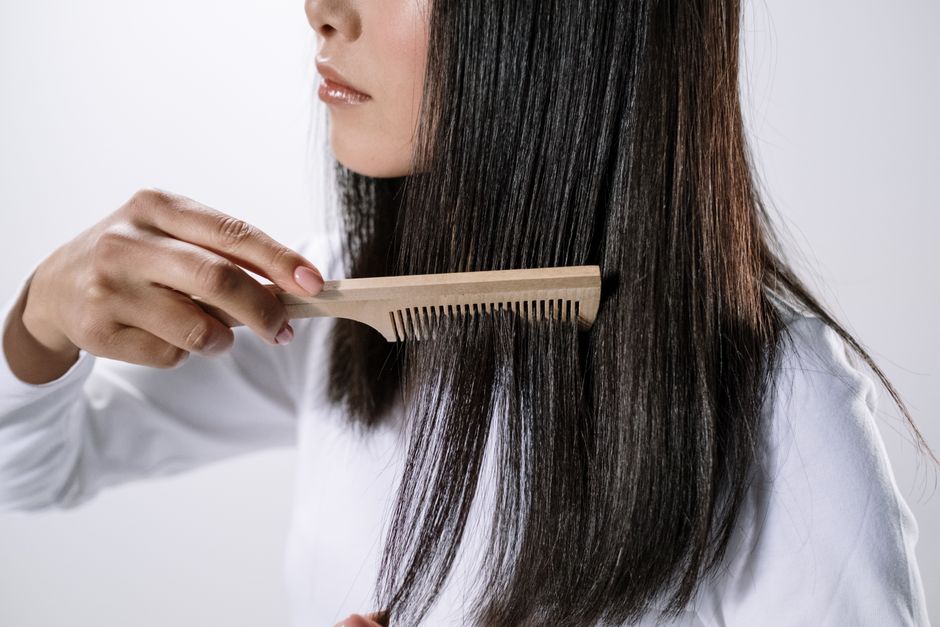
No, combing your hair does not make it grow faster. Hair growth happens inside the follicle, below the surface of the scalp, and that process is driven by genetics, hormones, age, and your overall health — not by how often a comb passes through your hair. Combing can affect how your hair looks and how much of it stays on your head, but it cannot speed up the rate at which new hair is produced.
That said, the idea isn’t pure nonsense. Combing does influence blood flow to the scalp, how hairs are arranged, and how much breakage occurs. The confusion comes from mixing up hair growth with hair appearance and hair retention. Those are three different things, and only one of them responds to a comb.
How Does Hair Actually Grow?
Each hair on your head grows from a follicle, a small pocket of cells embedded in the scalp. The visible hair shaft is already dead tissue. The living part — the part that actually grows — sits below the skin.
Hair growth follows a repeating cycle with three main phases. The anagen phase is the active growth stage, when the follicle builds a new hair. The catagen phase is a short transition period when growth stops. The telogen phase is a resting period, after which the old hair sheds and the cycle begins again.
Scalp hair typically grows about half an inch per month, though this varies from person to person. That rate is set by the follicle itself. No external mechanical action — combing, brushing, massaging, or tugging — has been shown to increase it.
Here is the point most people miss: the number of follicles you have is fixed at birth. You cannot create new ones, and you cannot make existing ones produce hair faster through physical manipulation. What you can do is avoid damaging the follicles and hairs you already have.
Does Combing Increase Blood Flow to the Scalp?
Combing does increase blood circulation in the scalp, at least temporarily. That part is real. The question is whether extra blood flow translates into faster hair growth.
Blood delivers oxygen and nutrients to the follicle, and a healthy blood supply is necessary for normal hair growth. But “necessary” is not the same as “more is better.” There is no good evidence that pushing additional blood to the scalp above normal levels speeds up the growth cycle or produces thicker hair.
This is where a lot of scalp-massage and brushing products make their pitch. The reasoning sounds logical: more circulation, more nutrients, more growth. But biological plausibility is not the same as demonstrated benefit. Some small studies have looked at scalp massage and reported changes in hair thickness, but the evidence remains limited and the studies have been small. No large, well-controlled human trial has confirmed that increased scalp blood flow from combing or massage increases hair growth rate.
If you enjoy a scalp massage, there is no harm in it. Just don’t expect it to override your genetics.
Can Combing Ever Help Your Hair?
Combing can help — just not with growth speed. Its real benefits are about distribution and appearance.
- It spreads your scalp’s natural oils (sebum) down the hair shaft, which can make hair look shinier and feel softer.
- It detangles hair and reduces the chance of knots that lead to pulling and breakage.
- It helps style hair and gives the appearance of more volume by separating strands.
- Gentle combing can remove loose hairs that have already shed, which is normal and expected.
None of these change how fast a follicle produces hair. They change how the hair you already have looks and how well it survives daily wear.
There is one indirect way combing might protect growth: by reducing breakage. If your hair snaps off near the scalp because of rough combing, it looks shorter and thinner even though the follicle is still growing normally. Careful detangling preserves length. That is retention, not growth, but the visual result can feel similar.




Can Combing Damage Hair or Cause Hair Loss?
Yes — done aggressively, combing can cause real harm. This is the more important side of the story.
Hair is weakest when it is wet. Wet hair stretches and breaks more easily than dry hair. Combing soaking-wet hair with a fine-tooth comb, or ripping through tangles from the top down, is a common cause of breakage.
Over time, repeated tension can also damage the follicle itself. Hairstyles that pull hair tightly — braids, tight ponytails, extensions — can lead to a condition called traction alopecia. This is hair loss caused by constant pulling. It is a recognized clinical condition, and if the pulling continues long enough, the loss can become permanent because the follicle can be scarred.
Signs to watch for include:
- Thinning along the hairline or where hair is pulled tightest
- Small bumps or tenderness at the roots
- Broken hairs of uneven length
- Patches of scalp showing through
If you notice these, loosening the style and giving the area a rest is the first step. Persistent loss should be evaluated by a clinician, because several conditions can look similar and only an exam can tell them apart.
What Actually Stimulates Hair Growth?
Since combing doesn’t do it, what does? The honest answer is that the list of things with real evidence behind them is shorter than the marketing suggests.
Genetics and hormones set your baseline. Androgenetic alopecia — common pattern hair loss — is driven largely by genetics and the hormone dihydrotestosterone (DHT). No comb affects this.
Overall health matters. Nutritional deficiencies, thyroid problems, and iron deficiency can all affect hair. Correcting a genuine deficiency can restore normal growth, but taking supplements you don’t need generally does not help.
Medical treatments exist for certain types of hair loss. Two that are well established in clinical use are minoxidil, a topical solution, and finasteride, an oral prescription medication for men. Both have evidence supporting their use in specific types of hair loss, and both have potential side effects. They are not appropriate for everyone, and they are not things to start without medical guidance. A clinician can assess whether either is suitable for your situation.
Stress and illness can push hairs into the resting phase, causing shedding a few months later. This is called telogen effluvium. It often resolves on its own once the trigger passes, but the timeline varies and should be discussed with a doctor if shedding is heavy or prolonged.
Is There Any Truth to the Combing Myth?
The myth likely survives because combing produces visible, immediate effects. Hair looks neater, feels softer, and appears fuller. People connect that change to growth.
There is also a grain of truth buried inside the myth. Combing increases scalp blood flow, and blood flow is needed for healthy hair. Gentle combing reduces tangles that cause breakage, which helps you keep the length you grow. So combing supports the appearance and retention of hair.
What it does not do is change the growth rate. That distinction is the whole answer. The rate is set inside the follicle by biology you cannot comb your way around.
If your goal is longer, fuller-looking hair, the practical steps are unglamorous: handle hair gently, especially when wet, avoid tight styles, eat a balanced diet, and see a clinician if you notice real thinning or shedding. Those steps rest on established understanding of how hair works. A better comb does not.
Frequently Asked Questions
Does combing hair make it grow faster?
No. Combing does not change the rate at which hair grows, because growth happens inside the follicle and is controlled by genetics, hormones, and health. Combing can improve how hair looks and reduce breakage, but it cannot speed up growth.
Does combing hair increase blood flow to the scalp?
Yes, combing temporarily increases blood flow to the scalp. However, there is no good evidence that this extra circulation speeds up hair growth, since normal blood supply is already sufficient for healthy follicles.
Can combing cause hair loss?
Aggressive combing, especially on wet hair, can cause breakage, and constant tight pulling can lead to traction alopecia. Gentle combing does not cause hair loss, but persistent thinning should be checked by a clinician.
What actually makes hair grow faster?
Nothing reliably speeds up the natural growth rate, which is set by your follicles. Correcting a genuine nutritional deficiency or treating an underlying condition can restore normal growth, and certain medications are used for specific types of hair loss under medical guidance.
