
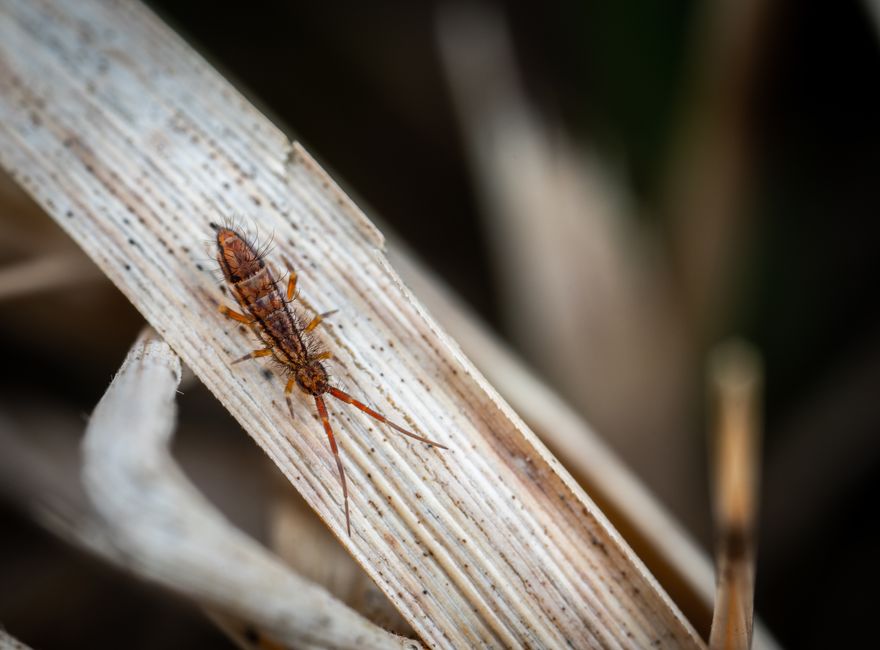
Springtails do eat mold. In fact, that is their primary job in nature. These tiny insects feed on fungi, mold, and decaying organic matter, which makes them a natural part of the decomposition process. However, the truth about mold control is more complicated than simply releasing a few springtails into your home. While they can help manage mold in specific settings like terrariums and potted plants, they are not a practical or effective solution for a mold problem in a house. Understanding what springtails can and cannot do is the key to deciding if they have any role in your mold management plan.
What Are Springtails and Why Do They Eat Mold?
Springtails are among the most common insects on Earth. They are tiny, usually less than 1/16 of an inch long, and get their name from a fork-like appendage that allows them to jump several inches into the air. They are not harmful to humans, pets, or structures. They do not bite, sting, or spread disease.
Their diet consists almost entirely of decaying plant matter, fungi, and mold spores. In soil, they act as recyclers. They break down organic material and release nutrients back into the earth. When they consume mold, they are doing exactly what they have done for millions of years. In a balanced ecosystem, springtails keep fungal growth in check.
This natural behavior has made them popular in the world of bioactive terrariums and vivariums. Hobbyists who keep reptiles or tropical plants often add springtails to their enclosed environments. The springtails consume mold that would otherwise overgrow the soil and harm the plants or animals living there. In that controlled setting, they are genuinely effective.
Do Springtails Eat Mold in Your Home?
Technically, yes. If a springtail is in your home and there is mold, it will eat it. But this does not mean you should rely on them for mold control. The scale of the problem is completely different.
A terrarium is a small, enclosed space with a manageable amount of organic matter. A home is a large, open environment with countless surfaces, air currents, and hidden spaces. Releasing springtails into a house would not result in them finding and consuming all the mold. They would scatter, dry out in low-humidity areas, and likely die long before making any noticeable impact on a mold colony.
There is also the question of reproduction. Springtails need moisture to survive. They thrive in damp soil and humid conditions. A home with a mold problem is often a home with a moisture problem. The springtails might survive in the damp areas, but they will not eliminate the mold. They will simply coexist with it.
The presence of springtails indoors is usually a symptom, not a solution. If you are finding springtails in your bathroom, kitchen, or basement, it means you have moisture and organic material they can feed on. That same moisture is what allows mold to grow. Seeing springtails should prompt you to look for the underlying moisture issue, not to celebrate having a mold-eating cleanup crew.
The Difference Between Managing Mold and Eliminating Mold
Springtails can manage mold in a small, controlled environment. They cannot eliminate mold from a home. This distinction matters.
Managing mold means keeping it at a level where it does not become a problem. This is what springtails do in soil. They consume mold spores and mycelium as part of their normal feeding, preventing the fungus from spreading unchecked. In a terrarium, this is enough to keep the environment healthy.
Eliminating mold means removing it entirely and preventing its return. This requires addressing the moisture source, removing contaminated materials, and cleaning affected surfaces. No insect can do this. Mold spores are everywhere. They are in the air, on surfaces, and in dust. The only reason mold does not grow everywhere is that it needs moisture to germinate. Kill the moisture, and the mold problem is solved. Add springtails, and you have simply added insects to a damp environment.
For a home, the standard approach to mold control is straightforward. Find and fix the water leak, reduce humidity, improve ventilation, and clean affected areas with appropriate products. For large infestations, professional remediation may be necessary. Springtails have no role in this process.




When Springtails Are a Good Idea for Mold Control
There are legitimate situations where adding springtails makes sense. The most common is a bioactive terrarium or vivarium. If you keep reptiles, amphibians, or tropical plants in a sealed enclosure, springtails are an excellent addition. They help break down waste, aerate the soil, and consume mold before it becomes visible.
Potted houseplants can also benefit. If you tend to overwater your plants, springtails in the soil can help prevent mold from forming on the surface. They will not harm the plant and can reduce the fuzzy white growth that sometimes appears on damp potting soil. This is a practical, low-cost solution for a minor issue.
Outdoor gardens are another place where springtails are beneficial. They are already present in most healthy soils and contribute to nutrient cycling. You do not need to buy or introduce them. They are there naturally.
In all these cases, the springtails are working in a small, contained, moist environment where their population can sustain itself. That is the only scenario where they are a meaningful mold control tool.
Why Springtails Are Not a Solution for Indoor Mold
Indoor mold control requires eliminating the conditions that allow mold to grow. Springtails do not change those conditions. They do not remove moisture from the air. They do not fix leaks. They do not clean surfaces. They simply eat what is already there.
There is also a practical concern. If you release springtails in a home, they will not stay where you put them. They are mobile and will move to find food and moisture. They may end up in your kitchen, bathroom, or anywhere else that suits them. While they are harmless, having hundreds of tiny jumping insects scattered throughout your home is not a desirable outcome.
Some people worry that springtails themselves indicate a mold problem. This is partially true. Springtails are attracted to damp environments where mold and fungi grow. If you have a sudden increase in springtails indoors, it is worth investigating for a moisture issue. But the springtails are not the problem. They are a sign that conditions are right for mold.
No research supports the use of springtails as an indoor mold remediation method. The evidence for their mold-eating ability comes from natural soil ecology and controlled terrarium use. Extrapolating that to a household environment has no scientific backing.
Better Ways to Control Mold Without Springtails
If you have mold in your home, the solution is moisture control. This is not a matter of opinion. It is the established principle behind all mold remediation.
Start by identifying the source of moisture. Common culprits include leaking pipes, roof leaks, poor bathroom ventilation, and high indoor humidity. Fixing the source is the first and most important step. Without this, mold will return no matter what you do.
For small areas of mold on non-porous surfaces, cleaning with soap and water or a commercial mold cleaner is usually sufficient. For porous materials like drywall, carpet, or insulation, removal and replacement may be necessary. Mold penetrates porous surfaces and cannot be fully cleaned.
Keep indoor humidity below 60 percent. In humid climates, a dehumidifier may be needed. Ensure bathrooms and kitchens are properly ventilated. Fix condensation issues on windows and pipes. These steps address the root cause of mold growth.
For extensive mold growth, especially if it covers a large area or is behind walls, professional remediation is recommended. Professionals have the equipment and training to safely remove mold and identify hidden moisture sources.
Frequently Asked Questions
Can springtails completely get rid of mold?
No. Springtails can consume mold in small, controlled environments like terrariums, but they cannot eliminate mold from an entire home. Mold removal requires fixing the moisture problem and cleaning affected surfaces.
Are springtails harmful to humans?
No. Springtails do not bite, sting, or transmit diseases. They are harmless to humans and pets and are considered a nuisance pest at most.
Why do I have springtails in my bathroom?
Springtails in your bathroom indicate excess moisture and organic material they can feed on. This same moisture can support mold growth, so you should look for leaks, improve ventilation, and reduce humidity.
Should I buy springtails to control mold in my houseplants?
Yes, for potted plants with mold on the soil surface, springtails can be effective. They will consume the mold and help keep the soil healthy. This is a reasonable use, unlike releasing them throughout a home.
