
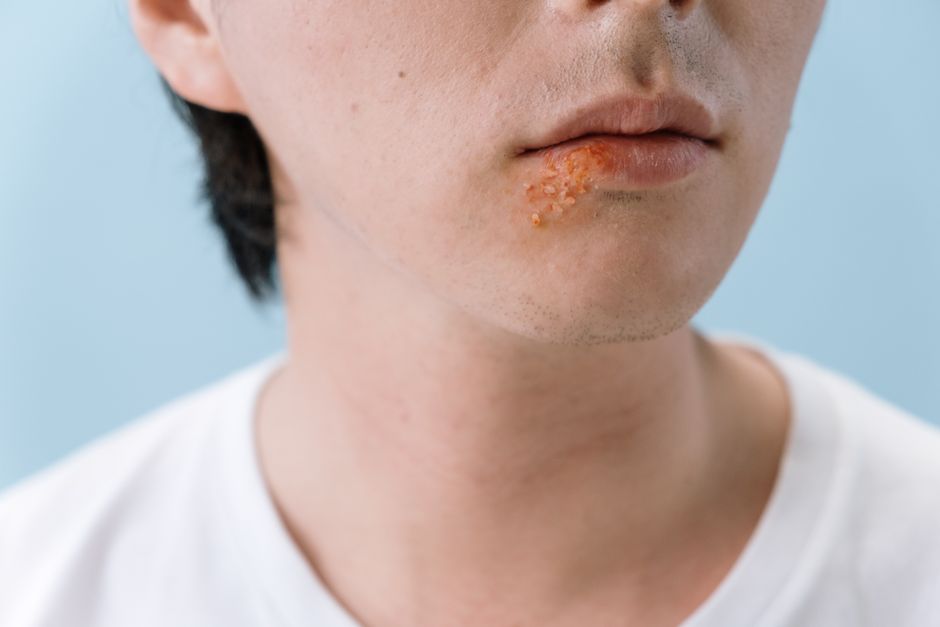
Cold sores do not contain whiteheads. A cold sore is a cluster of small fluid-filled blisters caused by the herpes simplex virus, and the fluid inside those blisters is clear or straw-colored, not white and pus-filled like a whitehead or pimple. This is one of the most useful differences to know, because telling the two apart changes what you should do about them.
Confusion is common. Cold sores can look bumpy and inflamed, and when they dry out and crust over, the yellowish surface can resemble a pimple or a whitehead. But the underlying cause, the way they behave, and the way they are treated are completely different.
What Is a Cold Sore, Exactly?
A cold sore is a viral infection, not a blocked pore. It is most often caused by herpes simplex virus type 1 (HSV-1), though HSV-2 can also cause sores around the mouth.
The virus enters the body through skin or mucous membranes, usually during childhood. Once inside, it travels along nerve pathways and settles into a cluster of nerve cells called a ganglion, where it stays for life. It does not leave. It does not get cured. It goes quiet.
Most of the time the virus is dormant and causes no symptoms. When something reactivates it, it travels back down the nerve to the skin near where it first entered, and a cold sore forms in roughly the same spot each time.
That is the key structural fact: a cold sore is a reactivation of a virus living in a nerve, and its visible form is a blister. A whitehead is a pore clogged with oil and dead skin cells. They start in completely different places and behave in completely different ways.
What Does a Cold Sore Look Like at Each Stage?
A cold sore moves through predictable stages, and knowing them helps you recognize what you are looking at.
- Tingling or itching: Many people feel a warning sensation, sometimes called a prodrome, for several hours to a day or two before anything is visible.
- Redness and swelling: The skin becomes red and raised before the blister appears.
- Blisters: One or more small, fluid-filled blisters form, usually in a tight cluster. The fluid is clear or straw-colored.
- Rupture and oozing: The blisters break, releasing clear fluid.
- Crusting: A yellow or brown crust forms over the area as it dries.
- Healing: The crust flakes off and the skin heals, often without scarring.
The whole sequence typically runs about one to two weeks in healthy people. The first outbreak someone ever has tends to be the worst and may come with fever, sore throat, and swollen lymph nodes. Later outbreaks are usually milder and shorter.
Notice what is missing from that list: pus. A cold sore does not fill with the thick white material that defines a pimple. If you see a genuine white head of pus, you are most likely looking at something else.
Why Do People Think Cold Sores Have Whiteheads?
Two things drive the confusion, and both are easy to understand.
The first is the crusting stage. When a cold sore dries, it forms a yellowish-white scab. Against red, inflamed skin, that scab can look a lot like the white tip of a pimple. But a scab sits on the surface of a healing sore. A whitehead is a collection of pus trapped inside a pore. They are different things that happen to look similar in a photo or in a mirror.
The second is that cold sores and acne can appear in the same area. The border of the lip, the corner of the mouth, and the chin are common spots for both. When someone has a bump near their lip, they may reasonably assume it is a pimple, especially if they get acne there regularly.
There is also a third, less obvious possibility worth knowing. Some sores around the mouth are not cold sores at all and are not acne either. Angular cheilitis, for example, causes cracked, red, sometimes crusted patches at the corners of the mouth. It is often related to moisture, irritation, or a yeast or bacterial issue, and it is treated differently from both cold sores and acne.



How Can You Tell a Cold Sore From a Whitehead?
A few features separate them reliably.
| Feature | Cold Sore | Whitehead |
|---|---|---|
| Cause | Herpes simplex virus | Clogged pore |
| Warning sign | Tingling or itching before it appears | Usually none |
| Contents | Clear or straw-colored fluid | White pus |
| Pattern | Cluster of small blisters | Single bump, sometimes several |
| Location | Often lip border, same spot each time | Anywhere with oil glands |
| Contagious | Yes, while blisters are present | No |
| Recurrence | Returns in the same area | Varies |
The tingling warning is one of the most reliable clues. Acne does not usually announce itself with a tingle. And the tendency to return in the same spot, again and again, points strongly toward a cold sore.
If you genuinely cannot tell, that is a reasonable time to have a clinician look at it, especially if it is the first time you have had it. A swab test can confirm whether HSV is present.
Should You Pop a Cold Sore Like a Pimple?
No. Never squeeze, pop, or pick at a cold sore.
Doing so can spread the virus to nearby skin, to your fingers, and to other people. It can also introduce bacteria into an open sore and lead to a secondary infection, which can make healing slower and the sore worse. It does not speed anything up.
Popping a whitehead is also not recommended, though for different reasons. Squeezing a pimple can push bacteria and inflammation deeper into the skin and increase the risk of scarring. But the risk with a cold sore is higher because you are dealing with a contagious virus.
Keep your hands off either one. Wash your hands if you touch the area, and do not share towels, lip balm, utensils, or cups while a cold sore is present.
How Are Cold Sores Treated?
Cold sores cannot be cured, but antiviral medications can shorten outbreaks and reduce how often they happen. These include acyclovir, valacyclovir, and famciclovir, available by prescription, and acyclovir cream, available over the counter in some forms.
Antivirals work best when started early, ideally during the tingling stage before the blister appears. This is why recognizing the warning sign matters. Starting treatment after the sore is fully formed is less helpful, though it may still be used.
For people who get frequent outbreaks, some clinicians prescribe daily antiviral therapy to reduce how often sores return. This is common clinical practice and is supported by evidence, though how often outbreaks occur and how much they interfere with life are factors in the decision. That is a conversation to have with a clinician, not a decision to make on your own.
Over-the-counter creams and home remedies vary widely in what they can do. Some may ease discomfort. Most have limited evidence for actually shortening an outbreak. Pain relievers and cool compresses can help with symptoms.
Cold sores usually heal on their own within one to two weeks. See a clinician if a sore is severe, spreads, does not heal, or if you have a weakened immune system. In people with weakened immunity, HSV infections can be more serious.
When Should You See a Doctor?
Most cold sores are uncomfortable but not dangerous. Certain situations call for medical attention.
- Sores that do not heal within two weeks
- Sores that spread widely or appear in unusual places
- Severe pain or difficulty eating or drinking
- Signs of a secondary bacterial infection, such as spreading redness, warmth, or pus
- Cold sores in a newborn, infant, or anyone with a weakened immune system
- Cold sores near or in the eye, which can be serious and need prompt care
- Frequent outbreaks that interfere with daily life
Cold sores near the eye deserve special mention. HSV infection of the eye can damage the cornea and needs prompt medical evaluation. Do not wait on that one.
Can You Prevent Cold Sores?
You cannot remove the virus once you have it, but you can reduce how often it reactivates and how easily it spreads.
Common triggers for reactivation include sun exposure, fever or illness, physical or emotional stress, fatigue, and skin injury. Not everyone has clear triggers, and what sets off one person’s outbreak may do nothing for another.
Steps that may help:
- Use lip balm with sunscreen and protect your lips from strong sun
- Get enough sleep and manage stress where you can
- Avoid picking at or irritating the lips
- Avoid close contact such as kissing while a sore is present
- Do not share items that touch the mouth
To prevent spreading HSV to others, avoid direct contact with the sore while it is present and until it has fully healed. The virus can spread even when no sore is visible, though the risk is highest when blisters are open.
One honest note: for people who get frequent outbreaks, some clinicians recommend daily antiviral therapy as a way to reduce recurrence. That is an established option, but whether it fits a given person depends on how often sores appear and how much they affect daily life. It is a decision to make with a clinician.
Frequently Asked Questions
Do cold sores have whiteheads?
No. Cold sores are fluid-filled blisters caused by the herpes simplex virus, and the fluid inside is clear or straw-colored, not white pus. A yellowish crust may form as the sore dries, which is what sometimes looks like a whitehead.
Can a cold sore look like a pimple?
Yes, especially during the crusting stage, when a yellowish-white scab can resemble a pimple tip. The tingling warning before it appears and its tendency to return in the same spot are clues that point to a cold sore.
What happens if you pop a cold sore?
Popping a cold sore can spread the virus to nearby skin and to other people, and it can let bacteria into the open sore. It does not speed healing and can make the outbreak worse.
How long does a cold sore last?
Cold sores typically heal within one to two weeks in healthy people. The first outbreak someone has tends to be more severe and may last longer than later ones.
