
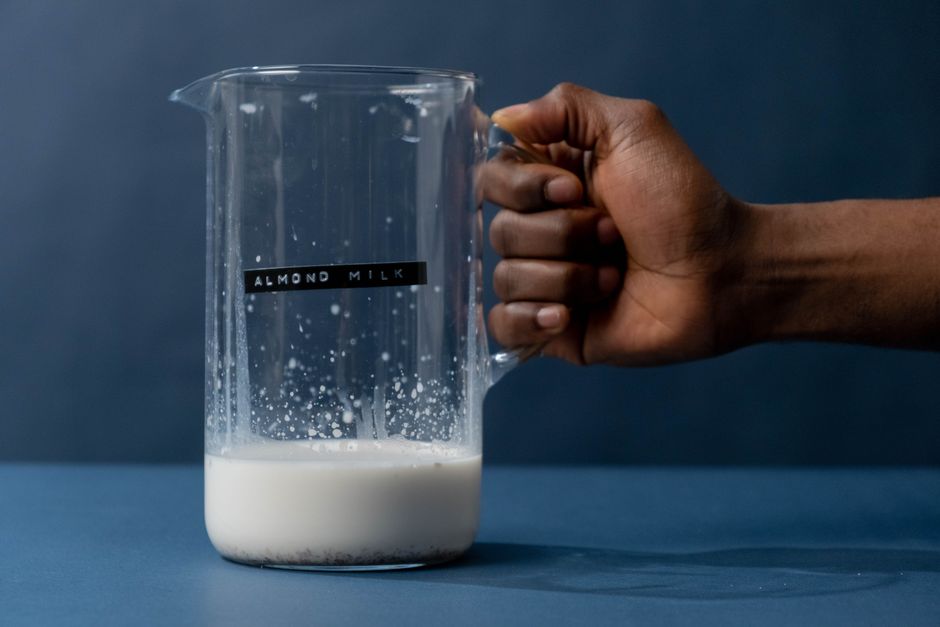
Yes, you can froth almond milk. It will not foam the way dairy milk does, but with the right product and a little technique, you can get a soft, usable foam for coffee and cocoa. The key is choosing the right almond milk and understanding why it behaves differently from cow’s milk.
Almond milk is a suspension of ground almonds in water, not a true emulsion of fat and protein like dairy. That difference explains almost everything about how it froths — and why some cartons foam beautifully while others barely bubble.
Why Does Almond Milk Froth Differently Than Dairy Milk?
Dairy milk foams because of two things working together: protein and fat. The proteins in cow’s milk unfold and coat air bubbles, while fat globules stabilize the structure. Almond milk has far less protein and a different fat profile. That means the bubbles it forms are weaker and collapse faster.
Commercial almond milk typically contains about 1 gram of protein per cup, compared with roughly 8 grams in cow’s milk. The almond content itself is often small — many cartons are mostly water. This is a detail most people miss: the label says “almond milk,” but the almonds may make up only a few percent of the volume.
The stabilizers and emulsifiers added to commercial almond milk — things like gellan gum and lecithin — actually help it froth. They hold air bubbles together in the absence of strong protein networks. This is why barista-style almond milks exist. They are formulated specifically to foam better.
Which Almond Milk Froths Best?
Barista-blend almond milk froths best. These products are made with higher fat content and added stabilizers designed to hold foam. Standard “original” or “unsweetened” almond milk will froth, but the results are thinner and fade faster.
Look for these features on the carton:
- Barista or “foaming” label — formulated for coffee, usually with added fat and stabilizers
- Higher fat content — full-fat or “original” versions foam better than fat-free
- Added emulsifiers — gellan gum and lecithin help stabilize bubbles
- Room temperature — cold almond milk froths less reliably
Avoid homemade almond milk for frothing unless you add a stabilizer. It has no emulsifiers, and the natural separation makes consistent foam difficult. It can still be warmed and whisked, but expect a thin layer rather than a dense foam.
How Do You Froth Almond Milk Without a Machine?
You can froth almond milk without a machine using a jar, a whisk, or a French press. None of these methods produce the dense microfoam of a steam wand, but they create enough airy foam for a casual coffee at home.
The jar method is the simplest. Fill a jar about a third full with room-temperature almond milk, seal it, and shake hard for 30 to 60 seconds. You will see bubbles form on the surface. Warm the milk gently first — warm liquid holds air better than cold — then shake and pour.
A French press works well too. Add warm almond milk to the press, pump the plunger vigorously for about 30 seconds, then pour. The mesh filter helps break up large bubbles and creates a finer texture than shaking alone.
A handheld milk frother — a small battery-powered whisk — is the most effective tool short of a steam wand. Submerge the whisk head and move it in small circles near the bottom of the cup for 20 to 30 seconds, then let it rest so the foam settles.




Can You Steam Almond Milk With an Espresso Machine?
You can steam almond milk, but it takes more care than dairy. Almond milk scalds and separates more easily when heated, and it does not stretch the way cow’s milk does. The result is a thinner foam that you should use quickly.
Steam it in short bursts and keep the wand moving. Do not let the temperature climb too high — almond milk can curdle or develop an off taste when overheated. Barista-style almond milk handles steam better than standard versions.
One practical point: many automatic espresso machines with built-in milk frothers are calibrated for dairy. They may produce poor results with almond milk. If your machine has a dairy and non-dairy setting, use the non-dairy one.
What About Sweetened, Unsweetened, and Vanilla Almond Milk?
Sweetened almond milk froths slightly better than unsweetened because added sugar increases viscosity, which helps hold bubbles. The difference is small. Vanilla versions behave much like the original.
Unsweetened almond milk is the thinnest and produces the weakest foam. If you want foam for a latte, a barista or original version will serve you better than unsweetened. If you are watching sugar, choose a barista-style unsweetened product if one is available.
Flavored or sweetened almond milk also changes the taste of your coffee. A vanilla almond milk foam will add sweetness and aroma, which some people want and others do not.
Does Frothing Change Almond Milk’s Nutrition?
Frothing does not change almond milk’s nutrition. It adds air and warms the liquid — nothing more. The calories, protein, fat, and sugar stay the same per serving.
Almond milk’s nutrition varies widely by brand. Unsweetened versions are typically low in calories and protein, while sweetened and barista versions add sugar and fat. Check the label rather than assuming a “healthy” reputation. Almond milk is not a strong protein source compared with dairy or soy milk, and it is not a reliable source of calcium unless it is fortified.
If you are using almond milk as a regular coffee companion, the label matters more than the frothing method. A barista version with added oil and sugar is a different product nutritionally than an unsweetened one.
Common Mistakes When Frothing Almond Milk
The most common mistake is using cold almond milk straight from the fridge. Cold liquid resists foaming. Let it sit at room temperature for a few minutes, or warm it gently before frothing.
Another mistake is over-frothing. Almond milk foam breaks down faster than dairy, so stop as soon as you have a decent head of foam. Keep pumping and the bubbles collapse.
Using a standard carton in a machine designed for barista blends is also common. If your foam is consistently disappointing, the product is usually the reason, not your technique. Switching to a barista-style almond milk often solves the problem.
Finally, do not expect almond milk foam to hold its shape for long. Pour it into your coffee right away. A foam that looks good in the cup will flatten within a minute or two.
Frequently Asked Questions
Can you froth almond milk?
Yes, almond milk can be frothed, though it produces a thinner, less stable foam than dairy milk. Barista-style almond milk froths best because it contains added fat and stabilizers.
Why does my almond milk not froth?
Standard almond milk is mostly water with little protein, so it struggles to hold air bubbles. Cold temperature and low fat content make it worse; try a barista blend at room temperature.
Can you froth almond milk in a coffee machine?
Yes, but use the non-dairy setting if your machine has one, since automatic frothers are often calibrated for dairy. Steam it in short bursts and avoid overheating.
Is almond milk good for latte art?
Almond milk is difficult for latte art because its foam is thin and breaks down quickly. Barista-style almond milk gives the best chance, but results are still less reliable than with dairy.
