
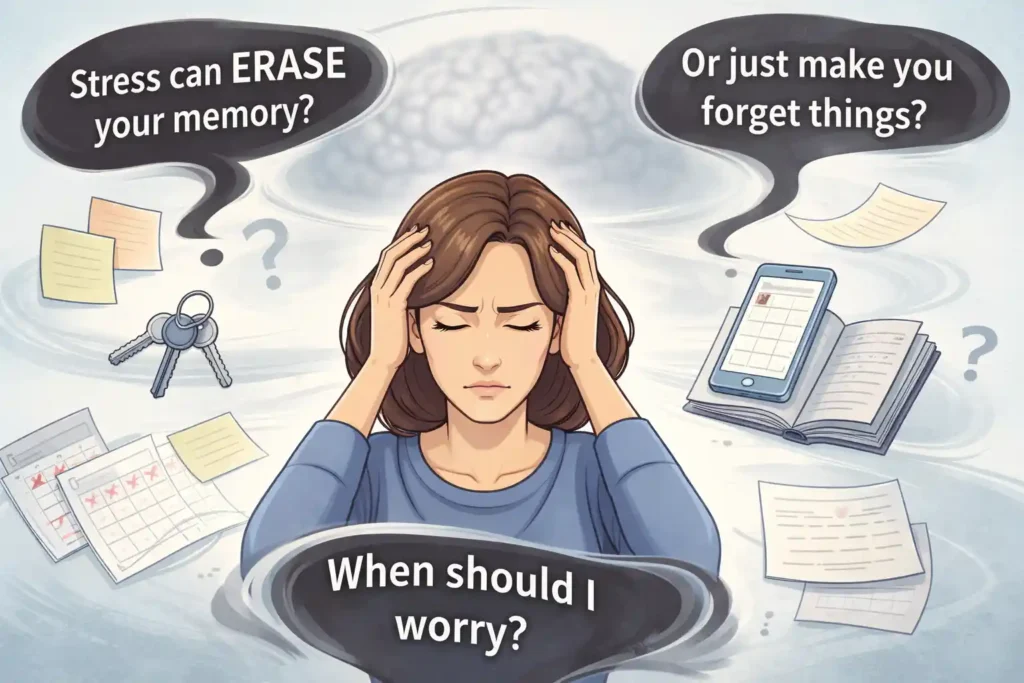
Yes, stress can cause memory loss and confusion by disrupting how the brain stores and retrieves information. It mainly affects memory recall rather than permanently erasing memories. Chronic stress can also impact brain regions like the hippocampus that support learning and memory.
Takeaways
- Stress affects memory recall more than memory storage — the information is usually still there, but harder to access.
- Confusion comes from cognitive overload, not brain damage — your brain is overwhelmed, not broken.
- Chronic stress can impact brain function over time — especially areas linked to learning and memory.
- Most stress-related memory issues are reversible — once mental load and stress levels improve.
- Clear red flags help separate stress from serious conditions — persistent or worsening symptoms need attention.
What Is Stress-Related Memory Loss?
Stress-related memory loss is a failure to access information, not a deletion of it. The memory is often still there. You just can’t retrieve it when needed.
This happens because stress shifts your brain into survival mode. Attention narrows. Distractions increase. Encoding—the process of storing new information—breaks down.
That’s why you forget names, lose your train of thought, or walk into a room and freeze.
How Does Stress Affect Memory Recall?
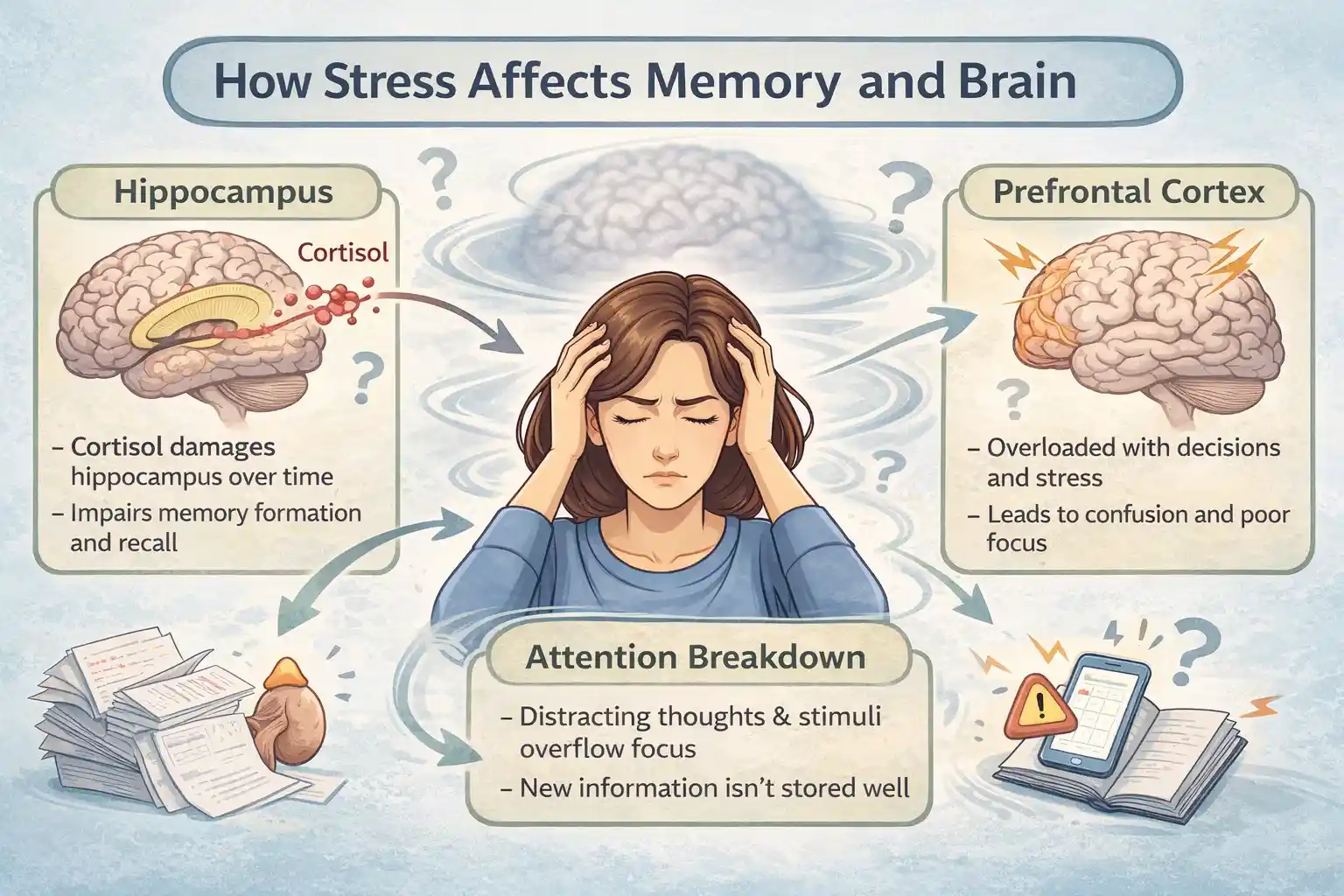
Stress affects memory through three main systems. Most articles mention one. You need all three to understand what’s actually happening.
1. Attention Breakdown
Stress competes for mental bandwidth. Your brain prioritizes threat, not detail.
If attention is weak for a moment, the memory never forms properly. You can’t recall what was never encoded well.
2. Cortisol and the Hippocampus
Stress releases cortisol. In small amounts, it helps focus. In excess, it interferes.
Research in Nature Reviews Neuroscience (2009) shows prolonged cortisol exposure reduces efficiency in the hippocampus—the brain’s memory center.
Over time, this affects how memories are formed and retrieved.
3. Prefrontal Cortex Overload
This is the part most people miss.
The prefrontal cortex handles:
- Decision-making
- Working memory
- Focus
Under stress, it gets overloaded. That’s when confusion kicks in. Thoughts feel slower. Simple decisions feel harder.
You’re not losing intelligence. You’re losing processing capacity.
Quick Takeaway: Stress disrupts attention, overloads thinking, and interferes with memory systems at the same time.
Can Stress Cause Memory Loss and Confusion or Just Forgetfulness?
Most people mix these up. They’re not the same thing.
Here’s the difference:
| Symptom | What It Feels Like | Main Cause | Should You Worry? |
|---|---|---|---|
| Forgetfulness | Misplacing items, blank moments | Poor attention | Usually no |
| Memory Loss | Missing chunks of memory | Storage or brain issue | Sometimes |
| Confusion | Mental fog, slow thinking | Cognitive overload | Depends on severity |
Stress mainly causes forgetfulness and confusion. True memory loss is less common and usually linked to other conditions.
Quick Takeaway: Stress makes you forget and feel foggy. It rarely erases memory.




Can Extreme Stress or Anxiety Cause Memory Loss?
Extreme stress can feel like memory loss, but it’s usually not.
Acute stress (short-term):
- Causes temporary recall problems
- Improves once stress reduces
Severe anxiety:
- Creates constant mental noise
- Blocks clear thinking
- Leads to confusion and forgetfulness
Chronic stress:
- Has longer-term effects on brain function
According to Harvard Health Publishing (2020), prolonged stress can interfere with memory systems, especially when combined with poor sleep.
Here’s the part people misunderstand: Extreme stress mimics memory loss more than it causes it.
Does Stress Affect Memory Differently by Age?
Yes. And ignoring this is a mistake most articles make.
Adults (35–60)
Work pressure and multitasking reduce focus. Memory issues here are usually attention-related.
Young Adults
Digital overload plays a role. Constant switching between tasks weakens memory formation.
Stress amplifies this problem.
Older Adults / Seniors
Stress interacts with natural cognitive decline. This doesn’t mean dementia, but it can amplify existing weaknesses. That’s why stress-related confusion feels more serious in older adults.
Quick Takeaway: Stress affects everyone, but the impact depends on baseline brain function.
What Is the Difference Between Memory Loss and Forgetfulness?
This distinction matters more than most people think.
- Forgetfulness: You can recall later. It was a retrieval issue.
- Memory loss: The memory is gone or incomplete.
Examples:
- Forgetfulness: You forget a name, then remember it later
- Memory loss: You don’t remember meeting the person at all
Stress mostly causes temporary retrieval failure, not permanent loss. This is why symptoms improve once mental load decreases.
When Is Memory Loss a Sign of Stress vs Something Serious?
You need a clear line here. Most articles avoid this.
Likely stress-related:
- Happens during busy or emotional periods
- Improves with rest or reduced workload
- Comes with fatigue or anxiety
Possible red flags:
- Repeating the same questions often
- Getting lost in familiar places
- Suddenly, severe confusion
- Memory gaps that don’t return
If symptoms persist or worsen, it’s not something to ignore.
Quick Takeaway: Stress-related memory issues fluctuate. Serious problems usually don’t.
Can Burnout Cause Memory Loss and Confusion?
Yes. And this is more common than people admit. Burnout is not just stress. It’s chronic mental exhaustion.
It affects:
- Processing speed
- Focus
- Working memory
People describe it as:
- “My brain feels slow.”
- “I can’t think clearly.”
That’s not memory loss in the traditional sense. It’s reduced cognitive performance. Burnout doesn’t erase memory. It limits your ability to use it.
How to Improve Memory When Stress Is the Cause
Most advice online is generic. Here’s what actually matters.
What works immediately:
- Reduce input (less multitasking)
- Write things down (external memory)
- Take short mental breaks
What works long-term:
- Sleep properly (deep sleep supports memory consolidation)
- Exercise (boosts brain-derived neurotrophic factor)
- Reduce chronic stress sources
What doesn’t work well:
- Passive relaxation without fixing the workload
- Relying only on supplements
- Trying to “push through” mental fatigue
Quick Takeaway: Memory improves when mental load decreases. Not the other way around.
Effects of Chronic Stress on the Brain (Hippocampus Explained)
Chronic stress changes the brain over time. Studies published in PNAS (2012) found that prolonged stress is linked to reduced hippocampal volume.
In simple terms:
- The brain adapts to constant stress
- Memory efficiency drops
This is not instant damage. It happens gradually. And in many cases, it can improve when stress levels are reduced.
Techniques to Reverse Stress-Related Memory Issues
You don’t need hacks. You need better brain conditions.
Effective approaches:
- Cognitive offloading: Use notes, reminders, systems
- Single-tasking: Improves encoding quality
- Sleep correction: Fixes memory consolidation
- Focused attention training: Reduces mental scatter
The goal isn’t to “boost memory.” The goal is to remove what’s interfering with it.
FAQs
Can anxiety cause memory loss?
Anxiety can affect memory by disrupting attention and focus. This leads to poor encoding and difficulty recalling information. The memory is usually still there, but access becomes harder due to constant mental distraction and overload.
Does stress affect memory recall?
Yes, stress directly affects memory recall by interfering with attention and brain function. High stress reduces the brain’s ability to retrieve stored information, especially when the mind is overloaded or fatigued.
Is memory loss a sign of stress?
Memory problems can be a sign of stress, but they are usually temporary. Stress-related issues often involve forgetfulness or confusion rather than true memory loss, and they tend to improve when stress levels decrease.
Can stress cause memory loss and confusion in the elderly?
Yes, stress can worsen memory and confusion in older adults. It often amplifies existing cognitive decline rather than causing new damage. Persistent or worsening symptoms should be evaluated to rule out other conditions.
Final Word
Stress can cause memory loss and confusion—but not in the way most people assume. It disrupts how your brain works under pressure rather than permanently erasing information.
In most cases, the issue is functional, not permanent. Fix the stress load, and memory usually follows.
