
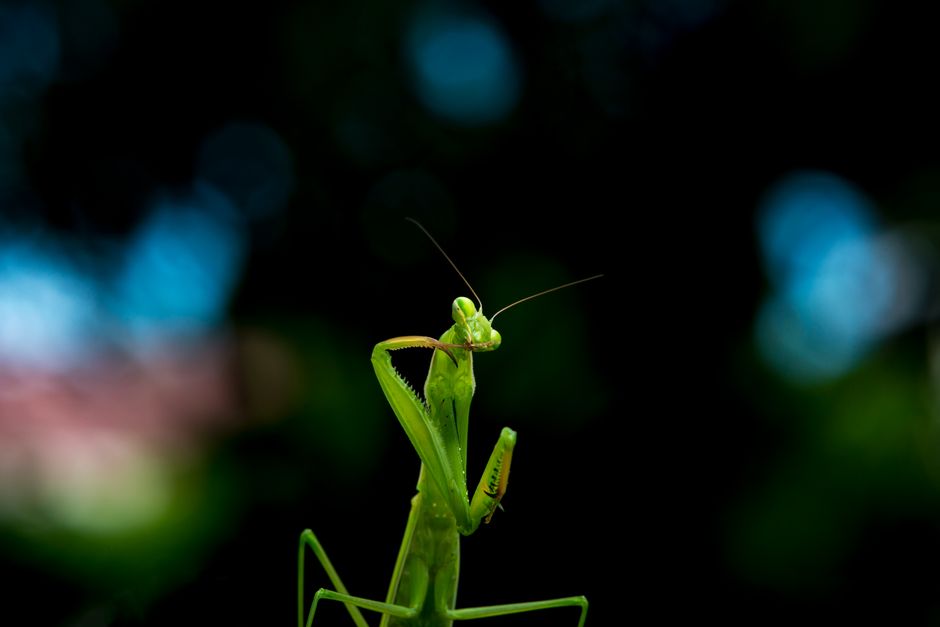
Praying mantises look like they were designed for combat. The folded front legs, the swiveling triangular head, the way they lock onto your finger with unblinking eyes. It is reasonable to wonder whether picking one up is a bad idea. The short answer is that a praying mantis can hurt you, but the realistic risk is small and almost always avoidable. A mantis has no venom, no sting, and no interest in humans as prey. The main hazard is a pinch from its front legs, and even that is uncommon and rarely serious.
Can Praying Mantises Hurt You?
Yes, but the injury is mechanical, not chemical. A mantis defends itself with the same raptorial forelegs it uses to catch insects. Those legs carry rows of sharp spines, and when a mantis grabs a finger it can draw blood or leave a small puncture.
What it cannot do is envenomate you. Praying mantises do not produce venom. They have no stinger, no fangs built for biting people, and no venom gland. This separates them from bees, wasps, spiders, and scorpions, where the danger comes from injected toxins. With a mantis, the entire risk is physical: a grab, a squeeze, and spines pressing into skin.
For most healthy adults, that means a brief sharp pinch and possibly a small scrape. It is not a medical emergency. People with thin skin, bleeding disorders, or a tendency toward easy infection should take the pinch more seriously, but the mechanism is still just a wound, not a toxic exposure.
Do Praying Mantises Bite or Pinch?
Both are possible, but pinching is far more common than biting. The forelegs are the primary tool. A mantis that feels threatened will strike and grip, and the spines along the leg do the damage.
Biting does happen. Mantises have chewing mouthparts, and a large one handled roughly may bite. The bite is not venomous, but it can break skin. A mantis is more likely to bite if it is trapped, squeezed, or held against its will for a long period.
Consider what a mantis actually does with those legs. It uses them to subdue insects, and some larger species can take small vertebrates. The grip is strong relative to the mantis’s size. That is why a pinch from a large species feels disproportionate to the insect’s small body. It is not aggression toward you. It is a startle response to being grabbed.
Are Praying Mantises Dangerous or Venomous?
Praying mantises are not venomous. No species produces venom that affects humans. This is one of the most persistent myths about them, and it is worth correcting clearly.
The confusion likely comes from a few places. Some people mistake the mantis for a spider or assume any insect that hunts is venomous. Others have heard that mantises can kill hummingbirds, which is true in rare documented cases, and assume that means they must be dangerous to people. Killing a small bird with a grip is not the same as being venomous.
Here is the honest position on danger. A mantis is dangerous to insects and occasionally to small animals it can overpower. It is not dangerous to a human in any way that compares to a bee, wasp, or spider. There is no venom, no sting, and no recorded pattern of serious human injury from a mantis encounter.





What Happens If a Praying Mantis Pinches You?
You will feel a sharp pinch, and the mantis may hold on. The immediate step is to stay calm and let it release on its own, or gently encourage it onto a surface. Pulling away while it grips can make the spines drag across skin and worsen the scrape.
After it lets go, treat it like any minor scrape:
- Wash the area with soap and water.
- Apply pressure with a clean cloth if it is bleeding.
- Cover it with a bandage if the skin is broken.
- Watch for increasing redness, swelling, warmth, or pain over the next few days.
Most pinches heal without issue. The concern with any broken skin is infection, not venom. If redness spreads, the area becomes hot, or you develop a fever, see a healthcare provider. That advice applies to any small wound, not specifically to mantis pinches.
There is no antivenom to give because there is no venom. There is no specific treatment beyond standard wound care. Anyone who tells you a mantis pinch requires special medical treatment is describing something that does not exist.
How Do You Handle a Praying Mantis Safely?
You do not need to handle a mantis at all. The simplest way to avoid a pinch is to leave it where it is. If you want to move one, do it without gripping it.
Let the mantis walk onto a flat surface, a leaf, or a stick on its own. Do not grab it around the body. Do not pinch it. Do not hold it against its will. A mantis that is walking freely is far less likely to strike than one that is restrained.
Children should be supervised around mantises. Kids tend to grab, and a grab is exactly what triggers the defensive response. Teaching a child to watch from a short distance is safer for both the child and the insect.
If you keep mantises as pets, which is common, use the same approach. Let them climb onto your hand rather than picking them up. Some species are calmer than others, but individual temperament varies, and even a calm mantis can startle.
Are Praying Mantises Beneficial in the Garden?
Mantises are generalist predators, which means they eat whatever they can catch. That includes pests, but it also includes pollinators like bees and butterflies, and other beneficial insects. The idea that they are a targeted pest-control solution is not accurate.
Some gardeners buy mantis egg cases, called oothecae, hoping to reduce pest numbers. The evidence that this meaningfully controls garden pests is weak. A mantis does not distinguish between a pest and a pollinator. It eats both. Releasing mantises is not a reliable substitute for other pest management methods.
This is a good example of where marketing and biology diverge. A mantis is a fascinating predator to observe. It is not a dependable garden tool. If you find one in your yard, you can appreciate it without expecting it to solve a pest problem.
When Should You Worry About a Mantis Encounter?
Almost never, in terms of the mantis itself. The only realistic concern is a secondary infection from broken skin, and that risk is low and manageable with basic wound care.
There is one situation worth naming. Some people are allergic to insect saliva or proteins, and a bite or pinch from any insect can trigger a localized reaction in a sensitive person. This is uncommon with mantises because bites are rare, but it is not impossible. If you develop swelling that spreads well beyond the wound, difficulty breathing, or a widespread rash, seek medical care. That is a general rule for insect bites and stings, not something specific to mantises.
For the overwhelming majority of people, a mantis encounter ends with nothing more than a story. The insect is not a threat. It is a small predator that would rather be left alone, and it defends itself only when it feels it has no other option.
Frequently Asked Questions
Can a praying mantis hurt a human?
A praying mantis can pinch or bite, which may break the skin, but it has no venom and cannot seriously injure a healthy adult. The realistic risk is a minor wound that heals with basic care.
Are praying mantises poisonous?
No. Praying mantises do not produce venom, so there is no poison involved in a mantis bite or pinch. Any injury is mechanical, from the spines on their front legs or their chewing mouthparts.
What should I do if a praying mantis pinches me?
Let it release on its own rather than pulling away, then wash the area with soap and water and cover it if the skin is broken. Watch for signs of infection like spreading redness or warmth over the next few days.
Do praying mantises bite people often?
Bites are uncommon. Mantises mostly pinch with their front legs when handled roughly, and they are far more likely to stay still or walk away than to attack a person.
