
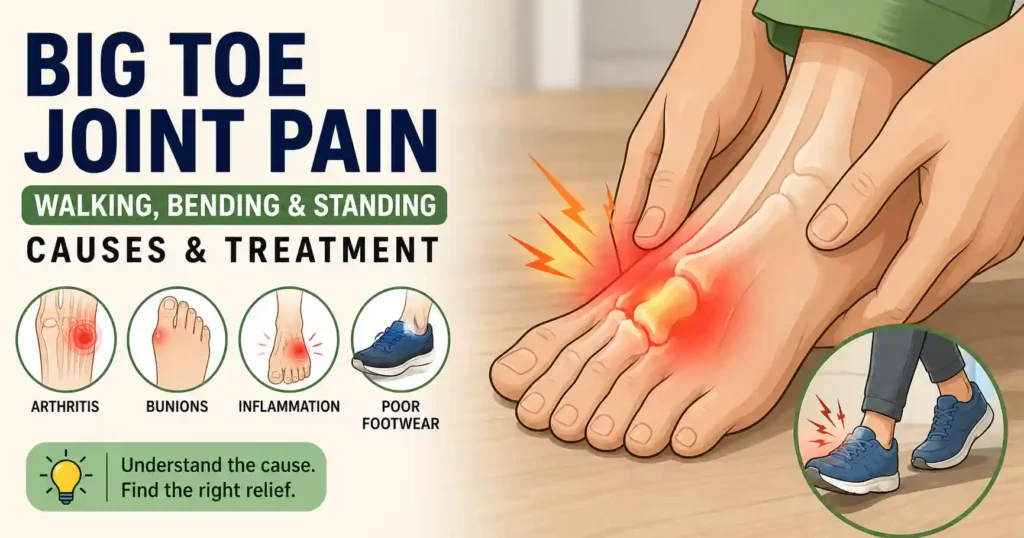
Big toe joint pain when walking is pain in the joint at the base of the big toe that worsens during movement, especially during the push-off phase of walking. This joint carries a large portion of body weight, so even small problems can trigger pain. The most common causes include joint stiffness, inflammation, and structural misalignment.
Key Takeaways
- Big toe pain during walking is pressure-driven — repeated load and movement together trigger discomfort.
- How the pain behaves matters more than location — patterns reveal the underlying cause better than the exact spot.
- Stiffness is an early warning sign — it often shows up before consistent pain begins.
- Swelling points to inflammation — not just mechanical stress, but tissue irritation.
- Most treatments miss the root cause — they reduce symptoms without fixing what’s creating the pain.
What causes big toe joint pain when walking?
Big toe joint pain when walking usually comes from a problem in the metatarsophalangeal (MTP) joint, where the toe meets the foot. This joint has to bend every time you take a step. If it doesn’t move well—or is inflamed—you feel it immediately.
The causes fall into a few clear groups.
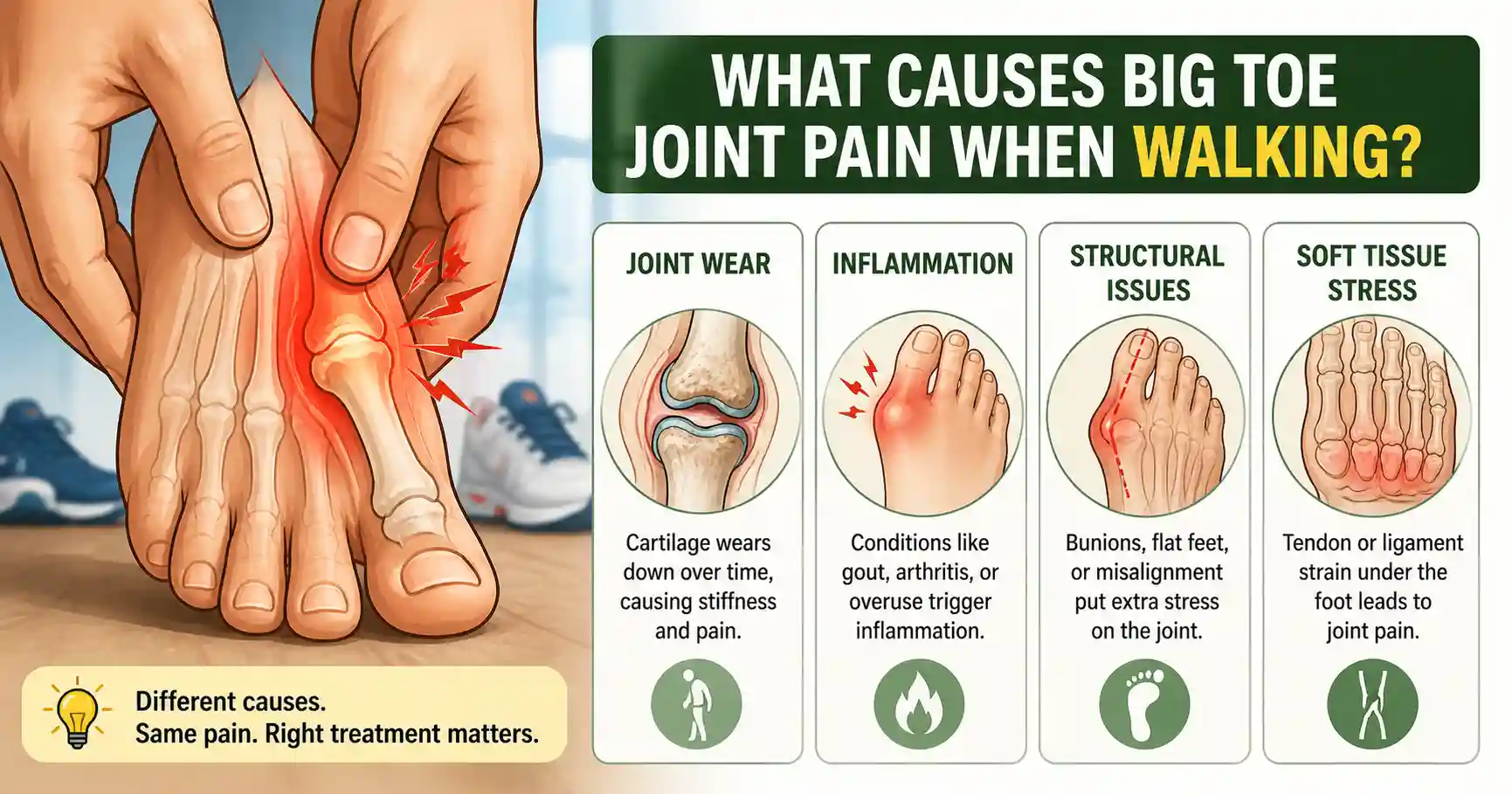
Joint degeneration (hallux rigidus / arthritis)
This is one of the most common reasons. The joint slowly becomes stiff and loses motion. As the cartilage wears down, bones start rubbing against each other. That creates pain, especially when the toe bends during walking.
Research from the American Academy of Orthopaedic Surgeons (AAOS, 2023) notes that hallux rigidus is a leading cause of big toe pain in adults over 40.
Inflammation (gout, injury, overuse)
Inflammation causes sudden or persistent pain.
- Gout: Uric acid crystals build up in the joint. Pain can be sharp, intense, and often comes with swelling.
- Overuse: Long walks, running, or standing for hours can irritate the joint.
- Injury: Even a minor strain can trigger inflammation that lingers.
What people miss: inflammation doesn’t always mean injury. Sometimes it builds slowly from repeated stress.
Structural problems (bunions, alignment issues)
If the toe is misaligned, pressure spreads unevenly.
- Bunions push the joint out of position
- Flat feet or poor arch support change how force travels through the foot
This creates constant stress on one side of the joint.
Soft tissue stress (sesamoiditis, tendon irritation)
Small bones and tendons under the big toe absorb impact. When they’re irritated, pain shows up during walking, especially on hard surfaces.
Non-obvious insight: Many people don’t have just one cause. A stiff joint plus poor alignment is common. That’s why pain can feel inconsistent—fine one day, worse the next.
Why does walking make big toe joint pain worse?
Walking makes big toe pain worse because of the force that moves through your foot.
Every step has a final phase called push-off. This is where the big toe bends and takes on a large portion of your body weight.
Here’s what actually happens:
- Your heel lifts off the ground
- Weight shifts forward
- The big toe bends upward
- The joint absorbs pressure and pushes you forward
That bending motion requires about 60–90 degrees of extension. If the joint can’t reach that range, the stress doesn’t disappear—it builds up as pain.
A study in the Journal of Foot and Ankle Research (2021) showed that reduced toe mobility significantly increases pressure in the joint during walking, which explains why stiffness leads to pain.
Another detail people overlook:
- Walking barefoot increases the direct load on the joint
- Shoes can either reduce or worsen pressure depending on design
Quick Takeaway: Walking hurts because the big toe must bend and carry a load at the same time—if it can’t do both smoothly, pain follows.
How do you know what’s causing your big toe pain?
You can narrow down the cause by looking at how the pain behaves, not just where it is.
| Symptom Pattern | Likely Cause | Why It Happens |
|---|---|---|
| Pain when bending the toe | Hallux rigidus | Joint stiffness limits movement |
| Sudden swelling + sharp pain | Gout | Uric acid triggers inflammation |
| Pain after long walks | Overuse / sesamoiditis | Repetitive stress irritates tissue |
| Pain near the bunion bump | Structural deformity | Misalignment increases pressure |
| Dull ache that worsens over time | Arthritis | Gradual joint degeneration |
Here’s the part most articles skip: Pain timing matters more than intensity.
- Pain at the start of movement → stiffness issue
- Pain after activity → overload or inflammation
- Constant pain → possible joint damage or advanced condition
People often confuse gout and arthritis. Gout is usually sudden and intense. Arthritis builds slowly and feels more like stiffness than sharp pain.





What does it mean if big toe pain happens when walking and running?
Pain during both walking and running usually means the joint is under more stress than it can handle.
Running increases force to 2–3 times your body weight. That extra load exposes problems that walking alone might not.
- Pain only during running → early-stage issue
- Pain during both → more advanced or structural problem
Running also increases the speed of push-off. That reduces the time your joint has to adapt to pressure, making pain more noticeable.
A small but important detail: if pain appears only after running, not during, it’s often overuse, not structural damage.
What does it mean if big toe pain happens when walking and standing?
Pain during both walking and standing points to load sensitivity, not just movement issues.
Standing keeps constant pressure on the joint. Walking adds motion to that pressure.
This usually links to:
- Poor footwear support
- Joint inflammation
- Early arthritis
If pain happens even when standing still, the joint is already irritated before movement starts. That’s a different problem from pain that appears only during motion.
What does it mean if big toe pain happens when walking and bending?
Pain during bending is one of the clearest signs of joint stiffness or restriction. This is common in hallux rigidus. The joint loses its ability to move smoothly. Instead of gliding, it resists movement.
Here’s the part most people miss: Loss of motion often shows up before pain.
By the time bending hurts, the problem has already been developing for a while.
Ignoring it usually leads to:
- Reduced walking efficiency
- Compensation (other parts of the foot take the load)
- Increased long-term damage
What does it mean if big toe pain happens with swelling?
Swelling changes the diagnosis completely. It usually points to inflammation, not just mechanics.
Common causes include:
- Gout
- Injury
- Arthritis flare-ups
According to the Arthritis Foundation (2022), gout often causes sudden swelling, redness, and severe pain in the big toe joint, sometimes overnight.
Key distinction:
- Swelling + heat + sudden pain → likely gout
- Mild swelling + stiffness → more likely arthritis
If swelling appears without any clear injury, it’s worth taking seriously.
What treatments actually help big toe joint pain when walking?
Treatment only works if it matches the cause. Most people treat symptoms and wonder why nothing changes.
| Treatment | Works Best For | Why It Helps | When It Fails |
|---|---|---|---|
| Rest | Acute inflammation | Reduces stress on the joint | Doesn’t fix stiffness |
| Ice | Swelling | Reduces inflammation | No effect on mechanics |
| Footwear change | Structural issues | Improves pressure distribution | Limited alone |
| Orthotics | Alignment problems | Redistributes load | Needs consistent use |
| Medication | Gout/inflammation | Reduces pain temporarily | Doesn’t fix the root cause |
Here’s the blunt truth: Most treatments fail because they don’t address how the joint moves.
- Ice won’t fix a stiff joint
- Rest won’t correct alignment
- Better shoes won’t reverse arthritis
What actually helps long-term is improving load distribution and joint function, not just reducing pain.
When should you worry about big toe joint pain?
You should pay attention when pain stops behaving like a minor issue.
Watch for:
- Severe swelling or redness
- Sudden intense pain
- Inability to walk normally
- Pain lasting more than 2–3 weeks
The bigger problem is quiet progression. Mild pain that comes and goes often gets ignored. Over time, that can lead to permanent joint stiffness or damage.
Conclusion
Big toe joint pain when walking is not random. It follows patterns—based on movement, pressure, and joint condition. Once you understand those patterns, the cause becomes clearer, and treatment becomes more targeted. Ignoring early signs like stiffness or mild pain often leads to bigger problems later.
FAQs
Why does my big toe hurt when I walk but not at rest?
Pain during walking usually means the joint is struggling with load and movement. At rest, the joint isn’t under pressure, so symptoms disappear. This often points to stiffness, early arthritis, or mechanical stress rather than inflammation.
Can shoes cause big toe joint pain when walking?
Yes, poorly fitting shoes can increase pressure on the big toe joint. Tight toe boxes or a lack of support can change how weight is distributed, leading to irritation, especially during long periods of walking or standing.
Is big toe pain a sign of arthritis?
Sometimes. Arthritis often causes gradual stiffness and pain that worsens with movement. But not all pain is arthritis. Inflammation, overuse, or alignment issues can cause similar symptoms, especially in earlier stages.
How long does big toe joint pain take to heal?
It depends on the cause. Minor irritation may improve within days, while joint degeneration or structural issues can persist for months or longer. Recovery also depends on whether the underlying cause is addressed.
Should I keep walking with big toe pain?
It depends on the severity. Mild discomfort may not require stopping completely, but sharp or worsening pain should not be ignored. Continuing to walk on an irritated joint can make the problem worse over time.
