
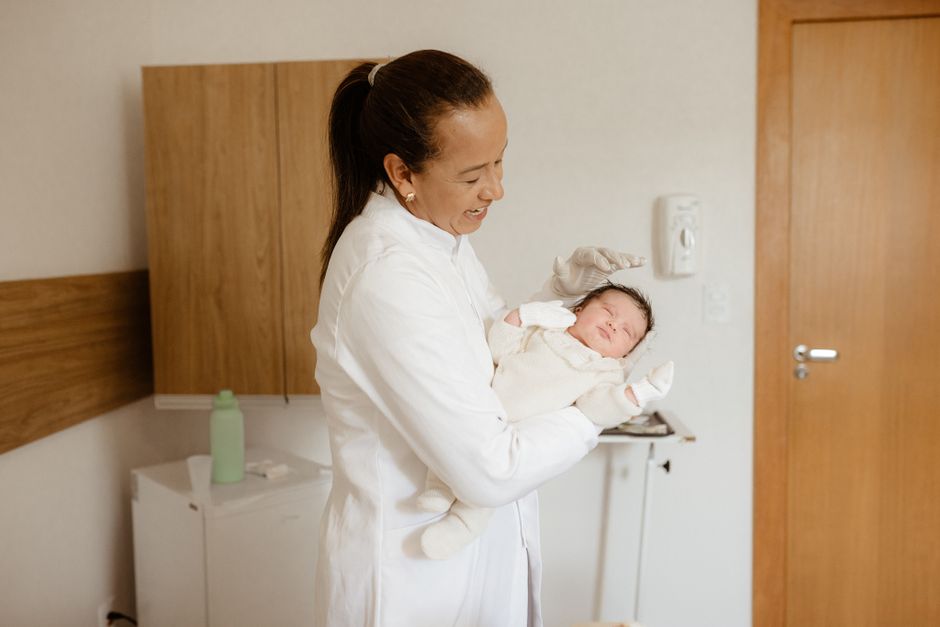
No, not all babies are born with blue eyes. Most babies of European ancestry are born with eyes that look blue-gray, and that color often changes over the first year. Babies of African, Asian, Hispanic, and other ancestries are usually born with brown eyes that stay brown. The “blue eyes at birth” idea is real, but it applies mainly to babies with lighter skin and lighter ancestry — not to every baby.
Why Are So Many Babies Born With Blue Eyes?
Eye color comes from melanin, the same pigment that colors your skin and hair. The colored part of the eye — the iris — has cells called melanocytes that produce melanin. How much melanin those cells make determines the final color.
Newborns have not finished making melanin in their eyes. Melanocytes in the iris are present at birth but often not fully active. When there is very little melanin in the front layer of the iris, light scatters and mostly blue wavelengths reflect back out. That is what makes the eye look blue. It is a lighting effect created by low pigment, not blue pigment itself. There is no blue dye in the human eye.
So the blue-gray color you see in a newborn is really “not enough melanin yet.” As melanin production ramps up over the following months, the iris can darken to green, hazel, or brown. This is why a baby’s eye color at birth is not a reliable prediction of the final color.
This process happens in babies of all backgrounds, but the starting point differs. Babies with more genetic tendency toward melanin production often already have brown eyes at birth and stay brown. Babies with less tendency start pale and may darken.
Are Babies Born With Blue Eyes — Or Do They Just Look Blue?
They genuinely look blue-gray, and in some cases they truly are blue and stay that way. The distinction matters because the color at birth is often a temporary stage rather than a final result.
Eye color is a physical trait. The iris is not fully pigmented at birth in many light-skinned babies. What you are seeing is the actual appearance of a low-melanin iris. It is not an illusion. It is just not permanent in most cases.
Two things are happening at once in a newborn’s eyes:
- The iris has little melanin, so light scatters and reflects blue.
- The pigment cells are still maturing, so the color can shift for months.
In babies who end up with blue eyes for life, the low-melanin state simply persists. In babies who end up brown-eyed, the melanin increases and the color changes. Both start from the same pale appearance.
How Does Eye Color Actually Develop?
Eye color is mostly set by genetics, but it is not a simple one-gene trait the way it was taught for decades. Multiple genes influence how much melanin ends up in the iris. The main ones control melanin production and distribution, and small variations in these genes add up to the final shade.
This is why two blue-eyed parents can have a brown-eyed child, and why two brown-eyed parents can have a blue-eyed child. The old classroom model of one dominant gene and one recessive gene is an oversimplification. Real inheritance involves several genes working together, and the outcome is not fully predictable from the parents’ eye colors alone.
Development follows a rough timeline:
- At birth: eyes often look blue-gray or dark gray in light-skinned babies.
- First few months: melanin production begins to increase.
- Around 6 to 12 months: the color starts to settle.
- By about age 3: eye color is usually close to final, though small shifts can continue in some people.
These timelines are general patterns, not rules. Some babies change quickly. Others change slowly. A few keep shifting subtly into childhood.





When Does a Baby’s Eye Color Stop Changing?
Most of the change happens in the first year. By 12 months, many babies have a color close to what they will keep. But for a meaningful number, the final color is not locked in until around age 3.
For babies born with dark brown eyes, there is usually little change. Their irises already have substantial melanin, and the color tends to stay stable from early on.
For babies born with blue-gray eyes, the direction of change is not guaranteed. Some stay blue. Some turn green or hazel. Some turn brown. You generally cannot tell which way it will go just by looking at the newborn.
One thing that does not reliably predict the outcome is the parents’ eye color. It raises the odds in one direction or another, but it does not settle the question. Genetics is more complicated than a simple chart.
Can You Predict a Baby’s Final Eye Color?
Not with certainty. You can describe probabilities based on the parents’ eye colors, but no one can promise a specific outcome from a newborn’s appearance.
Direct-to-consumer genetic tests sometimes offer eye color predictions. These are based on known gene variants and give a probability, not a guarantee. They can be reasonably accurate for some combinations and less accurate for others. They are not a substitute for just waiting.
What you can reasonably expect:
- If a baby is born with dark brown eyes, they will very likely stay brown.
- If a baby is born with blue-gray eyes, the color may stay light or darken over months.
- Parents’ eye colors shift the odds but do not determine the result.
The practical answer is that time is the only reliable predictor. By the first birthday, you usually have a good idea. By age 3, the answer is mostly settled.
Does Eye Color Affect Vision or Health?
Eye color itself does not change how well a baby sees. A blue-eyed baby and a brown-eyed baby can both have perfectly normal vision. The color of the iris is cosmetic in that sense.
There is one real health connection worth knowing. People with lighter irises have less pigment protecting the eye from ultraviolet light. Over a lifetime, that means lighter-eyed people may be somewhat more sensitive to bright light and may face a modestly higher risk of certain eye conditions linked to UV exposure. This is a long-term consideration for adults, not a concern for how a newborn’s eyes function.
Eye color is also not a sign of any disease. A baby born with blue-gray eyes is not showing a symptom of anything. It is a normal stage of development for many babies.
One exception to watch for is not about color but about appearance. If a baby’s eyes look cloudy, if one eye looks different from the other in a way that changes, or if there is persistent redness, discharge, or unusual sensitivity to light, that is worth mentioning to a pediatrician. These are not eye color issues. They are separate signs that deserve a professional look.
What About Babies Who Keep Their Blue Eyes?
Some babies are born with blue-gray eyes and keep them. This happens when the iris never develops much melanin. The genetic variants that keep melanin low in the iris are more common in people of Northern European descent, which is why blue eyes are most frequent in those populations.
Blue eyes are actually a low-pigment state, not a separate pigment. The same is true for green and gray eyes. All of these lighter colors come from having little melanin plus the way light scatters in the iris. Brown eyes have more melanin. The difference is quantity and distribution of one pigment, not different pigments for different colors.
This is a useful thing to understand because it explains why eye color can shift. As melanin increases, the color moves toward brown. If melanin stays low, the color stays light. The final color is simply where that process settles.
Do All Babies Start With Blue Eyes?
No. This is one of the most common misconceptions about newborn eye color. The “all babies are born with blue eyes” idea is not accurate.
Babies of African, Asian, Hispanic, Middle Eastern, and other ancestries with strong genetic tendencies toward melanin production are typically born with brown eyes. Their irises already contain substantial melanin, so there is no pale stage. The eyes look brown from the start and stay brown.
The blue-gray stage is common mainly in babies with lighter skin and lighter ancestry. Even within that group, not every baby starts blue. Some start gray, some start dark, and some start brown.
So the honest answer is that blue eyes at birth are common in some populations and uncommon in others. It is not a universal starting point for all humans.
Frequently Asked Questions
Are all babies born with blue eyes?
No. Many babies of European ancestry are born with blue-gray eyes, but babies of African, Asian, and other ancestries are usually born with brown eyes. The blue-gray stage is common in some groups and uncommon in others.
How long does it take for a baby’s eye color to change?
Most of the change happens in the first 6 to 12 months, and the color is usually close to final by around age 3. Some babies change quickly and others slowly, so there is no single timeline that fits everyone.
Can two blue-eyed parents have a brown-eyed baby?
Yes, this is possible. Eye color involves several genes, not just one, so the parents’ eye colors shift the odds but do not fully determine the outcome.
Does eye color affect a baby’s vision?
No. Eye color does not change how well a baby sees. Lighter eyes have less pigment to protect against ultraviolet light over a lifetime, but that is a long-term consideration, not a vision problem in infancy.
