
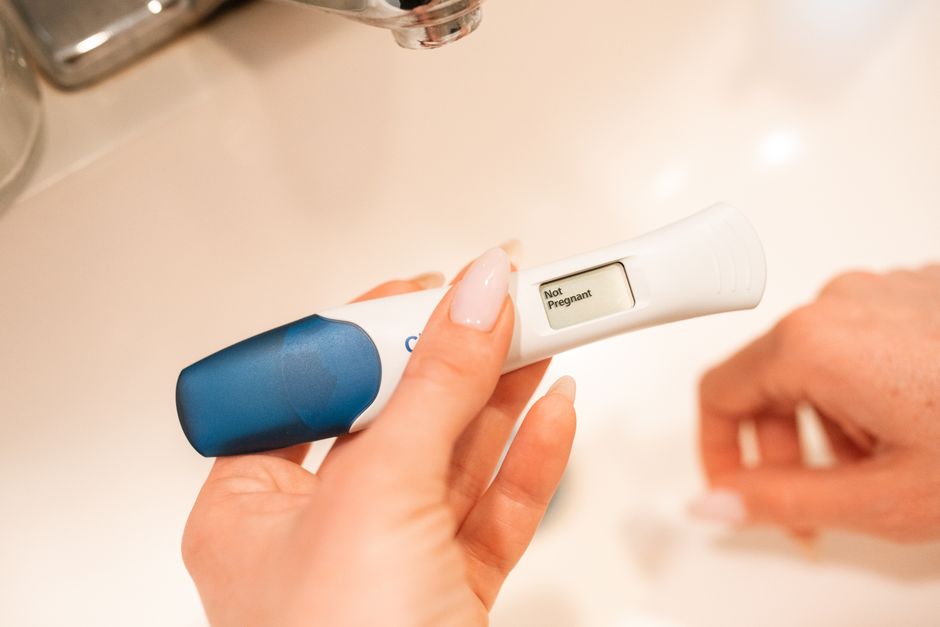
An ovulation test is designed to catch one specific hormone surge — and pregnancy produces a different hormone entirely. So no, an ovulation test is not a pregnancy test. It cannot reliably tell you whether you are pregnant, and using one that way can give you a false answer in either direction.
The confusion is understandable. Ovulation tests and pregnancy tests both work by dipping a stick into urine and reading a line or a digital result. They look nearly identical on the shelf. But they are measuring different hormones, and those hormones only partly overlap. Here is what each test actually detects, why the results can look similar, and what you should use instead.
What Does an Ovulation Test Actually Measure?
An ovulation test measures luteinizing hormone, usually called LH. LH is the hormone that surges roughly a day or two before your ovary releases an egg. That surge is the signal the test is built to catch.
LH rises and falls in a predictable pattern across the menstrual cycle. In the days before ovulation it climbs sharply, and the test turns positive when it crosses a certain threshold. This is why ovulation tests are useful for timing intercourse when you are trying to conceive — they flag the window when pregnancy is most likely.
The key point is that LH is not a pregnancy hormone. It is a cycle hormone. Its job is to trigger ovulation, not to sustain a pregnancy.
What Hormone Does a Pregnancy Test Detect?
A pregnancy test measures human chorionic gonadotropin, or hCG. This hormone is produced by the developing placenta after a fertilized egg implants in the uterus.
hCG is not normally present in meaningful amounts when you are not pregnant. It appears after implantation and rises quickly in early pregnancy. That is what makes it a reliable marker — if hCG is there, the test assumes a pregnancy is underway.
So the two tests are looking for two different molecules. LH tells you an egg is about to be released. hCG tells you an egg has already been fertilized and implanted.
Why Can an Ovulation Test Sometimes Show a Positive Result During Pregnancy?
This is where the confusion comes from, and it is a real chemical overlap. LH and hCG are built from a very similar structure. They share the same alpha subunit and have beta subunits that are closely related.
Because the two hormones are so similar, the antibodies used in some ovulation tests can cross-react with hCG. In other words, a high level of hCG — as happens in pregnancy — can sometimes trigger a positive line on an ovulation test.
That overlap is why people sometimes report a positive ovulation test and later find out they are pregnant. It is not the test detecting pregnancy on purpose. It is a case of mistaken identity at the molecular level.
But this is unreliable in both directions. The cross-reaction depends on the specific brand, the sensitivity of the test, and how much hCG is present. Some ovulation tests barely react to hCG at all. A negative ovulation test does not rule out pregnancy, and a positive one does not confirm it.




Can You Use an Ovulation Test to Find Out If You Are Pregnant?
No — not as a substitute for a pregnancy test. This is the practical bottom line.
The problem is that a positive ovulation test has two possible explanations that you cannot tell apart from the stick alone:
- You are about to ovulate, and the test is doing its normal job.
- You are pregnant, and the test is cross-reacting with hCG by accident.
Because both can produce the same result, a positive ovulation test gives you no clear answer. And a negative result is just as unhelpful — it may simply mean your hCG level is not high enough yet to cross-react, or that your particular test brand does not react to hCG at all.
Some people use ovulation tests as an early hint before a missed period, then confirm with a pregnancy test. That is a reasonable way to think about it, as long as you understand the ovulation test is not giving you a diagnosis. It is a vague clue at best.
When Should You Take a Pregnancy Test Instead?
Use a pregnancy test — not an ovulation test — whenever pregnancy is the question. Pregnancy tests are designed to detect hCG directly and are far more accurate for this purpose.
Timing matters. hCG only starts building after implantation, which usually happens several days after ovulation. Testing too early can give a false negative because there is not yet enough hCG to detect.
Most pregnancy tests are designed to be used from the first day of a missed period. Some are marketed as sensitive enough to use a few days earlier, but the earlier you test, the higher the chance of a false negative. If you get a negative result but still suspect pregnancy, waiting a few days and testing again is the standard approach.
If you have a positive pregnancy test, the next step is usually to confirm with a healthcare provider, who may use a blood test or an ultrasound. Blood tests can detect hCG earlier and measure the exact level, which urine tests cannot.
How Ovulation Tests and Pregnancy Tests Compare
| Feature | Ovulation Test | Pregnancy Test |
|---|---|---|
| Hormone detected | Luteinizing hormone (LH) | Human chorionic gonadotropin (hCG) |
| What it signals | Ovulation is approaching | A pregnancy has implanted |
| Best use | Timing conception attempts | Confirming pregnancy |
| Reliable for pregnancy? | No | Yes, when used at the right time |
| Sample type | Urine | Urine (or blood at a clinic) |
The table makes the core issue plain. Each test is built for one job. Using the wrong one for the wrong question introduces error that no amount of careful reading can fix.
Why the Two Hormones Get Confused
The structural similarity between LH and hCG is not a coincidence. Both belong to the same family of hormones, and their shared design is exactly why a test built for one can occasionally react to the other.
This is a useful thing to understand because it explains a lot of what people see online. Someone posts a photo of a positive ovulation test and a positive pregnancy test side by side, and it looks like proof that ovulation tests detect pregnancy. What is actually happening is cross-reactivity — a known limitation, not a feature.
Test manufacturers are aware of this. Many design their ovulation tests to minimize hCG cross-reaction, precisely so the test stays accurate for its intended purpose. That is good for ovulation tracking, but it makes the test even less useful as a pregnancy detector.
What If You Get a Positive Ovulation Test and Think You Might Be Pregnant?
Take a pregnancy test. That is the only reliable next step.
If you are trying to conceive, a positive ovulation test around mid-cycle most likely means you are about to ovulate — which is exactly when you would want to know. If your period is late and you are seeing positives on ovulation tests at an odd time in your cycle, a pregnancy test will give you a real answer.
If you are not trying to conceive and pregnancy is a concern, do not rely on an ovulation test to sort it out. Use a pregnancy test, and if the result is positive or you are unsure, contact a healthcare provider. They can confirm with a blood test and talk through your options.
One more honest note: no home test, ovulation or pregnancy, replaces a conversation with a clinician when something feels off. Home tests are screening tools. They are good at what they are designed for, and unreliable outside it.
Frequently Asked Questions
Can an ovulation test detect pregnancy before a missed period?
No, not reliably. An ovulation test detects LH, not hCG, and any reaction to pregnancy hormones is an accidental cross-reaction that cannot be trusted for early detection.
Why did my ovulation test show positive while I was pregnant?
LH and hCG are structurally similar, so some ovulation tests cross-react with the hCG of pregnancy. This depends on the brand and hormone levels, so it does not happen consistently.
Is a positive ovulation test a sign of pregnancy?
No. A positive ovulation test most often means you are about to ovulate, which is its intended purpose. It is not a reliable sign of pregnancy.
What should I use to confirm pregnancy?
Use a home pregnancy test, which detects hCG directly, ideally from the first day of a missed period. A healthcare provider can confirm with a blood test if needed.
