
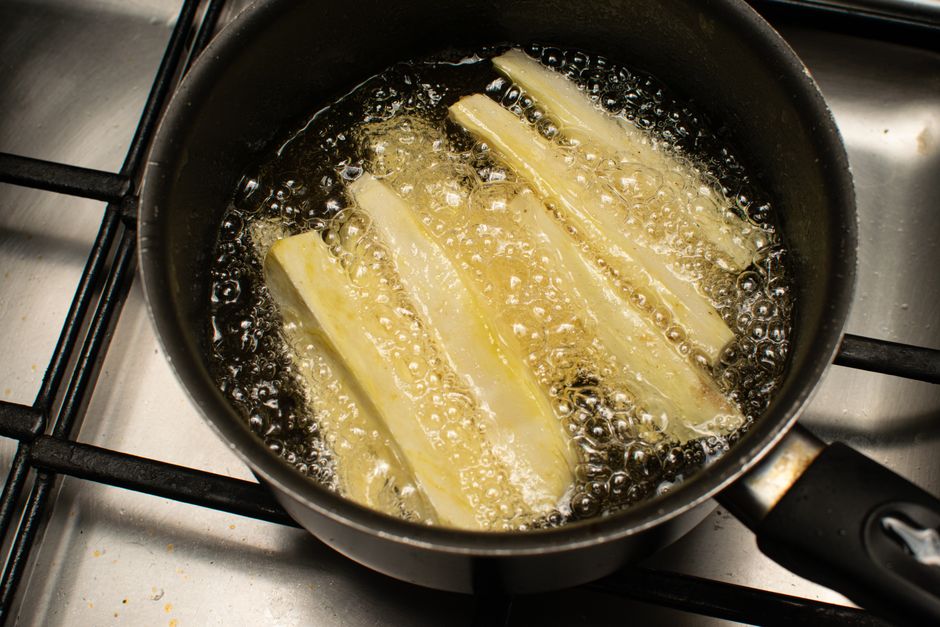
Bubbles in frying oil come from water. When food goes into hot oil, the water inside it turns to steam, and that steam rises through the oil as bubbles. A little bubbling is normal and expected. Bubbling that never stops, or that starts before any food goes in, points to a different problem — usually water or another contaminant already sitting in the oil, or oil that has broken down from repeated use.
The fix depends on which one you have. Fresh oil that foams the moment it heats up is contaminated. Oil that foams only around the food is doing its job. Oil that has turned dark, thick, and foamy after several uses is spent and needs to be replaced.
Why Your Frying Oil Is Bubbling And How To Stop It?
Water is the direct cause in almost every case, but where that water comes from changes what you should do about it.
Food is mostly water. A potato is roughly 80 percent water by weight. When it hits oil at frying temperature, that water turns to steam fast. The steam escapes upward through the oil, and you see it as bubbles. This is the same reaction that makes bread sizzle in a pan. It is not a defect. It is the cooking process working.
The bubbles slow down as the food dries out. That is why fries bubble hard for the first minute or two and then quiet down. When the bubbling nearly stops, most of the surface water is gone and the crust is forming. Cooks use this as a timing cue, and it is a reliable one.
The problem cases look different:
- Oil foams before any food is added. That means water or another contaminant is already in the oil.
- Oil foams violently and keeps foaming. The food may be wet on the surface, or the oil may be overloaded.
- Oil foams after it has been used several times. This is oil breakdown, not a water problem.
Each one has a separate cause and a separate fix. Treating all three the same way is why people keep having the same problem.
What Temperature Does Oil Need To Be For Frying?
Most deep frying happens between 350°F and 375°F (roughly 175°C to 190°C). That range is well established in food science and standard cooking references.
Temperature matters because it controls how fast water leaves the food and how much oil the food absorbs. Oil that is too cool does not drive off surface water quickly. The food sits in the oil longer, absorbs more fat, and comes out greasy. Oil that is too hot browns the outside before the inside cooks through.
There is a detail here that surprises people. Water boiling is not what makes food crisp. Water leaving is what makes food crisp. The bubbling you see is the water escaping. Once the surface dries out, the crust can form. Oil and water do not mix, so as long as steam is pushing outward from the food, oil has a hard time getting in. When the bubbling stops too early — because the oil is too cool — that outward pressure drops and the food takes on oil instead.
If you do not have a thermometer, a small cube of bread dropped in should brown in about 60 seconds at roughly 350°F to 365°F. This is a common kitchen test, not a precision instrument. A thermometer is more reliable.
What Causes Oil To Foam Before You Add Food?
If the oil bubbles or foams during heating with nothing in the pot, something is already in it. Water is the most common answer. Residual water from a previous batch, condensation, or a wet utensil can all do it.
Other contaminants cause the same effect:
- Soap residue left in the pan or fryer
- Batter or breading particles from a previous fry that were never strained out
- Salt added directly to hot oil
- Oil that has already broken down from heat, air, and repeated use
Salt is worth calling out because it is a common mistake. Salt does not dissolve in oil. It sits there and can act as a nucleation point where bubbles form. Salt your food after frying, not in the oil.
If the oil foams with nothing in it and it is fresh oil in a clean pot, the oil itself may be the issue. Some oils foam more than others, and oils that have been stored warm or exposed to light can degrade faster.




How Do You Stop Oil From Bubbling And Foaming?
Match the fix to the cause. There is no single trick that solves all three problems.
If the food is wet: pat it dry with paper towels before it goes in. This is the single most effective step for most home cooks. A dry surface means less water to flash off, which means less violent bubbling and less oil spatter.
If you are frying too much at once: fry in smaller batches. Adding a large amount of food at once drops the oil temperature sharply. Cooler oil means water leaves more slowly and the food absorbs more fat. It also means more sustained bubbling.
If the oil is contaminated: strain it, or replace it. Fine particles from previous batches sink and burn, and they accelerate breakdown. A fine mesh strainer or a coffee filter works for home use.
If the oil has broken down: replace it. Used oil that has turned dark, smells off, or foams persistently will not recover. No straining or reheating brings it back.
One more practical point. Never add water to hot oil, and never try to cool hot oil with water. Water hitting hot oil flashes to steam instantly and can throw burning oil out of the pot. If oil catches fire, cover the pan with a lid and turn off the heat. Do not use water.
How Many Times Can You Reuse Frying Oil?
There is no fixed number that applies to everyone. Reuse depends on what you fried, how hot the oil got, how long it stayed hot, and how well you filtered it between uses.
What is well established is what breakdown looks like. Oil degrades through heat, oxygen, and repeated exposure to food particles. As it breaks down, it darkens, thickens, foams more readily, and develops an off smell. Those are the signals to watch, and they matter more than a count of batches.
Some general guidance holds up:
- Oil used for lightly breaded foods and strained well after each use lasts longer than oil used for battered foods.
- Oil used for fish or strongly flavored foods picks up those flavors and is usually best used only for similar foods afterward.
- Oil held at high heat for long periods breaks down faster than oil heated briefly.
If the oil foams early in heating, smells stale or soapy, or looks darker than when you started, replace it. Those are not preferences. They are signs the oil has chemically changed.
Does The Type Of Oil Affect Bubbling?
Yes, but less than most people assume. The bigger factors are water, temperature, and how used the oil is.
Oils differ in smoke point, which is the temperature at which they begin to break down and produce visible smoke. Refined oils generally have higher smoke points than unrefined ones. Frying above an oil’s smoke point accelerates breakdown, and broken-down oil foams more.
For deep frying, oils with higher smoke points are the practical choice. Common options include refined canola, refined peanut, and refined vegetable oils. Extra virgin olive oil has a lower smoke point and is generally not the first choice for deep frying, though it is fine for shallow pan frying at moderate heat.
What does not hold up is the idea that one oil will never foam. Any oil will foam if it is wet enough, cool enough, or old enough.
When Should You Throw Out Frying Oil?
Throw it out when the signs of breakdown are clear. Foaming that starts early and does not stop is the most reliable one. A dark color, a thick feel, and an off or acrid smell are the others.
Oil that is merely cloudy can often be strained and reused. Oil that foams persistently cannot. The difference is that cloudiness is usually suspended particles, while persistent foaming reflects a change in the oil itself.
Dispose of used oil by letting it cool completely, then pouring it into a sealed container and putting it in the trash. Do not pour it down the drain. It clogs pipes.
Frequently Asked Questions
Why is my frying oil bubbling so much?
Water in the food is turning to steam and rising through the oil, which is normal. If the oil bubbles before you add food or keeps foaming after the food is done, the oil is contaminated or has broken down.
Why is my oil foaming with nothing in it?
Something is already in the oil, most often water, soap residue, or fine food particles from a previous batch. Fresh oil in a clean, dry pot should not foam during heating.
Can I still use oil that foams?
If it foams only while food is frying, it is fine and doing what it should. If it foams before food goes in or foams persistently, replace it rather than trying to strain or reheat it.
How do I stop oil from splattering and bubbling?
Pat food dry before frying, fry in smaller batches, and keep the oil between 350°F and 375°F. These three steps address the most common causes without any special equipment.
