
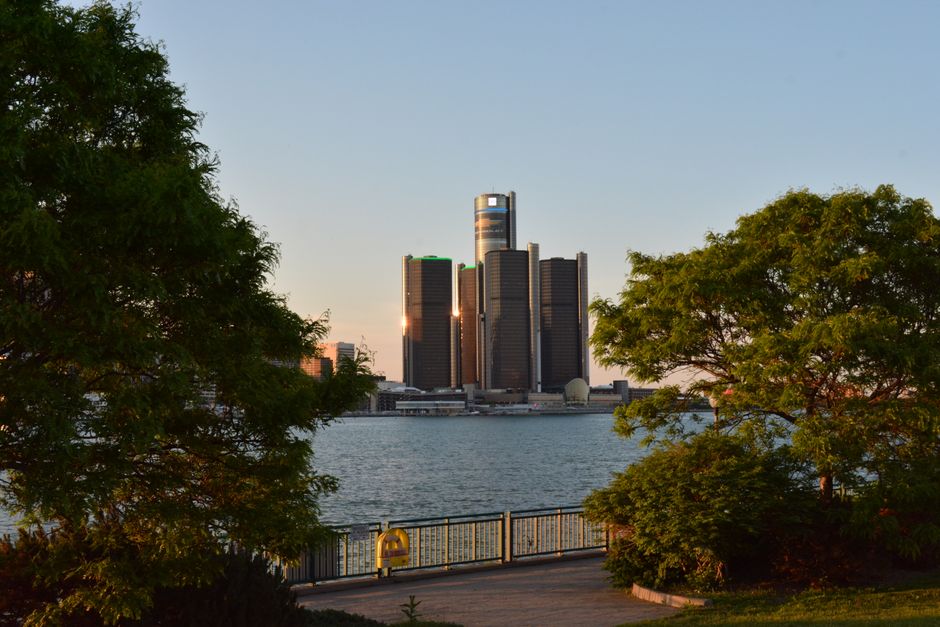
Detroit’s air quality can turn bad on any given day due to a combination of local industrial emissions, heavy traffic on major highways, and weather patterns that trap pollution close to the ground. When conditions are calm and stagnant, pollutants from cars, factories, and power plants accumulate in the air instead of dispersing. The most common culprit for a sudden spike in bad air is a weather phenomenon called a temperature inversion, which acts like a lid over the city.
What Causes Detroit’s Air Pollution on a Daily Basis?
Detroit has a unique mix of pollution sources that most other Midwestern cities do not share to the same degree. The city is surrounded by heavy industry, including steel mills, oil refineries, and chemical plants along the Detroit River. These facilities release fine particles, sulfur dioxide, and volatile organic compounds into the air every day.
Traffic is the other major contributor. The interstate system that runs through and around Detroit carries hundreds of thousands of vehicles daily. Cars and diesel trucks emit nitrogen oxides and particulate matter. When these emissions combine with sunlight and heat, they form ground-level ozone, which is the main ingredient in smog.
On a normal day, wind disperses these pollutants. On a bad air day, the wind is weak or the air is stagnant. The pollution simply sits over the city and builds up over hours.
Why Is Detroit Air Quality Bad Today? Why It Happens
If you check an air quality app and see Detroit listed as unhealthy, the immediate reason is usually a weather pattern. A high-pressure system settles over the Great Lakes region. High pressure brings clear skies and light winds, which sounds pleasant but is terrible for air quality. Without wind to push pollution away, emissions accumulate near the ground.
Temperature inversions make it worse. Normally, air near the ground is warmer than the air above it, so pollution rises and mixes into the atmosphere. During an inversion, a layer of warm air sits on top of cooler air near the surface. This traps the cooler, polluted air underneath. The city is effectively sealed inside a dome of its own exhaust.
Seasonal factors matter too. In winter, inversions are more frequent and last longer. People run their furnaces, and coal or gas power plants work harder. In summer, heat and sunlight drive chemical reactions that create ozone. Both seasons have their own reasons for producing bad air days.
How the Air Quality Index (AQI) Works
The Air Quality Index is a scale from 0 to 500 that tells you how polluted the air is right now. A value under 50 is good. From 51 to 100 is moderate, which is acceptable for most people but may affect those who are sensitive. From 101 to 150 is unhealthy for sensitive groups, including children, older adults, and people with asthma or heart disease.
When the AQI passes 151, the air is considered unhealthy for everyone. Levels above 201 are very unhealthy, and above 301 is hazardous. Detroit occasionally hits the orange zone (101-150) and less frequently the red zone (151-200). The highest readings usually happen during heat waves in July and August when ozone formation peaks.
The AQI is calculated based on five major pollutants: ground-level ozone, particulate matter (PM2.5 and PM10), carbon monoxide, sulfur dioxide, and nitrogen dioxide. In Detroit, ozone and PM2.5 are the two pollutants that most often push the index into unhealthy territory.





What Is PM2.5 and Why Is It Dangerous?
PM2.5 refers to tiny particles in the air that are 2.5 micrometers in diameter or smaller. For scale, a human hair is about 70 micrometers wide. These particles are small enough to bypass the body’s natural defenses in the nose and throat and travel deep into the lungs. From there, they can enter the bloodstream.
These particles come from combustion. Diesel engines, coal-fired power plants, wood burning, and industrial processes all produce them. In Detroit, the combination of diesel truck traffic and industrial activity means PM2.5 levels can climb quickly during stagnant weather.
Short-term exposure to high PM2.5 levels can irritate the eyes, nose, and throat. It can trigger coughing and worsen asthma. For people with heart conditions, even a day or two of elevated PM2.5 can increase the risk of serious events. This is not speculation; it is well-documented in environmental health research.
How Detroit Compares to Other Major Cities
Detroit is not the most polluted city in the United States, but it consistently ranks among the more polluted areas in the Midwest. Cities like Los Angeles and Houston often have worse ozone problems. However, Detroit’s proximity to heavy industry along the river gives it a distinctive pollution profile.
The American Lung Association’s annual State of the Air report has historically graded Detroit’s county areas poorly for both ozone and particle pollution. Some years the region receives an F grade for one or both categories. This means Detroit residents face more days with unhealthy air than residents of many other comparable cities.
The problem is not uniform across the metro area. Neighborhoods closest to the interstate highways and industrial corridors experience worse air quality than suburbs farther away. This pattern is consistent with what environmental researchers call environmental justice concerns, where lower-income communities often bear a greater pollution burden.
How to Protect Yourself on Bad Air Days
When the AQI reaches unhealthy levels, the most effective step is to reduce your exposure. This does not require dramatic lifestyle changes, just practical adjustments.
- Check the AQI in the morning before planning outdoor activities. Many weather apps include it.
- Limit strenuous outdoor exercise when the AQI is above 100. Walking is fine; running or cycling increases your breathing rate and pulls more pollution into your lungs.
- Keep windows closed and run an air purifier with a HEPA filter indoors if you have one.
- Avoid exercising near busy roads even on moderate air days. Pollution levels drop significantly just 200 to 500 feet away from major traffic.
- If you have asthma or heart disease, keep your rescue medications accessible on bad air days.
Masks like N95 respirators can filter out particulate matter if you must be outdoors for extended periods. They do not protect against ozone gas, so they are not a complete solution on smoggy summer days.
What Detroit Is Doing to Improve Air Quality
Detroit has made real progress over the past few decades. Air pollution levels are lower today than they were in the 1970s and 1980s, largely due to federal regulations like the Clean Air Act. Cars are cleaner, power plants have scrubbers, and industrial facilities face stricter emissions limits.
Ongoing efforts include electric bus fleet conversions by the Detroit Department of Transportation and state-level programs to reduce vehicle emissions. Community groups in Southwest Detroit, which sits near major industrial facilities and highways, have pushed for more air quality monitors in their neighborhoods. More monitoring means better data, which leads to more targeted action.
However, the fundamental challenge remains. A city built around the automobile and heavy industry will always face air quality pressure. Weather patterns that trap pollution are beyond human control. The goal is to reduce the baseline emissions so that even on stagnant days, the air stays within safer limits.
When Is Detroit’s Air Quality Worst?
Statistically, the worst air days in Detroit cluster in the summer months. Ground-level ozone forms when nitrogen oxides and volatile organic compounds react in the presence of sunlight and heat. July and August afternoons are prime conditions for this reaction, especially in late afternoon when traffic emissions peak and temperatures are highest.
Winter brings a different problem. Cold air inversions are more common and more persistent. Wood burning for heat, whether in homes or commercial buildings, adds particulate matter to the air. Diesel engines also emit more particles in cold weather because they run less efficiently.
There is also a daily pattern. Air quality is typically worst in the late afternoon and early evening. Morning rush hour creates a spike, but the sun has not yet had time to drive ozone formation. By mid-afternoon, the chemical reactions have had hours to cook, and the full effect is felt.
Frequently Asked Questions
Is Detroit’s air quality dangerous to breathe?
On days when the AQI is above 150, the air is unhealthy for everyone and can cause immediate symptoms like coughing or shortness of breath. On moderate days, the air is acceptable for most people but may bother sensitive individuals.
Why does Detroit smell bad sometimes?
The smell is usually from industrial emissions along the river, particularly sulfur compounds from refineries or wastewater treatment. These odors can occur even when the AQI is moderate, and they are a sign that industrial activity is releasing gases into the air.
Can air purifiers help with Detroit’s pollution?
HEPA air purifiers effectively remove particulate matter from indoor air and can meaningfully reduce PM2.5 exposure. They do not remove ozone gas, so their benefit is partial on smoggy summer days.
How often does Detroit have unhealthy air days?
Detroit typically experiences several days each year in the unhealthy-for-sensitive-groups range, with occasional days that are unhealthy for everyone. The exact number varies by year depending on weather patterns and wildfire smoke from Canada.
