
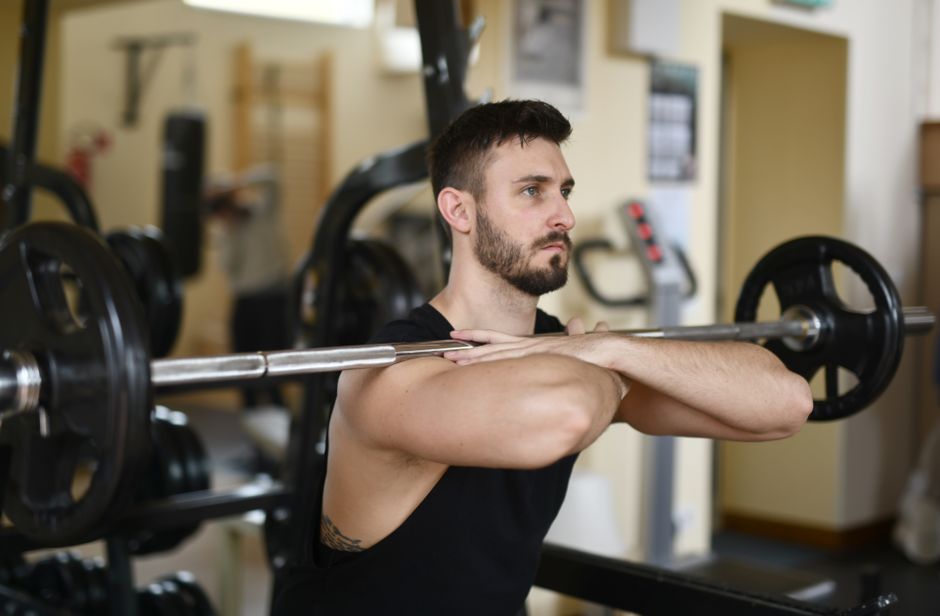
The front squat is one of the most effective lower-body exercises for building quadriceps strength, and it does so with less stress on the lower back and knees compared to the back squat. By placing the barbell on the front of the shoulders, the torso stays more upright, which shifts the workload to the quads while reducing the shear forces on the spine. This makes the front squat a valuable tool for lifters who want heavy leg development without the joint discomfort that often comes with other squat variations.
How the Front Squat Targets the Quadriceps
The front squat places the bar on the front deltoids, not on the upper back like a back squat. This simple change in bar position alters your center of gravity. To keep the bar balanced over your midfoot, your torso must remain more vertical throughout the movement. When your torso is upright, your knees travel further forward over your toes. That forward knee travel increases the angle at the knee joint, which forces the quadriceps to do more of the work.
The quadriceps are the muscles on the front of your thigh. They are responsible for extending the knee. In a front squat, the knee flexion is deeper relative to the hip angle. This means the quads are under greater tension for a longer portion of the lift. Research consistently shows that front squats produce higher quadriceps activation than back squats. The upright torso position is the key reason. It is not that the back squat is a bad exercise. It is that the front squat biases the quads more effectively.
Why the Front Squat Reduces Lower Back Stress
Lower back pain is a common reason people avoid heavy squatting. The back squat, especially the low-bar variation, requires you to lean forward. That forward lean increases the moment arm on the lumbar spine. The lower back must work harder to keep the trunk stable. Over time, this can aggravate existing back issues or create new ones.
The front squat reduces this stress because of the upright torso position. When your torso is vertical, the load stays closer to your spine’s natural alignment. The compressive forces on the vertebrae are more evenly distributed. Shear forces, which are the forces that push vertebrae against each other in opposite directions, are significantly lower. Some studies indicate that front squats reduce lumbar spine compression and shear forces compared to back squats. This does not mean the front squat is risk-free for your back. It means the mechanical demands on the lower back are lower, which is why many lifters with back sensitivity can front squat comfortably when they cannot back squat.
Knee Joint Stress: What the Research Shows
Many lifters worry that the forward knee travel in a front squat will hurt their knees. This concern is understandable but largely misplaced for healthy knees. The knee joint experiences forces in every squat variation. The question is not whether the knee is stressed, but how that stress is distributed.
In a front squat, the increased knee flexion places more stress on the quadriceps tendon and the patellofemoral joint. However, the total load on the knee is typically lower than in a back squat because you can handle less weight in the front rack position. The reduced external load often offsets the increased knee flexion. For lifters with healthy knees, this is generally well-tolerated. For those with patellofemoral pain, the front squat may still be uncomfortable because of the deep knee bend. It is not automatically safer for every knee condition. But for most people, the front squat does not increase knee injury risk when performed with proper form and appropriate loading.




How to Perform the Front Squat Correctly
Proper technique is not optional. It is the difference between a productive lift and an injury. Start with the bar in a front rack position. The bar rests on your anterior deltoids, not on your hands or wrists. Your elbows should be high, pointing forward. Your upper arms should be roughly parallel to the floor. If your elbows drop, the bar will roll forward, and you will lose the lift.
Set your feet shoulder-width apart or slightly wider. Point your toes out slightly, about 10 to 15 degrees. Take a deep breath into your belly and brace your core. Break at the hips and knees simultaneously. Descend with control, keeping your chest up and elbows high. Go down until your thighs are at least parallel to the floor. Deeper is fine if you have the mobility. Drive through your midfoot and stand up. Keep your heels planted the entire time. Do not let your knees cave inward. Push your knees out in line with your toes on the way up.
Common Mistakes That Increase Joint Stress
The front squat is technically demanding. Mistakes happen, and they usually increase joint stress. The most common error is letting the elbows drop. When the elbows drop, the bar moves forward. You compensate by leaning forward, which turns the front squat into a back squat with a front bar position. This defeats the purpose and increases lower back stress.
Another mistake is lifting with the wrists in a bent position under the bar. This places unnecessary stress on the wrist joints. If you lack wrist mobility, use a cross-arm grip or lifting straps. Both allow you to maintain an upright torso without wrist pain. A third mistake is using too much weight before your technique is solid. The front squat is not a lift to ego-lift. Start light, master the position, and add weight gradually. Your joints will thank you.
Why Front Squat Quad Strength With Less Joint Stress Works
The mechanical setup of the front squat is what allows for quad development with reduced joint strain. The bar position forces an upright torso. The upright torso reduces spinal shear forces. The forward knee travel increases quad activation. The reduced load on the bar decreases overall joint compression. These factors work together to create a squat pattern that is kinder to the spine and knees while still challenging the quads heavily.
This is why many physical therapists and strength coaches use front squats in rehabilitation settings. They are a way to load the lower body without exposing the spine to the same stresses as a back squat. It is also why front squats are a staple in Olympic weightlifting programs, where quad strength and upright posture are essential. For the general lifter, the front squat is one of the best returns on investment you can get for leg strength and joint health.
When to Choose the Front Squat Over the Back Squat
The front squat is not always the better choice. It depends on your goals and your body. If you want to lift the maximum amount of weight possible, the back squat wins. You can load a back squat with significantly more weight because the mechanics are more favorable for heavy loads. If you are a powerlifter, the back squat is part of your sport. You should train it.
Choose the front squat when your priority is quad development, when you have lower back sensitivity, or when you want to improve your posture under load. Many lifters use both. They back squat for overall lower body strength and front squat for quad emphasis and joint-friendly volume. If you have a history of knee issues, talk to a physical therapist before adding either squat variation to your routine. They can assess your specific movement patterns and tell you what is appropriate.
Frequently Asked Questions
Is the front squat easier on the knees than the back squat?
For most people, yes. The front squat uses less total weight, which reduces overall knee compression even though knee flexion is greater. However, people with specific patellofemoral pain may still find deep knee bends uncomfortable.
Why can I front squat more comfortably with a bad lower back?
The upright torso position reduces shear forces on the lumbar spine compared to the forward lean of a back squat. This lower mechanical stress on the vertebrae is why many people with back sensitivity tolerate front squats better.
Do front squats build bigger quads than back squats?
Front squats produce higher quadriceps activation because of the greater knee flexion and upright torso. Some studies suggest this leads to comparable or greater quad growth over time, though back squats still build substantial quad size.
What weight should I use for front squats compared to back squats?
Most lifters can front squat about 70 to 80 percent of their back squat weight. This is normal. The front rack position is mechanically harder, so do not be concerned if your front squat numbers are lower.
