
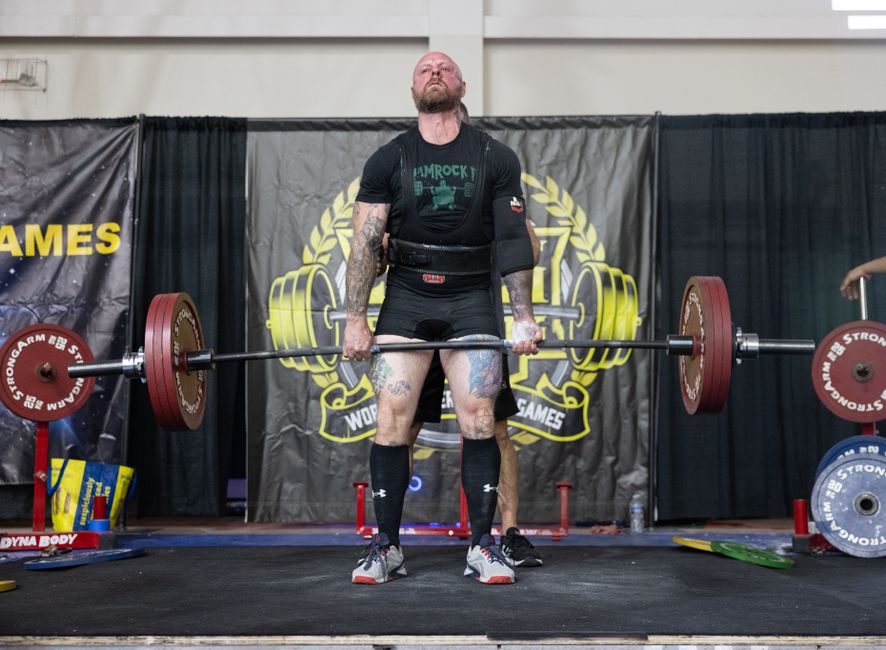
If your squat has crept past your deadlift, you are not doing anything wrong. It is one of the most common patterns in the gym, and it usually comes down to mechanics, not weakness. The squat and the deadlift look similar from across the room, but they place different demands on your body, and those differences explain why one number often runs ahead of the other.
Why Do I Squat More Than I Deadlift?
The short answer is leverage. In a squat, the bar sits on your upper back, close to your center of mass, and your legs travel through a longer range of motion with your torso relatively upright. In a deadlift, the bar starts on the floor, and you have to pull it past your knees while your hips and torso are folded forward. That starting position puts your back and hip extensors at a mechanical disadvantage compared to the bottom of a squat.
There is also a second reason that gets less attention: the squat has an eccentric phase. You lower the bar under control before you stand up. That stretch-shortening action lets your muscles store and reuse a small amount of elastic energy, which can help you move more weight. The deadlift starts from a dead stop on the floor. No stored energy, no rebound. Every rep begins from zero.
So when someone asks why they squat more than they deadlift, the honest answer is that these are two different lifts with two different leverage profiles. Comparing them directly is a bit like comparing a bench press to an overhead press. Both are pressing movements, but the mechanics are not the same.
What Makes the Deadlift Mechanically Harder?
Three things separate the deadlift from the squat in terms of difficulty.
Range of motion and bar path. In a squat, the bar moves in a mostly vertical line over your midfoot. In a deadlift, the bar starts at your shins and has to travel up past your knees before your hips can lock out. That longer path means more time under tension and more opportunity for the bar to drift away from your body.
Starting position. At the bottom of a deadlift, your hips are higher than they are in a squat, and your torso is angled forward. Your spinal erectors and hamstrings have to work harder to keep your back from rounding. In a squat, your torso stays closer to vertical, which reduces the load on your lower back.
No stretch reflex. As mentioned above, the squat uses the stretch reflex. The deadlift does not. That alone can account for a meaningful difference in how much weight you can move.
Is It Normal to Squat More Than You Deadlift?
Yes, it is common, especially for people who train squats more often or who have a build that favors squatting.
Body proportions matter a lot here. If you have long arms and a short torso, you are built for deadlifting. If you have short arms and a long torso, you are built for squatting. Most people fall somewhere in between, and their numbers reflect that.
Training history matters too. If you squat twice a week and deadlift once, your squat will likely pull ahead. If you deadlift heavy every week and squat light, the opposite happens. The lift you practice more is usually the lift you are better at.
What is less common is a large gap. If your squat is significantly higher than your deadlift and you have been training both consistently, it may be worth looking at your deadlift technique or your recovery.





When Does a Big Gap Signal a Problem?
A gap of a few pounds is normal. A gap of 50 or 100 pounds in someone who trains both lifts equally is worth investigating.
Several things can cause a deadlift to lag behind a squat:
- Grip strength. If your hands give out before your back and legs do, your deadlift will stall. Straps can help you train the pull without your grip being the limiting factor.
- Starting position. If your hips are too low or too high at the start, you lose leverage and the bar feels heavier than it is.
- Weak upper back. The deadlift requires your upper back to stay tight to keep the bar close. If that area fatigues early, the bar drifts forward and the lift fails.
- Recovery. Deadlifts are taxing on the lower back and nervous system. If you deadlift after a heavy squat day, your numbers will suffer.
None of these are reasons to panic. They are simply things to check if the gap bothers you.
Does Body Type Affect Squat vs Deadlift Strength?
Body type affects both lifts, but it tends to affect them in opposite ways.
Lifters with short legs and a long torso tend to squat well because their torso stays upright and their knees can travel forward without their hips shooting back. The same build can make deadlifting harder because the starting position requires more forward lean, which puts more strain on the lower back.
Lifters with long arms and short legs tend to deadlift well because the bar has less distance to travel and their starting position is more efficient. The same build can make squatting harder because the torso has to lean forward more to keep the bar over the midfoot.
This is why you see some people pull massive deadlifts and squat relatively little, and others do the reverse. It is not a sign of weakness in either lift. It is just how levers work.
Should You Try to Close the Gap?
Only if you want to. There is no rule that says your deadlift and squat have to match.
If you do want to bring your deadlift up, the most effective approach is usually to deadlift more often and to treat it as a skill, not just a strength exercise. That means paying attention to your setup, your bar path, and your bracing.
Some lifters find that adding a second deadlift day, even a light one, helps. Others find that reducing squat volume frees up recovery for deadlifts. Both approaches can work. The right one depends on your goals and how you recover.
What does not work is assuming that because you can squat a certain weight, you should be able to deadlift it. The two lifts are not interchangeable. They use different muscles in different ways, and they reward different body types.
What About the Idea That Deadlift Is More “Functional”?
You will sometimes hear that the deadlift is more functional than the squat because it mimics picking things up off the floor. That is true in a narrow sense. But “functional” is a fuzzy word.
Both lifts train your hips, legs, and back. Both carry over to daily activities like getting out of a chair or lifting a box. Neither is inherently better than the other. If your goal is general strength, doing both is better than doing either one alone.
The idea that one lift is more “real-world” than the other is mostly marketing. Your body does not know the difference between a barbell and a bag of groceries. It only knows load and movement pattern.
Frequently Asked Questions
Why can I squat more than I deadlift?
Because the squat uses the stretch reflex and keeps the bar closer to your center of mass, while the deadlift starts from a dead stop and puts your back at a mechanical disadvantage. These differences often let lifters move more weight in the squat.
Is it bad if my squat is stronger than my deadlift?
No, it is common and usually not a problem. A large gap may be worth checking if you train both lifts equally, but a small gap is normal.
How do I increase my deadlift if my squat is ahead?
Deadlift more often, treat it as a skill, and make sure your grip and upper back are not limiting factors. Some lifters also benefit from reducing squat volume to free up recovery.
Does body type determine whether you squat or deadlift more?
Yes, body proportions play a big role. Short arms and a long torso tend to favor squatting, while long arms and short legs tend to favor deadlifting.
