
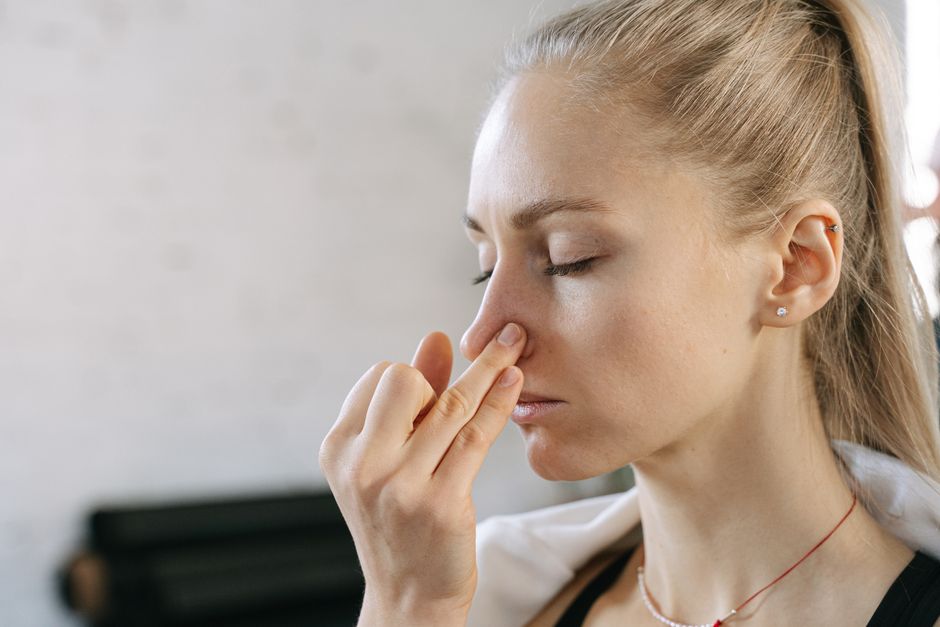
You notice a smell that seems to be coming from inside your own nose. It is not something in the room. It is not your neighbor’s cooking. It is a smell that feels like it is coming from your own mucus. This is not a common topic people talk about, but it is more common than you might think. The smell usually means there is something happening inside your nasal passages or sinuses that is creating an odor your nose can detect. The causes range from simple infections to less common neurological issues. Understanding why this happens is the first step to knowing what to do about it.
What Causes a Bad Smell in Your Nose?
The most common reason you smell mucus in your nose is an infection. When bacteria or fungi grow in your sinuses or nasal passages, they can produce waste products that have a distinct smell. Your nose picks up on that smell and you perceive it as coming from inside your head.
Sinusitis is the usual suspect. The CDC reports that about 28.9 million adults in the United States are diagnosed with sinusitis each year. When your sinuses are inflamed and filled with mucus that does not drain properly, bacteria can multiply. Some of these bacteria, like certain strains of Pseudomonas or anaerobic bacteria, are known to produce foul-smelling compounds. The smell can be sweet, musty, or like old cheese depending on the specific bacteria involved.
Another cause is a condition called atrophic rhinitis. This is less common but well-documented in medical literature. The lining of your nose thins out and the tissues shrink. Crusts form inside the nasal cavity, and bacteria grow on those crusts. The result is a persistent bad smell that the person can often smell themselves. Research published in the American Journal of Rhinology & Allergy has described this condition and its impact on quality of life.
Foreign objects are a surprisingly common cause, especially in children but also in adults with certain medical conditions. A piece of tissue, a bead, or even a dried blood clot can sit in the nasal passage for days or weeks. Bacteria start breaking it down and the smell follows. This is almost always one-sided — you only smell it in one nostril.
Why Do I Smell Mucus In My Nose When I Am Not Sick?
You can smell mucus in your nose even when you do not have a cold or flu. This can be confusing and worrying. The reason is that not all infections cause the classic symptoms of congestion, fever, or runny nose.
Chronic sinusitis is a prime example. The American Academy of Otolaryngology defines chronic sinusitis as inflammation of the sinuses lasting 12 weeks or longer. Many people with chronic sinusitis do not have constant pain or thick green discharge. They might just have a low-grade stuffiness, post-nasal drip, or that smell. The bacteria are still there, producing odor, even though the obvious signs of infection are mild or absent.
Fungal sinusitis is another possibility. There are different types, but the non-invasive form can cause a cheesy or musty smell. Fungal balls, also called mycetomas, can form in the sinuses. They are collections of fungus and mucus that do not invade the tissue but do create odor. A 2019 review in Current Allergy and Asthma Reports noted that fungal sinusitis is often underdiagnosed because its symptoms can be subtle.
Dental problems can also cause a smell in the nose that has nothing to do with a sinus infection. An abscessed tooth or a root canal infection in the upper jaw can spread into the maxillary sinus. This is called odontogenic sinusitis. The smell is actually coming from the tooth infection, but you perceive it in your nose because the sinus is right there. Studies suggest that up to 40% of cases of maxillary sinusitis may have a dental origin.
What Does Research on Nasal Odors Show?
Research on why people smell mucus in their nose has focused on three main areas: the types of bacteria involved, the role of the olfactory system, and the psychological impact of these smells.
A study published in International Forum of Allergy & Rhinology in 2020 looked at the bacterial profiles of people with chronic sinusitis who reported bad smells. They found that certain bacteria like Staphylococcus aureus and anaerobic bacteria were more common in those patients. The bacteria were not just present — they were actively producing volatile sulfur compounds. Those are the same compounds that make rotten eggs smell bad.
Another area of research involves something called phantosmia. This is when you smell something that is not actually there. It is a type of olfactory hallucination. Phantosmia can be triggered by sinus infections, head injuries, migraines, or even certain medications. A 2018 study in Chemical Senses found that about 6% of people with phantosmia reported the smell as being “foul” or “rotten.” The difference between phantosmia and a real infection is that with phantosmia, no one else can smell it, and it comes and goes without any mucus production.
The evidence also shows that chronic bad smells in the nose can affect mental health. A study in Rhinology found that people with persistent nasal odors had higher rates of anxiety and depression. They were also more likely to avoid social situations. This is not just about being embarrassed. The brain processes smell and emotion in overlapping regions, so a constant bad smell can directly affect your mood.





How to Tell If the Smell Is Coming From Your Nose or Somewhere Else
It can be hard to know if the smell is actually coming from your nasal passages or if it is a problem with how your brain processes smell. There is a simple way to check.
Cover one nostril and breathe in through the other. Then switch. If the smell is stronger on one side, it is likely coming from that nasal passage or sinus. If the smell is the same on both sides, it could be coming from the back of your throat, your mouth, or it could be a neurological issue.
Another clue is whether the smell changes with position. If you lean forward and the smell gets stronger, it may be coming from your sinuses. If you lie down and it changes, that also points to a physical source inside your head.
Here is a quick comparison of common causes and their signs:
| Cause | Typical Signs | One or Both Sides |
|---|---|---|
| Bacterial sinusitis | Congestion, facial pressure, thick discharge | Often both |
| Dental infection | Tooth pain, bad taste in mouth | Usually one side |
| Foreign object | No other symptoms except smell | Always one side |
| Phantosmia | No mucus, comes and goes | Both sides equally |
| Atrophic rhinitis | Dryness, crusting, no congestion | Both sides |
What Are the Common Misconceptions About Nasal Smells?
There is a lot of bad information online about why you smell mucus in your nose. Some of it is harmless but some of it can lead to wrong treatments.
The biggest misconception is that a bad smell in your nose always means a serious infection that needs antibiotics. That is not true. Many cases of sinusitis are viral, not bacterial. Antibiotics will not help a viral infection. They can actually make things worse by killing off good bacteria and allowing resistant bacteria to grow. The CDC estimates that about 30% of antibiotic prescriptions for sinusitis are unnecessary.
Another myth is that using nasal sprays or rinses with essential oils will fix the smell. Tea tree oil, eucalyptus, and peppermint are popular in DIY remedies. There is no strong clinical evidence that any of these oils kill the bacteria that cause nasal odors. Some of them can actually irritate the nasal lining and make inflammation worse. The American Academy of Allergy, Asthma & Immunology warns against putting undiluted essential oils into the nose.
Some people believe the smell means they have a brain tumor or a serious neurological disease. This is extremely rare. While certain neurological conditions like Parkinson’s disease or Alzheimer’s can affect the sense of smell, they usually cause a loss of smell rather than a bad smell. A persistent bad smell in the nose is far more likely to be a sinus or dental issue than a brain problem.
A final misconception is that you can “flush out” the smell by using a neti pot or saline rinse more often. Saline rinses can help by thinning mucus and removing debris. But if the source of the smell is a fungal ball or a dental abscess, rinsing will not reach it. Over-rinsing can also strip the protective mucus layer and make the nasal lining more vulnerable to irritation.
What to Do If You Smell Mucus in Your Nose
If you have been smelling mucus in your nose for more than a week, it is worth seeing a doctor. Start with your primary care provider. They can look in your nose with an otoscope and check for obvious issues like swelling or a foreign object. They can also refer you to an ear, nose, and throat specialist if needed.
An ENT doctor has tools that give a much better view. A nasal endoscope is a thin tube with a camera that goes into your nasal passages. It lets the doctor see the sinus openings, the lining, and any growths or blockages. A CT scan can show the sinuses in detail and reveal fluid levels, polyps, or fungal balls that are not visible from the outside.
If the cause turns out to be bacterial sinusitis, treatment usually involves a course of antibiotics. The typical duration is 5 to 7 days for acute cases, but chronic cases may need longer. Nasal steroid sprays can reduce inflammation and help the sinuses drain. Saline rinses are safe to use as a supportive measure, not as a cure.
For fungal sinusitis, treatment depends on the type. A fungal ball often needs to be removed surgically. Allergic fungal sinusitis may need surgery plus oral or topical steroids. Antifungal medications are not usually effective for the non-invasive forms.
If the cause is dental, you need to see a dentist. The tooth infection needs to be treated first. Once the dental problem is resolved, the sinusitis usually clears up on its own without separate treatment.
For phantosmia, treatment is more about managing the symptom. Some people find that saline rinses help temporarily. In severe cases, medications used for migraines or nerve pain can reduce the frequency of the phantom smells. Surgery is rarely needed for phantosmia alone.
Frequently Asked Questions
Can allergies cause a bad smell in my nose?
Allergies alone rarely cause a bad smell. But allergies can lead to sinus inflammation that traps mucus, which can then get infected and produce odor.
Is a bad smell in my nose a sign of COVID-19?
COVID-19 is more known for causing loss of smell rather than a bad smell. Some people report distorted smells during recovery, but a persistent bad smell is not a typical symptom.
How long does it take for sinusitis-related smell to go away?
With proper treatment, the smell usually improves within a few days to a week. Chronic cases may take longer and sometimes require surgery to fully resolve.
Can nasal polyps cause a bad smell?
Nasal polyps themselves do not produce smell. But they can block sinus drainage and lead to infections that do cause odor. Treating the polyps often helps the smell go away.
