
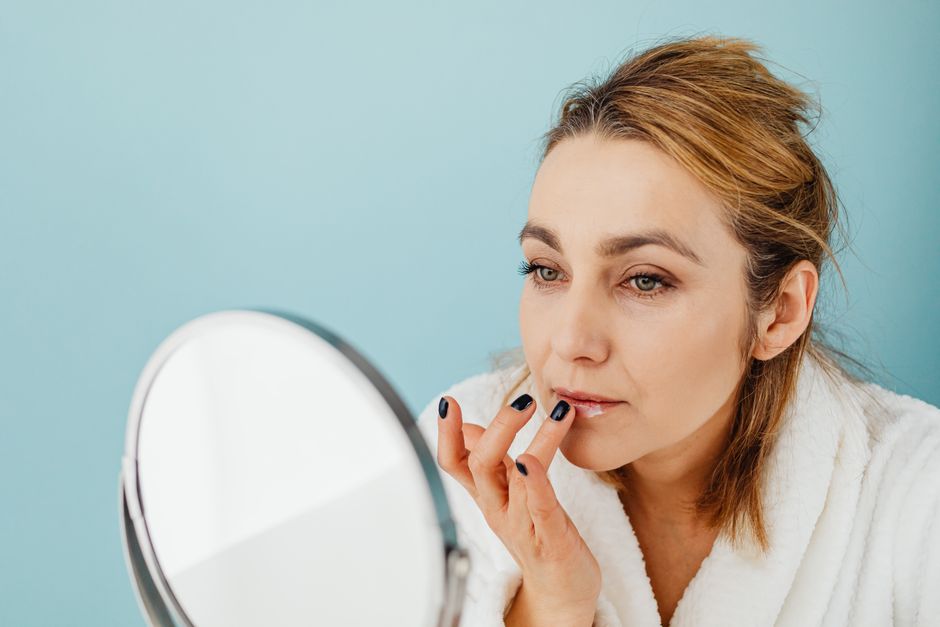
Picking your lips until they bleed is a body-focused repetitive behavior. It usually happens when the brain latches onto a small physical sensation — a dry patch, a flake of skin — and turns the act of removing it into an automatic habit. For many people it is not a sign of a serious problem. It is a loop, and loops can be understood.
The medical term for this kind of behavior is dermatillomania, also called skin picking disorder or excoriation disorder. It sits in the same family as hair pulling (trichotillomania) and nail biting (onychophagia). What all of these have in common is that the behavior is repetitive, hard to stop, and often leaves visible damage.
Lip picking specifically has an extra wrinkle: lips are thin-skinned, richly supplied with blood vessels, and constantly in motion. A small tear there bleeds fast and heals slowly because the area is always being stretched, licked, and exposed to air. That combination makes the cycle harder to break than picking at other parts of the body.
Why Do I Pick My Lips Until They Bleed?
The short answer is that the behavior serves a function — usually self-soothing, sometimes sensory relief, sometimes emotional regulation. The bleeding is a side effect, not the goal.
Researchers who study body-focused repetitive behaviors generally describe them as occurring on a spectrum. At one end, the behavior is mild and occasional. At the other, it meets the criteria for a clinical disorder, which requires that the picking causes significant distress or noticeable damage and is not better explained by another condition.
Three mechanisms appear repeatedly in the literature:
- Sensory relief. Removing an uneven piece of skin produces a small, satisfying completion. The brain registers the smooth surface as a reward.
- Emotional regulation. Picking can temporarily reduce tension, boredom, or anxiety. This is why it often increases during stressful periods.
- Automaticity. Much of the picking happens without conscious awareness — while reading, watching television, or driving. People often notice only when they taste blood.
A key distinction clinicians make is between focused picking and automatic picking. Focused picking is deliberate and often tied to a specific urge or emotional state. Automatic picking happens outside awareness. The two respond to different strategies, which is one reason generic advice like “just stop” tends to fail.
Is Lip Picking a Mental Health Condition?
It can be, but it is not automatically one. The behavior exists on a continuum, and most people who do it occasionally do not meet criteria for a diagnosis.
Excoriation disorder is listed in the DSM-5, the diagnostic manual used by mental health professionals in the United States. The criteria require that the skin picking is recurrent, causes skin lesions, and has been attempted to be stopped or reduced. It also must cause clinically significant distress or impairment in social, occupational, or other areas of functioning, and cannot be better explained by another mental disorder or a substance.
Lip picking frequently co-occurs with anxiety disorders, obsessive-compulsive disorder, and depression. It is not caused by one of these, and it does not cause them, but they tend to travel together. Some research suggests that body-focused repetitive behaviors share features with obsessive-compulsive disorder, particularly in how urges build and release, though they are classified separately.
If picking is causing sores that will not heal, bleeding that is hard to stop, or distress about your appearance, that is a reasonable point to talk to a clinician. Not because something is necessarily wrong, but because there are treatments that work better than willpower.
What Makes Some People Pick More Than Others?
There is no single cause. What the evidence points to is a combination of factors rather than one switch.
Genetics appear to play a role. Body-focused repetitive behaviors tend to run in families, and twin studies suggest a heritable component. That does not mean a specific “lip picking gene” exists. It means the underlying tendency toward repetitive self-soothing behaviors can be inherited.
Environmental triggers matter too. Dry indoor air, cold weather, and frequent lip licking all create the chapped texture that invites picking. So does anxiety, fatigue, and boredom. Many people report that the behavior gets worse during periods of high stress and improves when life settles down.
One non-obvious point: chronic lip licking can itself cause the problem it seems to soothe. Saliva contains enzymes that break down skin proteins. When saliva evaporates, it draws moisture away from the lip surface. The result is more dryness, more flaking, and more to pick. This is sometimes called lip-licking dermatitis, and it is a common reason the cycle keeps restarting.





How Do I Stop Picking My Lips?
The most effective approaches combine awareness training with a competing response. This is the core of a therapy called habit reversal training, which is a component of cognitive behavioral therapy and has the strongest evidence base for body-focused repetitive behaviors.
Habit reversal training works in stages:
- Awareness. Track when and where you pick. Most people find patterns within a week.
- Competing response. When the urge appears, do something physically incompatible with picking — clench your fists, press your fingertips together, or hold a small object.
- Environmental changes. Keep lips moisturized so there is less texture to pick at. Trim nails short. Remove mirrors from close-range positions if you tend to pick in front of them.
- Stimulus control. Identify the situations where automatic picking happens and add a barrier — gloves while watching television, a fidget tool during meetings.
For focused picking driven by strong urges, some clinicians use a technique called decoupling, which involves deliberately performing a similar movement in a way that does not cause damage. The evidence for decoupling is smaller than for habit reversal training, but it is used in practice.
There is no single method that works for everyone. What the research consistently shows is that willpower alone is the weakest strategy. Changing the environment and the automatic response is more reliable than trying to out-discipline the urge.
When Should I Talk to a Doctor or Therapist?
Seek medical attention if a sore on your lip is not healing, if bleeding is heavy or does not stop with gentle pressure, or if you notice signs of infection such as spreading redness, swelling, warmth, or pus.
Talk to a mental health professional if the behavior is causing distress, if you are spending significant time thinking about or hiding the picking, or if you have tried to stop on your own and cannot. These are the same criteria used to identify excoriation disorder, and they are a reasonable threshold regardless of whether a formal diagnosis applies.
Treatment options include cognitive behavioral therapy, habit reversal training, and in some cases medication. Selective serotonin reuptake inhibitors (SSRIs) are sometimes prescribed, but the evidence for their effectiveness in excoriation disorder is mixed and weaker than for conditions like OCD. N-acetylcysteine, an over-the-counter supplement, has been studied for body-focused repetitive behaviors with some promising but not definitive results. It is not a first-line treatment and should not be started without medical guidance.
No clinical guidelines currently exist that specify a treatment protocol for lip picking as a distinct condition. Most guidance is extrapolated from research on excoriation disorder and trichotillomania more broadly.
What Happens If You Keep Picking?
The main risks are infection and scarring. Lips heal well in most people, but repeated trauma to the same area can leave a permanent mark or a thickened patch of skin.
There is also a less obvious risk: the behavior tends to reinforce itself. Each time picking relieves tension, the brain learns that picking works. Over time the urge can become stronger and the relief shorter, which is the same pattern seen in other reinforcing behaviors.
Bacterial infection is the most common acute complication. The lips sit near the mouth, which carries a large and diverse bacterial population. An open sore there has a higher chance of becoming infected than a similar wound on, say, the forearm. Signs to watch for include increasing pain, swelling, and a yellow or green discharge.
In rare cases, people who pick extensively may develop a secondary infection that requires antibiotics. This is uncommon, but it is the main reason not to ignore a sore that is getting worse rather than better.
Does Lip Balm Help or Make It Worse?
Lip balm helps if it keeps the surface smooth and reduces the texture that triggers picking. It can make things worse if it contains ingredients that irritate the skin or if you become dependent on constant reapplication.
Some lip balms contain menthol, camphor, or phenol, which produce a cooling or tingling sensation. These can feel soothing but may irritate already damaged skin and drive more licking and picking. A plain occlusive balm — petrolatum or a simple wax-based product — is generally the safer choice for someone trying to break the cycle.
There is no strong evidence that any specific lip balm ingredient reduces picking behavior itself. The benefit is indirect: smoother lips mean fewer rough edges to notice and remove.
Is This Related to Other Body-Focused Behaviors?
Yes. Lip picking shares features with nail biting, cheek biting, hair pulling, and skin picking elsewhere on the body. These behaviors are grouped together because they share a similar function and respond to similar treatments.
Many people who pick their lips also bite their nails or pick at cuticles. This pattern suggests a general tendency rather than a lip-specific problem. It also means that strategies used for one behavior often transfer to another.
Understanding the shared mechanism can be useful. It reframes the behavior from a personal failing into a recognizable pattern that has known approaches. That shift alone helps some people approach it more effectively.
Frequently Asked Questions
Why do I pick my lips until they bleed without realizing it?
Much lip picking is automatic, meaning it happens outside conscious awareness while your attention is elsewhere. The brain registers the small relief of removing a rough edge without you noticing the action itself.
Is lip picking a form of OCD?
It is not classified as OCD, but it shares some features with obsessive-compulsive disorder, particularly the build-up and release of urges. It is diagnosed separately as excoriation disorder when it meets specific criteria.
Can lip picking cause permanent damage?
Repeated trauma to the same spot can leave scarring or a thickened patch of skin, and open sores can become infected. Most people heal without lasting marks if the picking stops.
What is the best way to stop picking my lips?
Habit reversal training, which combines awareness of when you pick with a competing physical response, has the strongest evidence base. Keeping lips moisturized and reducing triggers also helps.
