
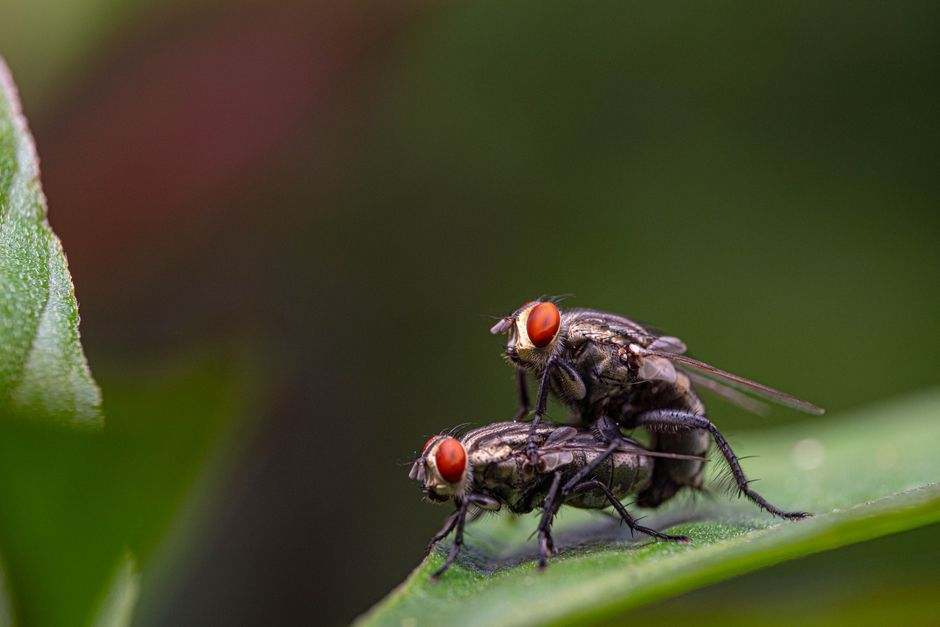
Not all flies bite. Most of the flies you swat at a picnic are harmless. The ones that do bite are almost all females, and they are not biting you out of hunger in the way a mosquito does. They need your blood to make eggs. That single biological fact explains most of what feels random and annoying about fly bites.
Only female flies in a small group of species take blood. Males of the same species feed on nectar and plant juices and never bite. The blood meal provides protein and iron the female needs to develop a batch of viable eggs. Without it, she can still live. She just cannot reproduce.
Why Do Flies Bite The Science Behind Their Need For Blood?
Blood is a concentrated source of protein, iron, and amino acids that a female fly cannot get in useful amounts from plants. Her eggs need those nutrients to develop properly. A single blood meal can support the development of a full batch of eggs, which is why a female that has just fed will often disappear from your yard for several days while she lays.
The flies that bite people fall into a few main groups. Biting midges, black flies, stable flies, horse flies, deer flies, and sand flies all take blood. They are not the same insect as the common house fly, which does not bite. House flies have sponging mouthparts built for liquids. Blood-feeding flies have piercing or cutting mouthparts built to get through skin.
There is a detail that surprises most people. Female flies usually need more than one blood meal. They lay eggs, then seek another host, then lay again. This cycle repeats through their adult life. That is why a biting fly problem does not fade after one round of bites. It continues as long as females are reproducing.
How Do Biting Flies Find You?
Biting flies use a combination of senses to locate a host, and they are better at it than most people assume. They detect carbon dioxide from your breath, body heat, and a range of chemical cues from your skin.
Different species rely on different signals. Horse flies and deer flies are strongly drawn to movement and dark shapes. Black flies and biting midges respond more to carbon dioxide and body odor. Sand flies are weak fliers that tend to stay close to the ground and to their breeding sites.
This matters for prevention. A repellent that works against one species may do little against another. An area with a horse fly problem is not solved by the same approach that works for biting midges. Some species also bite during the day, while others are most active at dawn and dusk. Knowing which fly is biting you is the first useful step.
Why Do Some People Get Bitten More Than Others?
Some people really do get bitten more. This is not imagination, and it is not about “sweet blood,” which is a myth with no biological basis.
Several factors appear to influence how attractive a person is to biting flies. Larger body size means more carbon dioxide and more heat, which draws more insects. Skin bacteria produce chemicals that some species find attractive. Sweat, and the lactic acid and ammonia in it, adds to the signal. Wearing dark colors may increase bites from certain species that orient toward dark shapes.
Alcohol consumption has been studied mainly in mosquitoes, not biting flies, and the evidence there is limited. It is often repeated as fact for all biting insects, which overstates what is known. The honest position is that body size, skin chemistry, sweat, and movement are the better-supported factors.
One thing that does not hold up: eating garlic, taking vitamin B, or drinking vinegar to make yourself less attractive. These are widely repeated and poorly supported. No reliable evidence shows they change how many flies bite you.




What Happens When A Fly Bites You?
The bite itself is often painless in the moment, especially with smaller species. The reaction comes afterward. When a fly cuts or pierces the skin, it injects saliva that contains compounds preventing blood from clotting and reducing the host’s ability to feel the bite.
Your immune system responds to those foreign proteins. That response, not the wound, produces the itch, redness, and swelling. This is why a bite can look fine for a few minutes and then swell and itch an hour later.
Reactions vary widely between people. Some develop a small red bump that fades in a day. Others get a larger, firmer swelling that lasts longer. In rare cases, people develop a more significant allergic response. The pattern of reaction depends on the species, the number of bites, and the person’s immune history.
Biting flies can also transmit disease. This is well established for certain species in certain regions. Black flies transmit onchocerciasis in parts of Africa and Latin America. Sand flies transmit leishmaniasis in many tropical and subtropical regions. In the United States, the disease risk from most common biting flies is low, though the bites themselves are still a nuisance and can become infected if scratched open.
How Do You Treat And Prevent Fly Bites?
Prevention works better than treatment, and it starts with understanding that different flies need different tactics.
- Use an EPA-registered repellent. Products containing DEET or picaridin are the best studied for biting insects generally. Follow the label directions.
- Wear light-colored, long-sleeved clothing when flies are active. This reduces exposed skin and may reduce attraction for species drawn to dark shapes.
- Avoid peak activity times for the species in your area, often dawn and dusk for many biting flies.
- Remove standing water and organic debris near your home where some species breed.
- Use screens and fans. Biting flies are relatively weak fliers and moving air makes landing harder.
For an existing bite, the goal is to reduce the immune response and prevent scratching. Washing the area with soap and water is reasonable. A cold compress can reduce swelling. Over-the-counter hydrocortisone or an oral antihistamine may help with itching. These are common approaches rather than proven treatments for every species.
Do not scratch. Scratching breaks the skin and opens the door to bacterial infection. If a bite becomes increasingly painful, hot, or starts spreading redness, that is a reason to see a clinician. Those signs suggest infection rather than a normal bite reaction.
For people with known severe reactions to insect bites, or for anyone traveling to regions where fly-borne diseases are common, talking to a healthcare provider before travel is the sensible step. Preventive medication and specific precautions exist for some of these diseases, and the right approach depends on where you are going.
Why Do Flies Bite Some Animals And Not Others?
Biting flies are not picky in a moral sense, but they are selective in practice. Each species has preferred hosts based on size, skin, and the chemical signals the animal gives off.
Some species feed mainly on large mammals like cattle and horses. Others feed on birds. Some feed on people. Many will feed on whatever is available. This is why livestock near a home can increase fly pressure on the people living there. The flies are not targeting you specifically. You are simply the closest suitable host.
This also explains why some yards have persistent fly problems and others do not. Nearby animals, wetlands, slow-moving streams, and decaying organic matter all support fly populations. Removing or managing those conditions reduces the number of flies looking for a meal.
Frequently Asked Questions
Do all flies bite?
No. Most fly species do not bite at all, and among those that do, only the females take blood. Common house flies do not bite and have mouthparts built for sponging up liquids.
Why do only female flies bite?
Females need the protein and iron in blood to develop viable eggs. Males of the same species feed on nectar and plant juices and never bite.
Do flies bite for food?
Not in the way mosquitoes do. Both male and female biting flies can survive on plant sugars. Females take blood specifically to reproduce, not to stay alive.
What attracts biting flies to people?
Carbon dioxide from breath, body heat, skin bacteria, sweat, and movement all play a role. Body size and skin chemistry also affect how attractive a person is to biting flies.
