
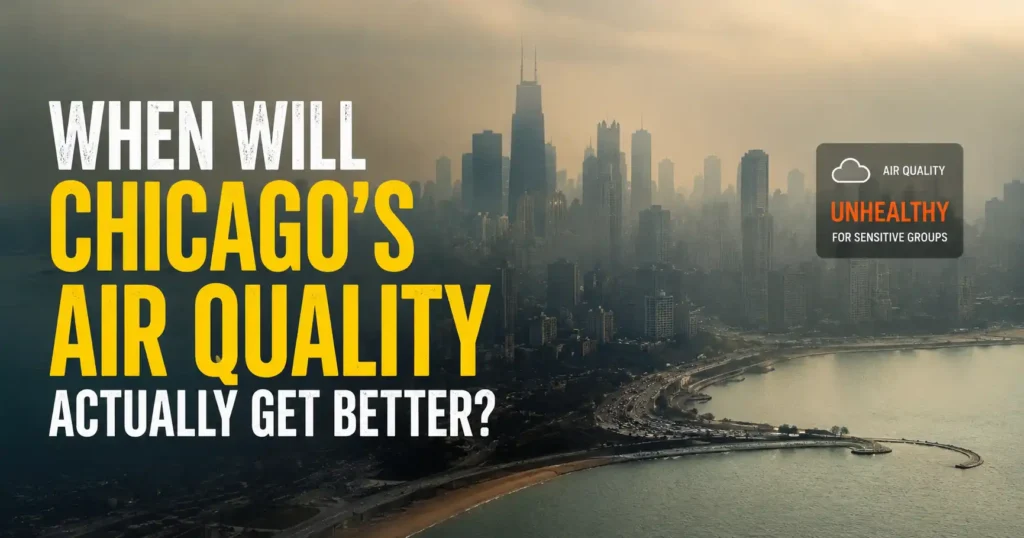
Chicago woke up this week to smoke-hazed skylines, a burning smell in the air, and an Air Quality Index that briefly ranked among the worst of any major city in the world. As Canadian wildfire smoke settled over the region, millions of residents were left asking the same question: when does this actually end?
Here’s what’s driving the smoke, how bad conditions have gotten, and the timeline for when relief is expected.
How Bad Is Chicago’s Air Quality Right Now?
The Illinois Environmental Protection Agency declared a Red Forecast Air Pollution Action Day this week, its most serious air quality warning tier, meaning pollution levels were expected to be unhealthy for everyone, not just sensitive groups. The National Weather Service issued an Air Quality Alert covering most of the Chicago metro area, with the North Side of the city and the northern suburbs registering “Unhealthy” readings, and areas closer to the Wisconsin border pushing into “Very Unhealthy” territory.
At its peak, Chicago’s air quality index briefly ranked among the worst of any major city on the planet, driven by a combination of drifting wildfire smoke and stagnant ground-level ozone pollution.
When Will Chicago’s Air Quality Improve?
This is the question dominating search interest right now, and the honest answer is: conditions are expected to gradually improve as a high-pressure ridge shifts, and rain moves into the region. Forecasters have pointed to increasing rain chances Friday afternoon and evening, with additional rain expected Saturday evening, both of which should help clear lingering smoke and wash pollutants out of the air.
That said, air quality forecasting is not an exact science when wildfire smoke is involved. Because the source of the pollution is hundreds of miles away in Canada, local rain and wind patterns matter as much as anything happening in Chicago itself. Officials have cautioned that specifics could change, and that some smoke-driven haze could linger into the weekend even as the worst of the hazardous readings ease.
Bottom line: most forecasts point to noticeable improvement by Friday into Saturday, with rain acting as the main driver of relief — but sensitive groups should keep monitoring real-time AQI readings rather than assuming the alert has fully lifted.
Why Is the Air Quality So Bad in Chicago Right Now?
Two things are stacking on top of each other:
- Wildfire smoke — Smoke from wildfires burning in Canada, primarily in Ontario, has been drifting south into the Midwest and Northeast, affecting well over 100 million people across the U.S.
- Ground-level ozone — Summer heat and stagnant air have created favorable conditions for ozone, or smog, to build up independently of the wildfire smoke. Chicago has historically struggled to meet federal ozone compliance standards during peak summer months.
When wildfire smoke and ozone pollution overlap, the combined effect pushes particulate and ozone readings into unhealthy or hazardous territory far faster than either factor would on its own.





Where Are the Canadian Wildfires Causing This?
The smoke affecting Chicago is coming primarily from wildfires burning in Ontario, Canada. Canadian fire authorities have reported more than 800 active wildfires nationwide this season, with over 100 classified as out of control.
While the 2026 wildfire season has so far been less severe than the record-breaking 2023 and 2025 seasons,1The significant wildland fire potential forecasts included in this outlook represent the cumulative forecasts of the ten Geographic Area Predictive Services units and the National Predictive Services unit, NIFC. officials say fire danger is expected to increase as summer continues, meaning more smoke events are possible in the weeks ahead.
Is Chicago’s Air Quality Really the Worst in the World?
For a period this week, yes — Chicago’s air quality index ranked among the worst of any major city globally, alongside other Midwest cities like Detroit and Milwaukee that sit closer to the smoke’s path.
This isn’t unprecedented: Chicago experienced similar “worst in the world” rankings during the historic 2023 Canadian wildfire season and again last summer.
Climate scientists have pointed to this as part of a broader pattern: warmer, drier spring conditions in Canada are contributing to earlier and more intense wildfire activity, which in turn increases the odds of these smoke events recurring year after year.
What Does “Hazardous” Air Quality Mean?
Air Quality Index (AQI) readings are grouped into categories:
- 0–50: Good
- 51–100: Moderate
- 101–150: Unhealthy for Sensitive Groups
- 151–200: Unhealthy
- 201–300: Very Unhealthy
- 301+: Hazardous
At “Hazardous” levels, health officials warn that the entire population, not just people with asthma, heart disease, or other respiratory conditions, may experience serious health effects, including headaches, irritated eyes and sinuses, chest pain, coughing, and difficulty breathing.
Do I Need an N95 Mask for Chicago’s Air Quality?
Health experts recommend an N952N95 Respirators, Surgical Masks, Face Masks, and Barrier Face Coverings, FDA. or similarly rated respirator mask for anyone who needs to spend extended time outdoors during hazardous air quality conditions, since standard cloth or surgical masks don’t filter out the fine particulate matter (PM2.5) found in wildfire smoke. For most people, the more effective step is simply reducing time outdoors and avoiding strenuous activity until conditions improve.
Recommended precautions during the alert:
- Avoid strenuous outdoor activities, especially for children, teens, older adults, and anyone with heart or lung conditions
- Keep any necessary outdoor time short
- Move workouts and physical activity indoors
- Choose lower-exertion activities like walking over running if you must be outside
- Consider an N95 mask for prolonged outdoor exposure
What About Chicago Fire FC’s Game?
With outdoor sports affected by air quality alerts before, it’s a fair question when a Chicago Fire FC match falls during a Red Forecast Air Pollution Action Day.
Teams and venues typically monitor real-time AQI readings and follow league and local health guidance on postponing or moving outdoor events, similar to how the Chicago Park District has moved activities indoors during the worst of this week’s smoke.
Fans planning to attend an outdoor match during an active air quality alert should check official team channels for the latest status before heading out.
Quick Answers
How long will the air quality be bad in Chicago?
Conditions are expected to gradually improve starting Friday as rain moves through the region, with further improvement possible into Saturday, though some haze could linger depending on wind and rain timing.
When will the smoke clear in Chicago?
Forecasters expect the smoke to thin out as a high-pressure ridge shifts and rain chances increase Friday and Saturday.
Why is Chicago’s air quality so bad today?
A combination of Canadian wildfire smoke and stagnant ground-level ozone pollution pushed the region into Unhealthy to Hazardous AQI territory.
Has this happened before?
Yes. Chicago experienced comparable or worse smoke events during the record 2023 Canadian wildfire season and again in recent summers, a pattern experts link to warmer, drier conditions fueling earlier wildfire activity in Canada.
Scientific References
- 1
- 2
