
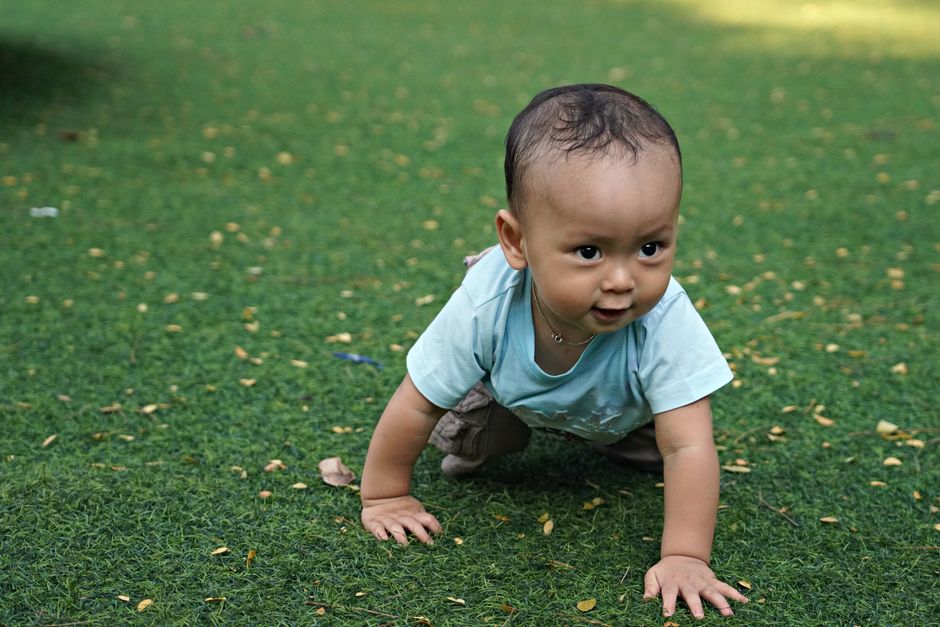
Most babies start crawling between 7 and 10 months of age, though some skip crawling entirely and move straight to pulling up and walking. Crawling is a developmental milestone, but it is not a required one — the American Academy of Pediatrics and other pediatric organizations do not list crawling as a mandatory step. What matters more is that your baby is building strength, coordination, and curiosity in their own time.
When Do Babies Usually Start Crawling?
The typical window for crawling is 7 to 10 months. Some babies begin as early as 6 months, while others start closer to 11 or 12 months. A smaller number never crawl at all and go directly from sitting to standing to walking.
Pediatricians generally look at a range rather than a single deadline. By around 9 months, many babies are mobile in some form — whether that means crawling on hands and knees, scooting on their bottom, rolling across the floor, or army-crawling on their belly. Each of these counts as progress toward independent movement.
If your baby is not moving independently in any way by 12 months, that is worth mentioning to your pediatrician. It does not automatically signal a problem, but it is a point where a professional check is reasonable.
What Are the Different Crawling Styles?
Not all crawling looks like the classic hands-and-knees pattern. Babies find many ways to get around, and most of these styles are perfectly normal.
- Classic crawl: Hands and knees, alternating opposite arm and leg. This is what most people picture.
- Army crawl: Belly on the floor, pulling forward with the arms. Common and often a precursor to hands-and-knees crawling.
- Bottom scoot: Sitting upright and scooting across the floor using the legs and bottom. Some babies do this instead of crawling entirely.
- Rolling: Rolling repeatedly to reach a destination. Less efficient but still a form of independent movement.
- Crab crawl: Moving sideways or backward with one knee bent and one foot flat. Unusual but generally not a concern on its own.
The style matters less than the fact that your baby is exploring movement. A baby who scoots on their bottom and never crawls on hands and knees is not behind. They have simply found a different route.
Why Do Some Babies Skip Crawling?
Skipping crawling is common and usually not a sign of a problem. Some babies have the strength and coordination to pull up to standing before they figure out forward crawling. Others simply prefer to get where they are going by rolling, scooting, or sliding.
Research has not found a consistent link between skipping crawling and later developmental problems. Some studies have looked at whether crawling is necessary for certain visual or spatial skills, but the evidence is mixed and does not support the idea that crawling is required for normal development.
One thing that is clear: the order in which babies acquire motor skills varies widely. Some walk before they crawl. Some crawl for months before taking a first step. The sequence is not fixed.





What Encourages a Baby to Crawl?
Tummy time is the single most useful thing you can do to build the strength babies need for crawling. It strengthens the neck, shoulders, arms, and core — the muscles that support hands-and-knees movement.
Pediatricians recommend starting tummy time in the first days of life, beginning with short sessions of a few minutes and building up as your baby tolerates it. By 3 to 4 months, many babies can handle longer stretches of supervised tummy time several times a day.
Other things that help:
- Place toys just out of reach during floor play to encourage reaching and movement.
- Give your baby plenty of supervised floor time — not just in swings, bouncers, or seats.
- Get down on the floor with your baby. Babies often copy what they see.
- Create a safe, open space where your baby can move without barriers.
There is no evidence that any specific device, program, or exercise speeds up crawling in a typically developing baby. Floor time and tummy time are the basics that matter.
When Should You Talk to a Pediatrician About Crawling?
Most variation in crawling timing is normal. But there are situations where a pediatrician should take a closer look.
Talk to your child’s doctor if:
- Your baby is not moving independently in any way by 12 months.
- Your baby seems to use one side of the body much more than the other.
- Your baby cannot bear weight on their legs or seems unusually stiff or floppy.
- Your baby loses skills they previously had — for example, stops rolling or sitting.
- You notice persistent asymmetry in how your baby moves, reaches, or holds their body.
These signs do not automatically mean something is wrong. But they are worth a conversation. Early evaluation can identify issues that benefit from support, and in many cases, the evaluation confirms that development is on track.
Does Crawling Predict Later Development?
Crawling is one milestone among many. It is not a strong predictor of later intelligence, academic performance, or athletic ability. The research on crawling and later outcomes is limited and does not support the idea that crawling is a critical stepping stone for cognitive development.
What pediatricians look at is the overall pattern: Is your baby gaining strength? Are they curious about the world? Are they progressively finding new ways to move and explore? A baby who scoots instead of crawls but is otherwise meeting milestones is developing typically.
The focus on crawling as a make-or-break milestone is largely cultural. Many healthy, typically developing children never crawl. The milestone that matters more is independent walking, which most children achieve between 12 and 15 months, though a wider range is still considered normal.
How Can You Keep a Crawling Baby Safe?
Once your baby is mobile, childproofing becomes urgent. A crawling baby can reach outlets, cords, small objects, and stairs faster than you might expect.
Key steps:
- Install safety gates at the top and bottom of stairs.
- Cover electrical outlets and secure loose cords.
- Move cleaning supplies, medications, and sharp objects out of reach.
- Anchor furniture and TVs to the wall to prevent tipping.
- Check floors for small objects that could be choking hazards.
- Keep hot liquids and stove handles out of reach.
Babyproofing is not a one-time task. As your baby gets faster and more curious, you will likely find new hazards to address. A good rule is to get on the floor at your baby’s eye level and look for anything that could cause harm.
Frequently Asked Questions
What age do babies usually start crawling?
Most babies begin crawling between 7 and 10 months of age, though some start as early as 6 months or as late as 12 months. A small number never crawl and go straight to walking.
Is it normal for a baby to skip crawling?
Yes, skipping crawling is common and is not considered a sign of a problem on its own. Many babies who never crawl develop typically and walk within the normal range.
Does crawling matter for brain development?
Current evidence does not support the idea that crawling is required for normal cognitive development. Some studies have looked at this, but results are mixed and do not show that crawling is necessary.
When should I worry if my baby is not crawling?
Talk to your pediatrician if your baby is not moving independently in any way by 12 months. Also mention any asymmetry, loss of skills, or unusual stiffness or floppiness.
