
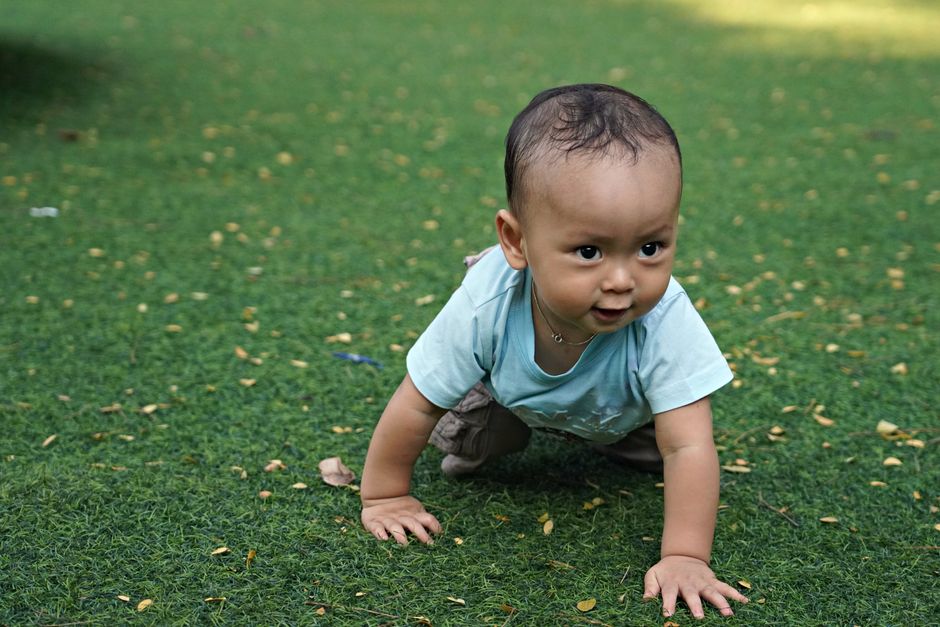
Most babies start crawling between 7 and 10 months of age. Some babies skip crawling entirely and move straight to pulling up and walking. Both are normal variations of development.
Crawling is a major milestone, but it is not a required one. Pediatricians look for a bigger picture: is the baby moving both sides of the body, showing interest in the environment, and gaining new motor skills over time. The exact style of movement matters less than the progress itself.
When Does A Baby Crawl?
The average baby begins crawling between 7 and 10 months. This is a wide range because babies develop at very different paces. Some start as early as 6 months. Others do not crawl until 11 or 12 months. A baby born prematurely may reach this milestone later than a full-term baby, adjusted for their due date.
Crawling is not a single skill. It is a sequence of movements that build on each other. Before crawling, a baby typically learns to roll over, sit without support, and push up on their hands and knees. These earlier skills lay the groundwork for the coordinated movement crawling requires.
There is no official “deadline” for crawling. The American Academy of Pediatrics does not list crawling as a required milestone for healthy development. It tracks rolling, sitting, standing, and walking. Crawling is common, but it is not universal.
What Are the Different Types of Crawling?
Not all crawling looks the same. Babies develop their own methods of getting from one place to another. Some of the most common styles include:
- Classic hands-and-knees crawl — moving opposite arm and leg together in a cross pattern.
- Bear crawl — moving on hands and feet with the bottom lifted high, knees straight.
- Belly crawl (commando crawl) — dragging the belly on the floor while pulling with the arms.
- Bottom scoot — sitting and pushing forward with one leg, often using one arm for support.
- Rolling crawl — getting around by rolling from place to place.
Each style is a valid way to move. What matters is that the baby is moving both sides of the body and exploring their environment. A baby who scoots or rolls instead of crawling is not delayed. They are simply using a different strategy.
Some babies never crawl at all. They may go straight from sitting to pulling up on furniture, then to cruising (walking while holding onto furniture), and finally to walking independently. Research has not shown that skipping crawling causes any developmental problems. The idea that crawling is essential for brain development is a popular belief, but it is not supported by strong clinical evidence.
What Skills Lead Up to Crawling?
Crawling requires strength, coordination, and balance. Babies build these skills over several months before they ever take their first crawl.
Tummy time is the foundation. When a baby spends time on their stomach, they strengthen the muscles in their neck, shoulders, arms, and back. These are the same muscles used for pushing up, reaching, and eventually crawling. Tummy time can begin in the first weeks of life, starting with short sessions of a few minutes several times a day.
By around 4 months, most babies can hold their head steady and push up on their forearms. By 6 months, many can push up onto their hands with straight arms and rock back and forth on their hands and knees. This rocking motion is a key sign that crawling is approaching. The baby is testing their balance and building the coordination needed to move forward.
Sitting independently is another important precursor. Sitting requires core strength and balance. A baby who can sit well usually has enough trunk control to begin experimenting with crawling positions.





How Can Parents Encourage Crawling?
Parents cannot force a baby to crawl, but they can create conditions that make it easier. The most effective approach is giving the baby plenty of supervised floor time. Time in swings, bouncers, and car seats limits movement. Floor time allows a baby to practice rolling, reaching, pushing, and shifting weight.
Placing toys just out of reach is a simple strategy. It gives the baby a reason to move. The toy should be close enough that the baby can see it and is motivated to reach it, but far enough that they have to shift their body to get it.
Some other practical ways to support crawling development:
- Use mirrors or interesting objects placed at eye level to encourage looking up and reaching.
- Let the baby play on different safe surfaces — a firm mat, a carpet, a hardwood floor with a grippy rug.
- Avoid walkers. Baby walkers are not recommended by pediatricians because they do not help babies learn to walk and they pose a serious injury risk.
- Give the baby barefoot time. Bare feet allow better grip and sensory feedback on the floor.
There is no evidence that any specific exercise or program makes a baby crawl earlier. Babies develop at their own pace. The goal is not to speed up the timeline. The goal is to provide opportunities for movement and let the baby progress naturally.
When Should Parents Be Concerned About Crawling?
Most babies who do not crawl by a certain age are perfectly fine. However, there are some signs that warrant a conversation with a pediatrician.
Parents should seek advice if their baby is not showing any interest in moving by 9 months. This includes not rolling, not pushing up on their arms, or not making any attempt to move across the floor. A baby who shows no interest in movement may need an evaluation.
Other concerning signs include:
- Using only one side of the body to move while dragging the other side.
- Not sitting without support by 9 months.
- Loss of skills they previously had. If a baby stops rolling or stops bearing weight on their legs, that is a reason to call the doctor.
- Stiff or floppy muscle tone that makes movement difficult.
It is also worth noting that some babies who skip crawling and go straight to walking are developing normally. The concern is not the absence of crawling itself. The concern is the absence of any forward movement progress. If a baby is scooting, rolling, or pulling up, they are developing motor skills even if they never crawl on hands and knees.
Pediatricians do not have a standard “crawl by” date. They evaluate motor development as a whole. If a baby is reaching other milestones — sitting, standing, cruising — the absence of crawling is rarely a problem.
What Happens After Crawling?
Crawling is usually a bridge between sitting and walking. Once a baby crawls confidently, they typically begin pulling up to stand. This usually happens between 9 and 12 months. Pulling up leads to cruising, which is walking while holding onto furniture. Independent walking usually follows between 9 and 15 months, with the average around 12 months.
Some babies crawl for weeks and then quickly move to walking. Others crawl for months. There is no standard duration. The transition depends on the individual baby’s strength, balance, and confidence.
Once a baby starts walking, crawling often disappears quickly. Some babies mix crawling and walking for a period, using crawling for speed and walking for short distances. Others abandon crawling the moment they can walk. Both patterns are normal.
Parents should also be aware that crawling changes the home safety picture. A mobile baby can reach cords, drawers, stairs, and small objects. Babyproofing should happen before crawling starts, not after. This includes securing furniture to walls, covering electrical outlets, installing safety gates at stairs, and keeping small objects out of reach.
Frequently Asked Questions
Is it normal for a baby to skip crawling?
Yes, some babies skip crawling entirely and go straight to pulling up and walking. Skipping crawling has not been shown to cause developmental problems.
What is the latest age a baby should crawl?
There is no official deadline, but most babies crawl between 7 and 10 months. If a baby shows no interest in any movement by 9 months, it is worth discussing with a pediatrician.
Does tummy time help babies crawl sooner?
Tummy time strengthens the muscles needed for crawling, but it does not guarantee a baby will crawl earlier. It supports healthy motor development overall.
Should parents worry if a baby crawls backward instead of forward?
No, crawling backward is common and normal. Many babies crawl backward first before they figure out how to move forward.
