
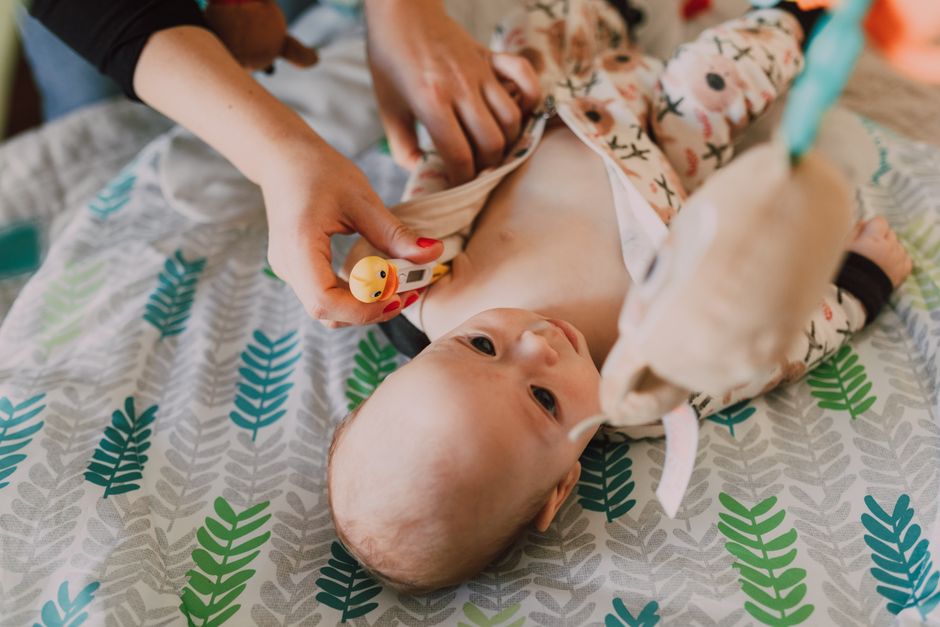
Most babies stop spitting up between 6 and 12 months of age. The exact timing depends on how quickly the muscle at the top of the stomach matures. For many babies, spitting up slows noticeably around 6 months and largely stops by the first birthday.
When Do Babies Stop Spitting Up?
Spitting up usually peaks between 2 and 4 months of age and then gradually declines. By 6 months, many babies are spitting up less often. By 12 months, most have stopped or nearly stopped.
The reason for the timeline comes down to anatomy. The muscle that seals the top of the stomach, called the lower esophageal sphincter, is not fully developed in newborns. When that muscle is loose, milk can flow back up into the esophagus and out of the mouth. As the sphincter matures, spit-up becomes less frequent.
Two other changes speed things along. Around 6 months, most babies start sitting upright more, which lets gravity help keep stomach contents down. When babies begin eating solid foods, the thicker texture also tends to stay in the stomach more easily than liquid alone.
Some babies stop spitting up as early as 4 months. Others still spit up occasionally at 12 months. Both can fall within the range of normal. The pattern matters more than one specific date.
What Is the Difference Between Spitting Up and Vomiting?
Spitting up is a gentle flow of milk that often comes with a burp. Vomiting is a forceful ejection involving stomach contractions. The two are not the same, and the difference matters for knowing when to call a doctor.
Spit-up typically dribbles out of the mouth, sometimes with a burp, and the baby usually seems unbothered. Vomiting is more forceful and may travel some distance. A vomiting baby often seems uncomfortable or distressed before and after.
One detail that surprises many parents: how much spit-up looks like a lot. A tablespoon of milk spread across a burp cloth can look like an entire feeding. The volume is usually smaller than it appears.
Babies who spit up and continue to gain weight well are generally getting enough. Weight gain, not the amount of spit-up on the bib, is the more reliable sign that feeding is going well.
What Causes Babies to Spit Up So Often?
Spitting up happens because of normal infant anatomy, not because of anything a parent is doing wrong. The stomach sits close to the esophagus, the sphincter muscle is loose, and babies spend most of their time lying flat or being held in positions that let milk flow back up.
Several things can make it more likely on any given day:
- Feeding too quickly or taking in a lot of milk at once
- Swallowing air during feeding
- Lying flat right after a feeding
- Being handled or bounced soon after eating
- Pressure on the belly from a full stomach
None of these mean something is wrong. They are simply conditions that make an already loose sphincter more likely to let milk through.
Some babies spit up more than others without any underlying problem. The range of normal is wide, and a baby who spits up after every feeding can still be perfectly healthy.



Does Spitting Up Mean My Baby Is Overfed or Not Getting Enough?
Spitting up does not usually mean a baby is overfed or underfed. Most babies who spit up are getting exactly the right amount of milk. The milk simply comes back up before it is fully digested.
When babies are overfed, they often spit up more forcefully or seem uncomfortable. When they are not getting enough, the more telling signs are slow weight gain, fewer wet diapers, and a baby who seems unsatisfied after feedings.
A few signs suggest a baby is feeding well:
- Steady weight gain over time
- Regular wet diapers
- Contentment after most feedings
- Alert, active behavior during awake periods
If a baby is gaining weight and having regular wet diapers, the spit-up itself is rarely a cause for concern. Tracking weight gain over weeks is more useful than counting spit-up episodes.
What Helps Reduce Spitting Up?
Several feeding and positioning habits can reduce how often a baby spits up. These are practical steps, not treatments, and they work by giving the stomach a better chance to hold milk down.
Feeding in a more upright position helps gravity work in the baby’s favor. Burping partway through a feeding and again at the end can release trapped air. Keeping the baby upright for a while after feeding, rather than lying them flat right away, also helps.
Avoiding vigorous play or bouncing right after a feeding reduces pressure on a full stomach. Feeding smaller amounts more often can help some babies, though this depends on the baby and the feeding method.
These steps reduce spit-up for many babies, but they do not stop it entirely. The sphincter still needs time to mature, and no feeding technique can speed that up.
When Should Spitting Up Concern a Parent?
Most spit-up is normal, but some signs point to something that needs medical attention. The key is to look at the whole picture: how the baby is growing, behaving, and feeling, not just how much milk comes back up.
Contact a pediatrician if a baby:
- Is not gaining weight or is losing weight
- Vomits forcefully, with milk shooting across a room
- Has vomit that is green or bloody
- Refuses to feed or seems in pain during feedings
- Has fewer wet diapers than expected
- Seems unusually fussy, lethargic, or unwell
- Has spit-up that starts suddenly after months without it
Forceful vomiting in a young infant can be a sign of a condition called pyloric stenosis, which needs prompt medical care. Green or bloody vomit is always a reason to seek care right away.
Some babies have gastroesophageal reflux disease rather than simple spit-up. GERD involves more significant reflux that causes distress or interferes with feeding and growth. It is less common than ordinary spitting up and is diagnosed by a doctor.
Does Spitting Up Always Stop on Its Own?
For most babies, spitting up resolves on its own as the digestive system matures. No treatment is needed in the typical case. The sphincter tightens, the baby sits up more, and solid foods help keep milk down.
A small number of babies continue to have reflux past the first year. When that happens, it is worth having a doctor take a look, especially if the baby seems uncomfortable or is not growing well.
What parents can do is watch the pattern over time. A baby who spits up less each month is on a normal track. A baby whose spit-up is getting worse, not better, deserves a closer look.
Frequently Asked Questions
At what age do babies usually stop spitting up?
Most babies stop spitting up between 6 and 12 months of age. The exact timing varies, and some babies stop earlier while others continue occasionally past their first birthday.
Is it normal for a 6-month-old to still spit up?
Yes, it can be normal for a 6-month-old to still spit up, especially if the baby is gaining weight and seems content. Spit-up often declines around this age but does not always stop completely.
Can teething or solid foods make spitting up worse?
Starting solid foods usually reduces spit-up because thicker food stays down more easily, but some babies spit up more during teething from extra saliva. The pattern varies from baby to baby.
When should I worry about my baby spitting up?
Worry is reasonable if your baby is not gaining weight, vomits forcefully, or has green or bloody vomit. Call a pediatrician for any of these signs.
