
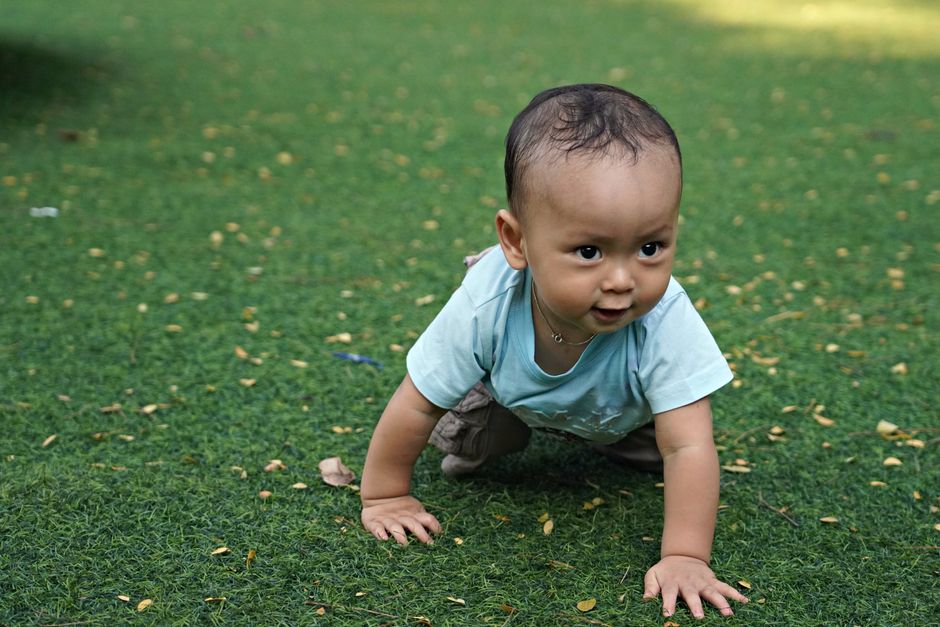
Most babies sit with support by around 4 to 6 months, sit without help by around 8 to 9 months, and crawl between 7 and 10 months. These are typical ranges, not deadlines. Some healthy babies skip crawling entirely and go straight to pulling up and walking.
Watching a baby learn to move is one of the more exciting parts of the first year. It is also a time when parents get a lot of conflicting advice about what should happen and when. This article covers the physical skills behind sitting and crawling, the wide range of normal timing, and the signs that are worth raising with a pediatrician.
When Do Babies Sit Up And Crawl? Facts
Sitting and crawling are two separate skills that build on each other. Sitting requires steady control of the head, neck, and trunk. Crawling requires enough arm and leg strength to move the body across a surface, plus the coordination to alternate sides.
The Centers for Disease Control and Prevention publishes developmental milestone checklists used by pediatricians across the United States. Based on that framework, the general timeline looks like this:
- Around 4 months: holds head steady without support
- Around 6 months: sits with support, may briefly sit alone with hands propping
- Around 9 months: sits without support
- Around 9 months: begins to move around, which may include crawling, scooting, or rolling
Notice that the CDC milestone for movement at 9 months is not specifically “crawls.” It is “begins to move around.” That wording is deliberate. Crawling is common, but it is not treated as a required milestone the way sitting is.
Many babies crawl between 7 and 10 months. Others bottom-scoot, roll to get where they want to go, or skip floor crawling altogether and pull to standing instead. None of these patterns on their own indicates a problem.
What Physical Skills Have to Develop First?
Sitting and crawling depend on a sequence of strength and control that starts at the neck and works downward. This is sometimes described as head-to-foot development, and it holds up well in practice.
First comes head control. A newborn cannot hold their head steady. By around 4 months, most babies can. Without that, trunk control is not possible.
Next comes trunk strength. Between 4 and 6 months, babies build the core strength to hold themselves upright. Early sitting usually involves propping on the hands, which is why a young baby often topples sideways when they reach for a toy.
Then comes the ability to shift weight and rotate the upper body. This matters for crawling because moving forward on hands and knees requires pushing off one side while reaching with the other.
Finally comes coordination between the two sides of the body. Crawling is a cross-body movement. The right arm and left leg move together, then the left arm and right leg. That pattern takes practice.
One useful clarification: the order of these skills is fairly consistent, but the speed is not. A baby who is quick to sit may be slower to crawl, and the reverse happens too.
Why Do Some Babies Skip Crawling?
Skipping crawling is common and, in most cases, not a concern. Estimates vary, but a meaningful share of babies never crawl on hands and knees.
There are a few reasons this happens. Some babies develop the strength to pull to standing before they develop an interest in crawling. Others find a different way to move, such as scooting on their bottom or rolling across the floor. A baby who gets where they want to go has solved the problem, even if the method is not the classic crawl.
The idea that skipping crawling causes later problems with reading or coordination has circulated for decades. The evidence for that claim is weak. Some early studies suggested a link, but larger and better-designed research has not confirmed that skipping crawling predicts learning or coordination problems later in life.
What matters more than the crawl itself is whether the baby is developing ways to explore and move. A baby who is not moving in any way by around 9 months is a different situation than a baby who is moving well without crawling.





What Are the Different Crawling Styles?
Crawling is not one single movement. Several styles are all considered normal.
- Classic crawl: hands and knees, alternating opposite arm and leg
- Bear crawl: hands and feet, bottom in the air
- Commando crawl: belly on the floor, pulling with the arms
- Bottom scoot: sitting upright, using the legs and arms to slide forward
- Rolling: moving by rolling rather than crawling
Some babies use more than one style. A baby might commando crawl for a few weeks and then shift to hands and knees once their arms get stronger.
The style itself is not usually the concern. What a pediatrician looks at is whether movement is symmetrical, meaning both sides of the body are being used, and whether the baby is making progress over time.
How Can You Support Sitting and Crawling?
There is no set of exercises that has been proven to make a baby crawl earlier. What the evidence does support is giving babies safe chances to move on their own.
Tummy time is the main one. Placing a baby on their stomach while awake and supervised builds the neck, shoulder, and trunk strength that sitting and crawling both depend on. It can start within the first days of life in short stretches and build up over time. The American Academy of Pediatrics recommends supervised tummy time while babies are awake.
Floor time matters too. A baby on a firm, safe surface with room to move has the chance to practice rolling, pushing up, and reaching. Containers like bouncers, swings, and seats have their place, but long stretches in them limit that practice.
Once a baby is moving, childproofing becomes the priority. Crawling opens up a new range of reach. Outlet covers, stair gates, cabinet locks, and keeping small objects off the floor all matter at this stage.
One honest note: products marketed to speed up crawling, such as certain mats or devices, do not have strong evidence behind them. A safe floor and time to move are the basics.
When Should You Talk to a Pediatrician?
Developmental timelines have a wide range of normal, so a single missed milestone is not usually a red flag on its own. What matters is the pattern over time.
The CDC and the American Academy of Pediatrics recommend developmental monitoring at every well-child visit, with screening when concerns come up. It is reasonable to raise a question if:
- A baby cannot hold their head steady by around 4 months
- A baby does not sit without support by around 9 months
- A baby is not moving around in any way by around 9 months
- A baby uses only one side of the body to move
- A baby loses skills they previously had
Losing a skill that was already there is worth prompt attention. That is different from a baby who is simply slower than average.
If you are unsure, ask. Pediatricians expect these questions, and early evaluation, when it is needed, tends to lead to better support. Early intervention services are available in every state for children under 3, and a referral does not require a diagnosis.
Does Prematurity Change the Timeline?
Yes. Babies born early often reach motor milestones later than the standard ranges, and pediatricians usually adjust for this.
The adjustment is based on the due date, not the birth date. A baby born two months early may be expected to sit and crawl roughly two months later than a full-term baby, at least through the first couple of years.
This is why a pediatrician will ask about gestational age when tracking development. A timeline that looks delayed on paper may be right on track once prematurity is factored in.
Frequently Asked Questions
At what age do babies usually sit up on their own?
Most babies sit without support by around 8 to 9 months. Sitting with support typically starts around 4 to 6 months.
Is it normal for a baby to skip crawling?
Yes. Many babies never crawl on hands and knees and go straight to pulling up, scooting, or walking. Skipping crawling on its own is not considered a sign of a problem.
When should I worry if my baby is not crawling?
Talk to a pediatrician if your baby is not moving around in any way by around 9 months. A single missed milestone is not usually a concern, but a lack of movement is worth checking.
Does tummy time help babies learn to crawl?
Tummy time builds the neck, shoulder, and trunk strength that sitting and crawling depend on. It supports development but does not guarantee a baby will crawl earlier.
