
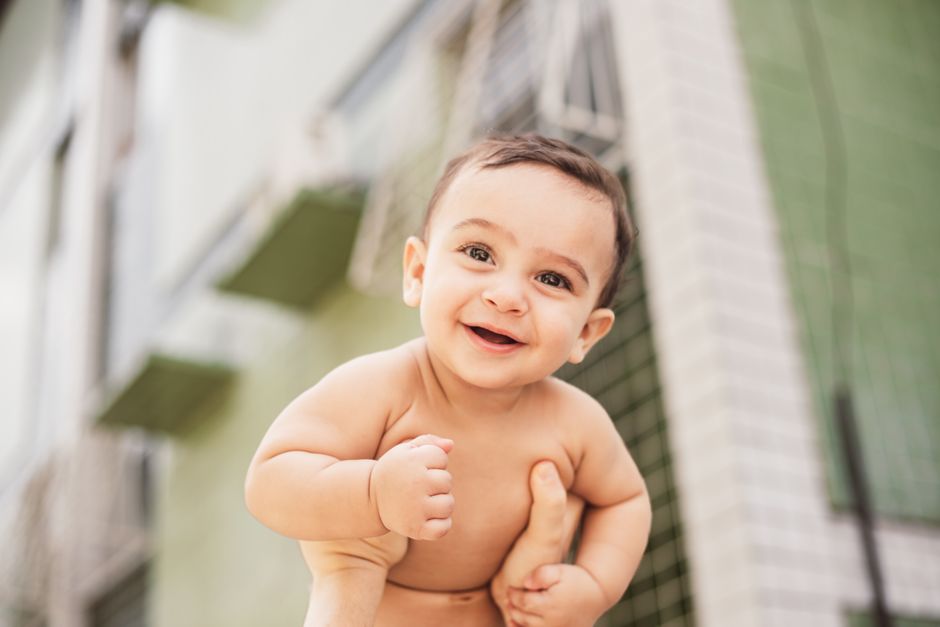
Most babies start laughing for the first time between 3 and 4 months of age. This first laugh is usually a response to something physical, like gentle tickling or a funny face. By 6 months, most babies laugh regularly at playful interactions, and by 9 to 12 months, they begin to laugh at surprises and games like peek-a-boo.
When Do Babies Laugh for the First Time?
The timeline for a baby’s first laugh is fairly consistent, though every baby develops at their own pace. The earliest genuine laughs typically appear around the 3-month mark. This is not a hard rule, but a well-established developmental window.
Some babies may laugh as early as 10 to 12 weeks. Others may not produce a full laugh until closer to 5 months. Both ends of this range are normal. Pediatricians look for a pattern of social development rather than a single milestone date.
Before the first laugh, you will hear cooing and gurgling sounds. These usually start around 6 to 8 weeks. These early vocalizations are the building blocks for laughter. They show that your baby is learning to control their voice and respond to you.
What Makes a Baby Laugh?
Early laughter is primarily a physical and social response. In the first few months, laughter is often triggered by unexpected physical sensations. Gentle bouncing, soft tickling on the belly, or blowing raspberries on their tummy are common triggers.
Visual stimuli also play a role. Babies often laugh at exaggerated facial expressions. A big smile, a surprised look, or a silly noise can be hilarious to a 4-month-old. The key is the element of surprise combined with a safe, familiar environment.
As babies grow, the cause of laughter shifts. By 6 months, they laugh more at social games. By 9 months, they understand object permanence. This is why peek-a-boo becomes so funny. The disappearance and reappearance of your face is a genuine surprise to them.
The Difference Between Smiling and Laughing
Smiling and laughing are different developmental achievements. Social smiling usually appears earlier, around 6 to 8 weeks. This is a specific smile directed at a person, not just a reflex.
Laughing requires more coordination. It involves vocal cords, breathing control, and facial muscles working together. It also requires a higher level of social understanding. A baby must find something genuinely funny, which is a cognitive leap from simply recognizing a face.
Reflex smiles, which happen in newborns during sleep, are not social. They are involuntary muscle movements. A true social smile is a response to you. A laugh is a response to something the baby perceives as funny or exciting.





When Do Babies Laugh at Peek-a-Boo?
Laughter at peek-a-boo typically begins between 6 and 9 months. This milestone aligns with the development of object permanence. Before this age, a baby may smile at the game, but they do not fully understand the surprise of your face disappearing and reappearing.
Around 9 months, laughter at this game becomes more robust. The baby understands you are hiding and anticipates your return. The anticipation is what makes the reveal funny. This is a sign of developing memory and social prediction skills.
By 12 months, many babies will try to play peek-a-boo themselves. They may cover their own face with a blanket and pull it down, waiting for your reaction. This is a sign of social turn-taking, a key skill for later conversation.
What If My Baby Is Not Laughing Yet?
If your baby has passed the 5-month mark and has not laughed, it is worth discussing with your pediatrician. However, a lack of laughter alone is rarely a cause for alarm. It is one data point in a larger picture of development.
Pay attention to other social milestones. Does your baby smile back at you? Do they make eye contact? Do they coo and babble? Do they respond to your voice? If these other behaviors are present, a delayed laugh is often just a personality difference.
Some babies are simply more serious. They may observe the world with intense focus rather than laughing readily. This is not a sign of a problem. It is a temperament trait. However, if your baby is not showing any social responsiveness by 6 months, seek professional guidance.
Red flags include a lack of smiling, no eye contact, no response to sounds, or no babbling. If you see these signs alongside no laughter, contact your pediatrician. Early intervention is most effective when started early.
How to Encourage Your Baby to Laugh
You cannot force a laugh, but you can create conditions that make laughter more likely. The most effective approach is to be playful and responsive. Watch your baby for cues. If they are engaged and smiling, try a silly sound or a gentle game.
Repetition is important. Babies learn through repetition. If a particular noise or face made your baby smile yesterday, try it again today. The familiarity combined with the surprise of the moment often triggers laughter.
Physical play is a strong trigger for many babies. Safe, gentle bouncing on your knee or soft tickling can work well. Stop if your baby turns away or seems overwhelmed. Laughter should be a positive experience, not an overstimulating one.
Avoid trying to force a laugh through aggressive tickling. Watch for signs of distress. A baby who is overstimulated may cry or turn their head away. Respect their limits. The goal is connection, not performance.
Why Laughter Matters for Development
Laughter is more than a cute milestone. It is a sign of social and cognitive growth. When a baby laughs, they are processing a situation, understanding it is safe, and sharing an emotional response with you.
This shared laughter builds attachment. It is a two-way communication loop. You do something, the baby responds, you respond back. This back-and-forth is the foundation of all future social skills, including language.
Laughter also releases endorphins, which promote bonding and reduce stress for both parent and baby. It is a natural, healthy part of emotional regulation. A baby who laughs is learning that the world is a safe and enjoyable place.
Research consistently shows that early social interaction, including play and laughter, supports healthy brain development. The specific neural pathways for social communication are strengthened through these repeated positive exchanges.
Frequently Asked Questions
When do babies start laughing out loud?
Most babies produce their first real laugh between 3 and 4 months of age. This is usually triggered by physical play or exaggerated facial expressions.
Is it normal if my baby doesn’t laugh at 4 months?
Yes, it can be normal. Some babies do not laugh until 5 months, and they may still be developing social smiles and cooing at this stage.
What is the difference between a baby smiling and laughing?
Smiling is a simpler social response that appears around 6 to 8 weeks, while laughing requires more vocal and cognitive coordination. Laughing usually appears several weeks after social smiling is established.
Can babies laugh in their sleep?
Yes, babies can make laughing sounds during sleep. These are often reflex movements or part of active sleep, and they are not the same as social laughter when awake.
